WASHINGTON/TEHRAN: US President Donald Trump has said that he is giving Iran until the weekend to make a deal to end the war.
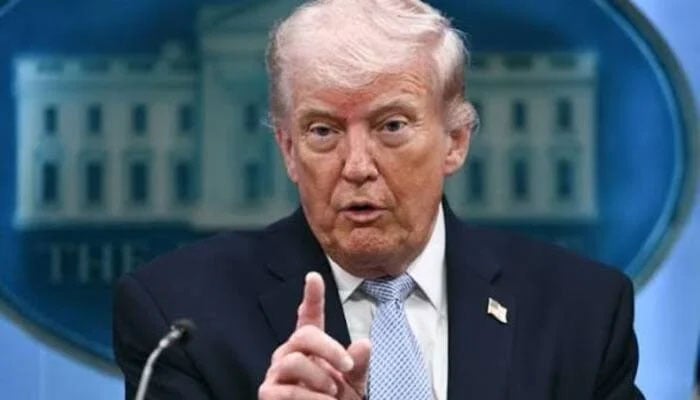
President Trump told reporters Tuesday he was “an hour way” from making the decision to strike Iran on Monday, but that US allies in the Persian Gulf requested he not go ahead with the plan. Trump made the comments to reporters while offering them a tour of the White House ballroom construction site.
“I never tell anybody when. But they knew that we were very close. I would say we were. I was an hour away from making the decision to go today, and we would probably not be talking about a beautiful ballroom today. We’d be talking about that.
“I had made the decision, so they called up. They had heard I made the decision. They said, sir, could you give us a couple of more days because we think they’re being reasonable,” the president said.
The president said he would allow a “limited period of time” — two or three days, at least — for talks to continue, saying several Gulf states had told him there was progress in negotiations brokered by Pakistan toward a peace deal.
“Well, I mean, I’m saying two or three days, maybe Friday, Saturday, Sunday something. Maybe early next week, a limited period of time, because we can’t let them have a new nuclear weapon.”
Earlier on Monday Trump said that he was holding off on a strike on Iran that had been scheduled for Tuesday — plans that had not been mentioned by US officials until the president made his announcement in a Truth Social post.
Talking to reporters, Trump said that the United States may need to hit Iran again.
He also said Iran’s leaders are begging to make a deal.
The US president insisted that the war with Iran is not unpopular, contrary to what recent polling suggests, arguing that people understand it’s about stopping Iran from having a nuclear weapon.
“Everyone tells me it’s unpopular, but I think it’s very popular,” he told reporters at the White House.
The president said Americans’ opinions change when he explains that Iran cannot be allowed to obtain a nuclear weapon that could potentially strike Los Angeles or other major US cities.
Iran denies ever trying to build a nuclear weapon, and Trump had previously argued that a round of US-Israeli airstrikes in June 2025 had “obliterated” the Iranian nuclear program.
“I tell you what, when we explain it to people, I don’t really have enough time to explain to people,” he said Tuesday. “I’m too busy getting it done.”
Meanwhile, Ebrahim Azizi, head of the Iranian parliament’s national security committee, said President Trump’s “hesitation” in launching new military attacks against Iran “is rooted in one reality”.
“He knows any move against Iran means facing a decisive military response and a unified nation,” Azizi wrote. “Power is the only language he understands!”
Meanwhile, Iran’s Deputy Foreign Minister Kazem Gharibabadi has commented on Trump’s Monday post on postponing a planned attack on Iran.
“It speaks of readiness for a massive assault at any moment,” Gharibabadi wrote on ‘X’.
Gharibabadi mocked Trump’s Monday assertion, stating that the US president included a threat to resume attacks on Iran in his statement.
“This means calling ‘threat’ by the name of ‘opportunity for peace,’” the Iranian official wrote. “Iran, united and resolute, is prepared to confront any military aggression,” Gharibabadi wrote on X. “For us, surrender holds no meaning; we either triumph or become martyrs.”
Meanwhile US Vice President J D Vance said that Iran must agree to never have a nuclear weapon or US remains ‘locked and loaded’ to restart military campaign. Giving an update on Iran at a White House news briefing, Vance said the US has a “simple proposition” and there are “two paths to go down”.
“Iran cannot have a nuclear weapon,” he said, warning of the associated dangers and touting the US’s “degradation” of Iran’s military capabilities.
He says Iran having a nuclear weapon would lead to other nations “scrambling” to get their own, setting off a “nuclear arms race” that would “make us all much less safe”.
“Iran would really be the first domino in what would set off a nuclear arms race all over the world,” he says.
He says the US is “willing to cut a deal so long as the Iranians are willing to meet us on that core issue of never having a nuclear weapon”.
He says that the US is negotiating in “good faith” and he thinks a deal is possible.
Option B, Vance went on, is to restart the military campaign “to continue to prosecute the case, to continue to try to achieve America’s objectives.”
“That’s not what the president wants and I don’t think that’s what the Iranians want either,” he says.
He says there’s an opportunity to reset the Washington-Tehran relationship, “but it takes two to tango”.
“We are not going to have a deal that allows the Iranians to have a nuclear weapon, so as the president just told me, we are locked and loaded. We don’t want to go down that pathway but the president is willing and able to if we have to.”
Asked if Russia could take possession of Iran’s enriched uranium, Vance said: “That is not currently the plan of the United States government. The Iranians have not raised it.”
Vance stated that he feels the Iranians want to make deal, but added: “But I will not say with confidence that we’re going to reach a deal until we’re actually signing a negotiated settlement here. And I think it’s ultimately up to the Iranians if they’re willing to meet us [halfway].”
Vance elaborated on the US’s goal in the talks, adding: “We want to see not just the commitment [from Iran] to not have a nuclear weapon, but the commitment to work with us on a process to ensure that … years down the road that the Iranians are not rebuilding that nuclear capability.
When asked about the length of the conflict, which Trump said would last six weeks but has now passed 11 weeks and hasn’t ended yet, Vance contends that the “active period of conflict” lasted around five weeks, and says that a “big chunk” of the 11 weeks has been under a ceasefire.
“This is not a forever war, we’re going to take care of business and come home.”
Meanwhile, US Secretary of State Marco Rubio and UN Secretary-General António Guterres discussed US efforts to stop Iran from placing mines and imposing tolls in the Strait of Hormuz on Tuesday, including a UN Security Council resolution on the issue.
“The secretary emphasised the overwhelming support of a broad base of UN members for these efforts,” US State Department spokesman Tommy Pigott said in a statement.
Meanwhile, the US has imposed new sanctions on Iran, a posting on the US Treasury department’s website showed on Tuesday.
The list published includes 12 new individuals, a host of companies and several shipping vessels.
Meanwhile US Treasury Secretary Scott Bessent urged Europe to “join the United States in moving aggressively” on sanctions to curb Iran’s income.
Bessent called Tuesday on European nations to help the US stop mechanisms that finance terror organisations, including shell companies operating in Europe.
In remarks delivered to the “No Money for Terror Conference” in Paris, France, Bessent lauded US sanctions and other measures as having “deprived the Iranian regime of revenue for their weapons programmes, terrorist proxies and nuclear ambitions,” according to a transcript of his remarks provided by the Treasury.
But while the US is “hardly alone in facing the scourge of terrorism, especially from Iran,” Bessent argued that “too often, we seem to be alone in our resolve to thwart it.”
“Crushing the threat of terrorism compels all of you to step up and join us in rooting out the financing that sustains it — from shell companies that are embedded within Europe, to shadow banking networks that lurk across the Middle East, and drug cartels across the Western Hemisphere,” he said, urging fellow finance ministers and other officials to embrace economic sanctions as “instruments of peace” to “create the conditions that can hasten a change in behavior.”
“If we are serious about ‘no money for terror,’ then there must also be ‘no room for excuses,’” Bessent told his counterparts, urging them to “join the United States in moving aggressively.”
Meanwhile, the UAE said that its air defences intercepted six drones in last 48 hours.
The UAE’s Defence Ministry says the drones were targeting “civilian and vital areas” but were successfully intercepted.
No casualties or damage was reported, it said in a statement. The ministry added that the drones that targeted the country’s Barakah nuclear facility on Sunday had originated in Iraqi territory.
Separately, in a break from his recent rhetoric, Iran´s supreme leadee, in his latest message on Tuesday, set his people a more productive mission: get out and make babies.
Ayatollah Mojtaba Khamenei was reportedly wounded in the US-Israeli bombardment that killed his father and predecessor and ignited the Middle East war on February 28, and he has not been seen in public since.
But several written messages have been attributed to him and in the latest — a letter in response to well-wishes from pronatalists — he urged Iranians to secure great power status by growing their population.
“By earnestly pursuing the correct, necessary policy of population growth, the great Iranian nation will be able to play a major role and experience strategic leaps in the future,” he posted on social media platform X.
In a longer version of his remarks carried by state broadcaster IRIB, Khamenei told activists: “It is hoped that your sincere efforts... will lead to fruitful results, God willing.”
The country´s fertility rate has however fallen drastically in recent decades, from 6.5 in 1979, the year of the Islamic revolution, to just 1.7 in 2024, according to World Bank figures.
In 2020, an Iranian health official said state hospitals and clinics had stopped providing vasectomies or handing out contraceptives in order to turbo-charge population growth.
On the other hand, Donald Trump’s presidential approval rating fell to nearly its lowest level since he returned to the White House, hit by a drop in support among Republicans, according to a new Reuters/Ipsos poll.
The four-day poll, which closed on Monday, showed 35 per cent of the country approved of Trump’s job performance, down a percentage point from a Reuters/Ipsos poll earlier this month and just above the low-point of his presidency — 34 per cent — seen last month. Trump started his current term in January 2025 with a 47 per cent approval rating. The president’s popularity has taken a hit this year as Americans suffer from surging gasoline prices since Trump ordered strikes on Iran in February alongside Israel.