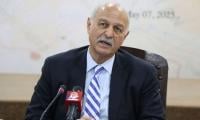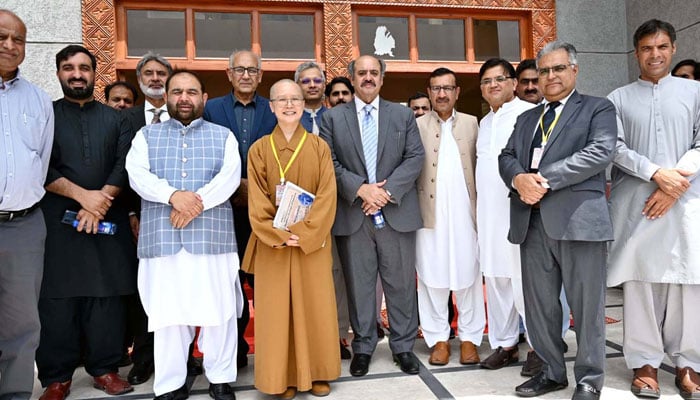
Islamabad : The Third International Conference on the Buddhist Heritage of Pakistan opened on Tuesday at the Taxila Institute of Archaeology and Civilizations, Quaid-i-Azam University, bringing together scholars, diplomats, monastic leaders and heritage experts from across the world, says a press release.
In his welcome address, Vice Chancellor Prof Dr Zafar Nawaz Jaspal stressed the need to preserve Pakistan’s diverse cultural heritage and reaffirmed the university’s commitment to research and international collaboration on Gandharan studies.
Keynote speaker Dr Stefan Baums, a leading scholar of Gandhari Buddhist manuscripts, presented his latest findings and outlined Gandhara’s historical role in shaping Asia’s intellectual, artistic and spiritual traditions.
Federal Minister for National Heritage and Culture Aurangzeb Khan Khichi, the chief guest, said the conference provided a platform for intercultural dialogue, scholarly cooperation and international understanding.
“This is not only an academic forum. It reflects the government’s and organisers’ shared commitment to protecting Gandhara’s historical and spiritual legacy and promoting the universal values of peace, harmony, tolerance and compassion,” he said.
During the opening session, souvenirs were presented to the minister and vice chancellor by Venerable Jue Cheng, Chief Abbess of Fo Guang Shan for Malaysia, Singapore, Indonesia, India and Thailand. Venerable You Deng and Prof Ghani ur Rahman presented mementos to ambassadors and members of the diplomatic corps. Dr Ijlal Hussain, Director of the Silk Road Centre, conducted the launch ceremony.
Organised jointly by the Humanistic Buddhist Research Centres at Quaid-i-Azam University and Universiti Malaya, Fo Guang Shan Education Centre Malaysia, the Directorate of Archaeology and Museums Khyber Pakhtunkhwa, the Silk Road Centre, Pakistan Tourism Development Corporation, and the International Institute for Central Asian Studies, the conference runs under the theme “Exploring the Buddhist Heritage of Pakistan through Multidisciplinary Research”.
More than 36 speakers from Pakistan and abroad are participating. The academic sessions conclude on 20 May and will be followed by field visits to heritage sites until 23 May 2026.