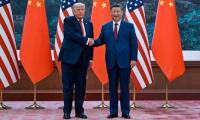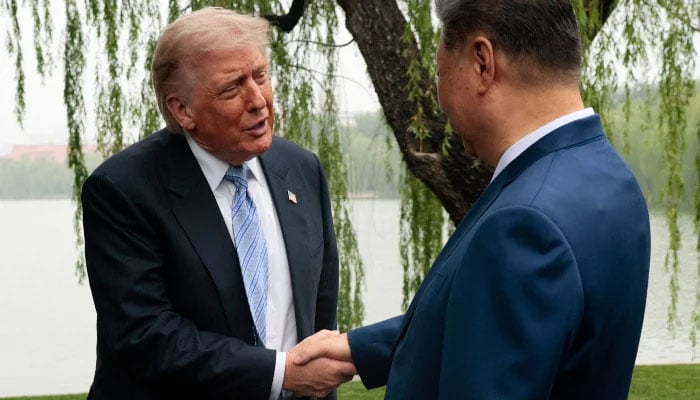
The exchange of pleasantries between US President Donald Trump and his Chinese counterpart, Xi Jinping, augurs well for a world gripped by uncertainty and volatility due to ongoing conflicts in the Middle East and elsewhere. It is heartening to see these two global leaders seeking cooperation across different fields to protect their bilateral interests, but can they do so without securing global peace?
Trump claimed that he had struck "fantastic trade deals, great for both countries", but few details have emerged on what the two superpowers agreed. Accompanied by several CEOs, Trump is believed to have discussed agriculture, aviation, electric vehicles and artificial intelligence (AI) chips. Despite the ongoing tensions over the Iran war, trade dominated the talks, creating hopes that the two giant powers would make efforts to end the tariff war triggered by reckless policies of the American administration.
The visit was defined by warm rhetoric and symbolism. Trump was wooed with a packed itinerary that included an honour guard, a state banquet and an invitation to the exclusive compound where China’s Communist Party leaders live and work. This clearly shows that the People’s Republic has a keen interest in working with the US to create a world where the threat of tariffs can be avoided in favour of free trade and business promotion. Trump unexpectedly reciprocated, inviting Xi to the White House in September, and said talks had been "very successful", while Xi called it a "historic and landmark" visit.
Trump seemed euphoric over the success of the visit, asserting that his government has secured deals or the promises of deals that would immensely benefit American businesses and people. He revealed to reporters aboard Air Force One that China had agreed to buy 200 Boeing jets, with a potential commitment to buy an additional 750 planes. The aerospace giant confirmed the deal. The Republican leader also said American farmers will be happy with his trade deals because China would be buying "billions of dollars" of soybeans. Experts believe that if the Boeing orders are finalised, this would be the plane-maker’s first major Chinese deal in nearly a decade. It was largely shut out of the world’s second-largest aviation market because of trade tensions between Beijing and Washington.
However, while Trump is hailing it as a great success, many are taking it with a pinch of salt, as the Republican leader has in the past made similar claims about various deals that did not fully materialise. The market was expecting a 500-plane deal, which did not see the light of day. Many believe that even the details of this 200-plane deal are murky because the Chinese side has not released them.
The American president expressed a desire for both sides to work to implement the "important consensus" reached by the two leaders and bring greater stability to bilateral trade ties and the global economy. But many people wonder how such a consensus can be implemented without addressing some of the core problems that create irritants in the ties between the two giant powers. For instance, there are still questions about the trade truce agreed in October, when Washington suspended steep tariff increases on Chinese goods while Beijing eased restrictions on rare-earth exports critical to manufacturing. It is surprising that Trump was quoted as telling reporters he and Xi did not discuss tariffs at all.
It may be mentioned that beyond bilateralism, there are other points worth pondering. China and America have investments in several parts of the world. Global stability is crucial to protecting their interests. Trump’s tariff sword is also causing anxiety in several parts of the world. Even if the US manages to resolve tariff issues with the communist country, it would not go far toward alleviating people’s fears about the constant threat of the tariff regime. Therefore, the two global powers should not only discuss tariffs bilaterally, but also engage the European Union, BRICS and other stakeholders to find a permanent solution, as the issue is not affecting just one or two countries but is impacting global trade.
No trade or business takes place in a vacuum. The global economy is not an abstract phenomenon. It is closely linked to the way states run their affairs, solve their disputes, conduct their economic activities and view the interests of the global community. If parts of the world are pushed towards war and conflict, they will definitely affect the global economy. For instance, look at the impacts of the Iran war, which has greatly disrupted the global supply chain. Agriculture and other fields have also been hit by US-Israeli aggression and the closure of the Strait of Hormuz.
It is not only the people of the Global South who are facing the brunt of this conflict but the reckless policies of Washington and Tel Aviv are also creating immense hardships for the working class in America, Europe and other capitalist countries. The biggest victims of this insane conflict are the Iranians, Palestinians and Lebanese. Israel seems to be repeating its destructive policies in Lebanon, reducing several parts of the invaded country to ashes.
Therefore, China and the US, as global powers, should rise to the occasion and make every effort to douse the flames of the war in the Middle East first. They should not forget that small wars in the Balkans in the 19th century and tensions in the early 20th century suddenly caused the eruption of the first mass slaughter in modern times. You cannot promote businesses when states harbour deep suspicions about each other’s designs.
Saudi Arabia, Qatar, Bahrain, Iraq, Pakistan and Oman are also fearful about the unresolved war that has already created immense difficulties for the vast majority of mankind.
If the US is genuinely interested in promoting business and trade, it must remember that such trade is global in many ways, and no promotion is possible without creating an environment conducive to economic activity. The current volatility in the Middle East does not augur well for global economy, peace, and stability. Therefore, it is important that the two global powers go beyond bilateral interests and work first for global peace. Ending hostilities in the Middle East would be the first step towards this stability. Therefore, without losing any time, the US should prevail upon Israel to prevent its naked aggression against Lebanon, while China should engage Iran to sort out enriched uranium and other issues threatening global peace. The two powers should also engage the US, Russia, BRICS and the UN to ensure lasting peace in the Middle East.
The writer is a freelance journalist who can be reached at: [email protected]