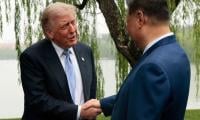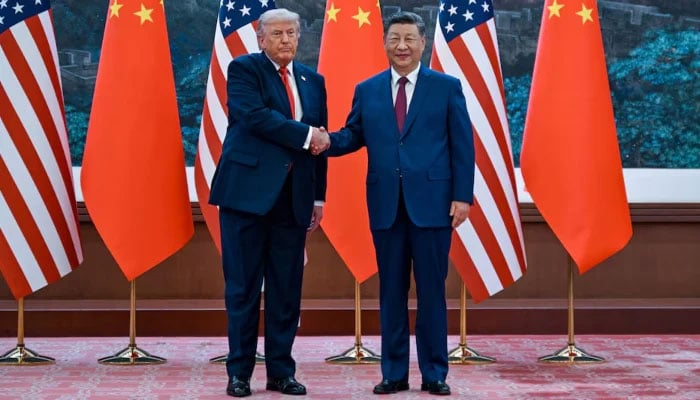
It was a visit remarkably high in ceremony and optics. Chinese President Xi Jinping walked some 100 steps down his office to welcome his American counterpart, Donald Trump.
Paramount leaders in China seldom, if ever, display such magnanimity toward their guests. Not only that, but Trump was also taken by Xi in person to his official residence, which, as the latter himself told his guest, was an ‘extremely rare’ event in a country where the private lives of top leaders remain off camera. But was the summit between the two superpowers high in substance as well?
Xi described the visit as heralding a ‘new bilateral relationship,’ and Trump dubbed it ‘incredible.’ Such hortatory words notwithstanding, no joint statement or communique was issued at the end of the two-day visit, suggesting that the two sides didn’t see eye to eye on the core issues. While trade and Taiwan remain the perennial core issues between the two superpowers, they most likely were overshadowed by the hottest issue of the day – the US-Iran war.
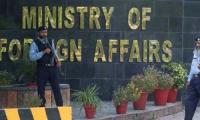
In a statement issued on the visit, the White House claimed that “Both countries agreed that Iran can never have a nuclear weapon”. However, the Chinese Ministry of Foreign Affairs (MFA) didn’t explicitly endorse this claim and instead stated that “This conflict, which should never have happened, has no reason to continue”.
“It is important to steady the momentum in easing the situation, keep to the direction of political settlement, engage in dialogue and consultation, and reach a settlement on the Iranian nuclear issue and other issues that accommodates the concerns of all parties”. the ministry further stated.
The second-mentioned statement embodies the usual Chinese response to international issues in which it isn’t directly involved: non-committal and taking no overt sides. This, however, doesn’t mean that China has no stake in the US-Iran conflict; on the contrary, it has substantial ones. What it means is that Beijing isn’t going to publicly commit itself to a particular course of action.
China is the world’s largest crude oil importer. Imports make up about 70 per cent of its total oil consumption. In 2025, it purchased some 11.6 million barrels per day (BPD) of crude oil. China buys oil not only for current consumption but also to maintain its strategic reserves and safeguard its mammoth population (1.41 billion) and massive industrial infrastructure (valued at over $5 trillion) from a supply shock. The country stockpiled about 500,000 BPD in 2025. More than 90 per cent of Chinese crude imports are seaborne.
According to the General Administration of Customs of China (GACC), in 2025 the seven largest exporters of crude oil to China, in descending order, were Russia, Saudi Arabia, Malaysia, Iraq, Brazil, the UAE and Oman, which together accounted for 75 per cent of its total crude imports. The US also exported 147,000 BPD to China. Surprisingly, GACC didn’t report any oil imports from Iran and only 7,000 BPD from Venezuela, though it’s widely believed that China is the largest buyer of Iranian oil. Some Western sources claim that Iran and Venezuela – both currently under American sanctions – are significant suppliers of oil to China and that the supplies are rebranded as of Malaysian origin. At any rate, four of the seven largest oil exporters to China are Gulf countries (Saudi Arabia, Iraq, the UAE and Oman).
It’s here that the Strait of Hormuz, which has been called Iran’s trump card in the war with the US, figures in for China. The strait is important primarily because it provides the only passage for ships cruising between the Persian Gulf and the Indian Ocean. In other words, the Gulf countries depend almost exclusively on the Strait of Hormuz for their trade with the rest of the world. Iran controls seven out of the eight islands along the strait, which accounts for more than 40 per cent of China’s total oil imports.
The countries along the Persian Gulf – including Iran, Saudi Arabia, Oman, the UAE, Qatar, Bahrain, Kuwait and Iraq – constitute the world’s primary oil production hub. Over 25 per cent of global oil and 30 per cent of global LNG trade passes through the Strait of Hormuz. It serves as the exclusive maritime passage for petro exports from Iran, Iraq, Kuwait and Qatar. Saudi Arabia and the UAE also partly depend on the strait for their overseas trade. Four-fifths of the oil exports through the strait go to Asian countries, notably China, Pakistan, India, Japan and South Korea. Qatar, the world’s second-largest LNG exporter, depends entirely on this route for all its maritime shipments.
Petroleum products are essentially price elastic, which means that a surge in their price has only a marginal impact on their demand, because they fall into the category of ‘essential’ products. That’s why supply disruptions in one part of the world can have a profound impact on petro prices worldwide.
A surge in oil prices is bad for China, given its massive oil imports. Interruptions in oil supply are even worse for it. Since the onset of the US-Iran war, crude oil prices have risen sharply. The benchmark Brent crude surged from $72 a barrel on February 27 to a peak of $120 a barrel, or $48 per barrel or more than 55 per cent. Hence, for every barrel of crude it imports, China has to pay millions of dollars in additional costs every day. No country – not even the one which has the world’s largest foreign exchange reserves – can afford such an exorbitant cost for a long period.
Petro imports are only a part of China’s gigantic trade portfolio. The country is the world’s largest trading nation, the largest exporter and the second-largest importer. Over the decades, the economy has been the mainstay of China’s rise and foreign trade has been the mainstay of the economy. China has over $400 billion in trade with Middle East countries. The Persian Gulf and the Strait of Hormuz provide maritime passage for a considerable part of this trade.
Hence, China can’t afford volatility in the Middle East, particularly even a partial blockade of the Strait of Hormuz. For Beijing, the normal working of the strait and the Persian Gulf is more important than Iran’s nuclear programme. Beijing, thus, is seeking an early end to the war without much interest in the continuation or cessation of Iran’s nuclear programme. The latter is primarily America’s concern and that of Iran’s neighbours and Israel. It’s in this context that the above-quoted statements from the Chinese MFA may be seen.
Washington, on the other hand, is primarily interested in Iran’s nuclear programme – halting, capping or suspending it. The normal working of the Strait of Hormuz can wait. It’s here that the interests of the two superpowers are mutually discordant and remain so after the Beijing summit.
The writer is an Islamabad-based columnist. He tweets/posts @hussainhzaidi and can be reached at: [email protected]