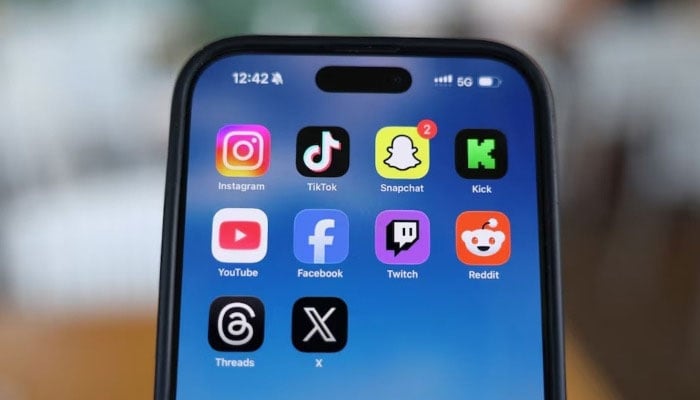
LAHORE: Doubts have emerged over the authenticity of official figures recently presented to a Senate committee on social media usage in Pakistan, including claims that 20 per cent of social media accounts in the country are fake and that platforms comply with 83 per cent of Pakistan’s content removal requests. Digital rights experts described the figures as “puzzling” and lacking transparency.
During a May 6 meeting of a sub-committee of the Senate Standing Committee on Information and Broadcasting, an official reportedly told lawmakers that, out of 140 million internet users in Pakistan, around 20 per cent of social media accounts were fake and often used for fraud, harassment and blackmail.
Later, a representative of the National Cyber Crime Investigation Agency (NCCIA) informed the committee that social media companies responded more positively to Pakistan’s requests than to India’s, with a response rate of 83 per cent for Pakistan and 74 per cent for India.
Officials have now distanced themselves from both statements.
A senior NCCIA official, who asked not to be named, told The News he did not know the basis for the 20 per cent figure cited by an official.“There is no proper yardstick or mechanism to determine how many accounts are fake and how many are real,” the official said.
He said the Pakistan Telecommunication Authority (PTA) might have some relevant data, but it was unlikely to maintain precise figures on fake accounts.
“To determine this accurately, each account would need to be verified individually to establish whether it is genuine or fake,” he said, adding that this would be difficult in practice.
The official also disputed the 83 per cent compliance figure presented by an official from his own agency. “Response [from a social media company] does not mean a positive response,” he said.
He added that Meta had the highest level of cooperation with Pakistan, with response rates ranging from 20-30 per cent, while other platforms responded at rates of 10-15 per cent. The response rate from X, formerly Twitter, was even lower, he explained.However, his colleague, Arif Shahbaz Khan Wazir, the director of administration at the NCCIA headquarters, who represented the agency at the Senate sub-committee meeting on May 6, confirmed that he did make the 83 per cent response rate statement.
He then defended the claim, adding that the figure included both accepted and rejected responses to requests made by Pakistani authorities.“The 83 per cent figure is derived from the number of emails sent by Pakistani authorities to social media companies,” he said. “For instance, if 100 requests are sent, responses are received for 83 of them.”
But Farieha Aziz, a Karachi-based digital rights activist, described the figures presented by NCCIA and other officials before the Senate Standing Committee as “bizarre”.
She particularly questioned how the 83 per cent response rate had been calculated.
“Every platform responds differently,” she told The News. “A response is not necessarily compliance. A response [by a social media company] could also be to seek more information or to state that a request does not meet the criteria.”
Aziz said compliance itself could also be partial, with platforms sometimes removing only some of the reported content after review.
“What the Senate committee should press for is disaggregated data [from the NCCIA], year-wise or quarter-wise, with respect to the number of requests sent by Pakistan, the types of requests, and the distinction between response and compliance for each platform,” she said. “Unless this data is available, how can percentages with such a broad stroke be reported?”
She also pointed to the absence of the half yearly reports that the investigation agency is required to submit to parliament under Section 53 of the Prevention of Electronic Crimes Act (PECA).
“Merely presenting numbers is not enough,” she said. “They have to be rooted in credible data and that data has to be visible for cross checks.”