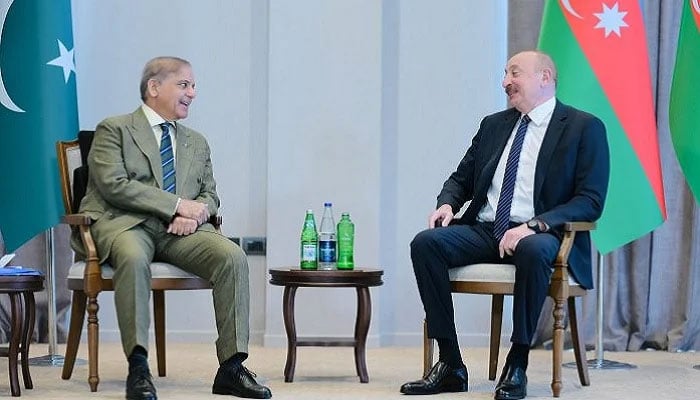
ISLAMABAD: Prime Minister Shehbaz Sharif and Azerbaijan President Ilham Aliyev Tuesday reiterated their shared commitment to deepening cooperation across areas of mutual interest, including trade and investment, energy and people-to-people contacts.
The prime minister held a telephone call with the Azerbaijan president where both the leaders expressed satisfaction on the positive trajectory of bilateral relations. The two leaders exchanged greetings and reaffirmed the strong fraternal bonds of friendship between Pakistan and Azerbaijan, the PM Office Media Wing said in a press release.
The prime minister conveyed his best wishes to President Aliyev for the success of the upcoming World Urban Forum to be held in Baku next week. He noted that, most regrettably, pressing commitments would preclude his personal attendance at the event, but he had ensured that Pakistan would be well-represented at the forum.
President Aliyev expressed his deep appreciation at Pakistan’s remarkably successful initiatives to bring about a ceasefire between Iran and the US. They agreed to maintain close contact, and looked forward to their meeting, in person, later this year.
Separately chairing another meeting, the prime minister directed the relevant authorities to introduce a modern and sustainable solid waste management (SWM) system across the country in coordination with provincial governments. The prime minister decided to formulate a comprehensive roadmap for generating electricity from solid waste as part of the government’s broader strategy to promote renewable and environmentally friendly energy sources. He also directed the formation of a task force to prepare a detailed action plan for converting solid waste into energy. He added that the task force would suggest recommendations in light of modern technology and international best practices. The prime minister instructed officials to ensure the inclusion of private sector representatives and internationally renowned experts in the proposed task force to make the initiative more effective and result oriented. He said that generating energy from solid waste would help reduce dependence on imported fuel and save valuable foreign exchange reserves.
Meanwhile, in a meeting with a delegation of senior politicians and members of the Senate from Balochistan at the Prime Minister’s Office, PM Shehbaz reiterated that the development, prosperity and welfare of the people of Balochistan remained the federal government’s top priority. The prime minister said that Balochistan was rich in natural resources and emphasised that the government was making every possible effort to ensure that the people of the province fully benefited from those resources.
He said the federal government, in collaboration with the provincial government, was actively working for the progress and uplift of Balochistan and undertaking measures aimed at improving the living standards of its people.
Chairing another meeting on food security and fertiliser reserves, the prime minister directed the authorities to ensure timely provision of fertiliser to farmers at all costs and ordered continuous monitoring of fertiliser supplies to safeguard the country’s food security, a PM Office news release said. The prime minister said meeting the agricultural sector’s requirements was the government’s top priority to ensure food security in the country.
He directed the relevant ministries and institutions to formulate plans for alternative fertiliser supplies from Central Asian states in view of possible disruptions in supply chains from Gulf countries. The prime minister also instructed the authorities to ensure sufficient fertiliser stocks for both Kharif and Rabi crop seasons and emphasised accelerating work on projects aimed at increasing local fertiliser production through installation of new plants. He directed to take strict action against artificial shortages and hoarding of fertiliser to protect farmers from exploitation and maintain stable supplies in the market.
The meeting was informed that uninterrupted supply of natural gas to fertiliser factories was continuing in line with national requirements to sustain local production.