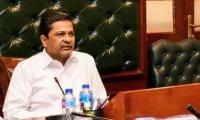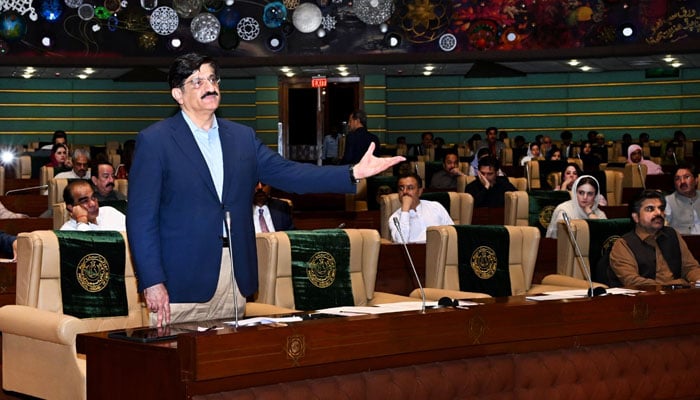
Sindh Chief Minister Syed Murad Ali Shah on Monday moved a resolution in the Sindh Assembly to mark the first anniversary of operation Marka-e-Haq, paying tribute to the martyrs, armed forces, political leadership, media, youth and people of Pakistan for their role in safeguarding national unity and sovereignty in the military clash with India last year.
The Sindh Assembly unanimously lauded the sacrifices and professional capabilities of the Pakistani armed forces and paid tribute to Chief of Defence Forces Field Marshal Asim Munir and the services chiefs for their leadership during the armed conflict.
The House also appreciated the leadership of President Asif Ali Zardari and Prime Minister Shehbaz Sharif. The resolution acknowledged diplomatic efforts of Bilawal Bhutto Zardari and paid homage to the services of Zulfikar Ali Bhutto and Benazir Bhutto for strengthening the country’s defence.
The role of the people of Pakistan, media, civil society and youth in demonstrating unity and resilience during the crisis was also appreciated in the resolution, which was unanimously passed by the House.
Addressing the assembly after presenting the resolution, the CM described the day of Marka-e-Haq as historic, noting that one year earlier, the people of Pakistan, armed forces, political leadership and media had stood united against external aggression.
He said India had maintained hostile intentions toward Pakistan since 1947 and referred to several past conflicts, including those of 1965 and 1971. He stated that after the separation of East Pakistan, Bhutto initiated Pakistan’s nuclear programme by convening leading scientists in Multan and making the country’s defence capability a national priority.
The CM noted that India had carried out nuclear tests in 1974 and again in 1998, after which Pakistan responded by becoming the first nuclear power in the Muslim world. He added that successive governments continued the programme initiated by Bhutto.
Referring to the last year’s tensions, Shah alleged that India staged a ‘false flag operation’ in Pahalgam on April 22 and immediately blamed Pakistan without evidence. He said Pakistan had offered cooperation and demanded an impartial investigation.
He said India attempted an attack on April 29, which was thwarted by Pakistan’s armed forces, followed by missile strikes on May 7 targeting civilians. According to the CM, the Pakistan Air Force responded decisively during the night of May 7 and 8, bringing down eight Indian aircraft, including Rafale jets, within 25 minutes.
“Pakistan’s falcons shattered India’s arrogance,” he said, adding that although 47 Indian aircraft were in the air, Pakistan targeted only those involved in the attacks. The CM stated that more than 77 Indian drones were also shot down by the Pakistani forces and citizens, while the Indian media spread propaganda regarding alleged attacks on the Karachi port and other cities.
He said that after further attacks on the night of May 9, Pakistan launched Operation ‘Bunyan-un-Marsoos’ in response to India’s ‘Operation Sindoor’. He stated that Pakistan targeted 26 Indian military installations, including those in Surathgarh, Sirsa, Naliya, Bathinda, Awantipora, Srinagar, Jammu, Udhampur, Adampur, Ambala and Pathankot – and avoided civilian targets.
Shah praised the performance of the Pakistan Air Force and said the JF-17 fighter aircraft played an important role in defending the country. He also highlighted the contributions of the Pakistan Peoples Party leadership towards strengthening Pakistan’s defence capabilities, including the development of missile technology and the acquisition of modern aircraft and submarines.
Shah said Pakistan demonstrated restraint despite having the capability to inflict greater damage, adding that the country accepted a ceasefire because it desired peace and stability in the region.
He said the entire nation – including the youth, media and civil society – had shown unity during the conflict and conveyed a strong message to the world that Pakistan was a resilient and united nation.
Calling for continued national unity, the CM said no power in the world could harm Pakistan if the nation remained united and committed to the principles of Quaid-e-Azam Muhammad Ali Jinnah. He reaffirmed that the Pakistan Peoples Party and Sindh government would always remain at the forefront in defending the country and supporting national sovereignty, unity and security.