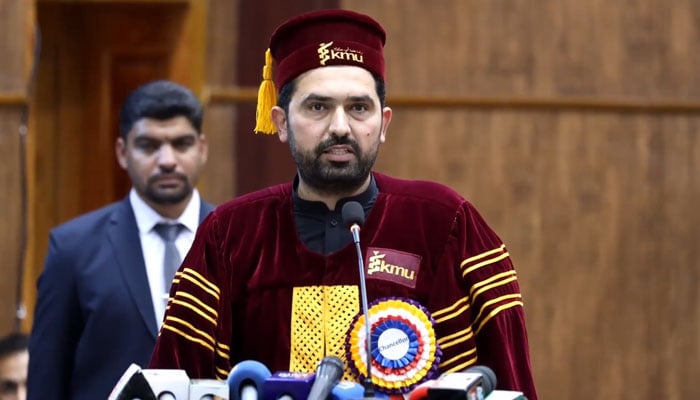
PESHAWAR: Chief Minister Muhammad Sohail Afridi on Friday announced the recruitment of 2,400 doctors and pledged expansion in the province’s health sector.
He was addressing the Convocation 2026 of Khyber Girls Medical College (KGMC).
Around 200 female doctors from the 2023 and 2024 sessions of Khyber Pakhtunkhwa’s first public-sector women’s medical college, KGMC, were awarded degrees during the ceremony.
The convocation featured the distribution of gold medals and academic distinctions among high-achieving students.
The event was attended by provincial Health Minister Khaleeq-ur-Rahman, Vice Chancellor of Khyber Medical University and Executive Director of the Higher Education Commission Prof Dr Zia-ul-Haq, Dean of KGMC Prof Dr Shahzad Akbar, senior faculty members, parents, and a large number of students.
The chief minister congratulated the graduates and their families, describing the convocation as a defining academic milestone for both the students and the institution.
“There was a time when this province echoed with violence and fear, but that chapter has ended and the journey towards progress has begun,” he said.
Referring to the country’s political and economic situation, Sohail Afridi claimed that Pakistan witnessed economic stability and stronger growth during the government of then prime minister Imran Khan between 2018 and 2022, adding that economic indicators had deteriorated afterwards.
He expressed concern over rising inflation, unemployment, and worsening security conditions, saying ordinary citizens were paying the price for flawed policy decisions.
“We warned against the resettlement of those people [militants] in 2022, who were responsible for the killings of over 80,000 people, but no one listened. Today, innocent people are suffering, and we are carrying funerals every day,” he remarked.
However, critics point out that Imran Khan was in power in 2022, and his opponents now hold him responsible for the current wave of violence. He and then corps commander of Peshawar Lt Gen Faiz Hameed have been accused of facilitating the return of militants from Afghanistan for resettlement in the country.
The chief minister, however, assured the graduates that the provincial government was focused on strengthening public healthcare and creating opportunities for young professionals.
“Your province needs you. Women doctors are essential for improving healthcare delivery across Khyber Pakhtunkhwa. You must move forward with confidence, stand up for your rights, and serve humanity with dedication,” he told the graduates.
The ceremony also recognised academic excellence, with gold medals awarded to outstanding graduates, including Dur-e-Shahwar Wahab, Hina Aksir, Sabina Shahid Waziri, Adan Qayyum, Sadiqa Naz, Maria Zareesht, Areej Altaf, Noor Fatima, Rida Tahseen, Sabeen Khan, Muqaddas Mukhtiar, Nayab Shaukat, Shaima Sami, Maria Afridi, Sidra Hassan, Maliha Shahid, Shagufta Bibi, Halima Durrani, Kabsha Zain, Shafaq Rahat, and Qandeel Murtaza.
Among the top achievers, Qandeel Murtaza secured 17 gold medals and overall distinctions, while Muqaddas Mukhtiar and Sabeen Khan also earned recognition for exceptional academic performance in their respective batches.
In his address, KGMC Dean Prof Dr Shahzad Akbar said the institution had evolved into one of Pakistan’s leading public-sector medical colleges for women since its establishment in 2004.
He said the college, in collaboration with Hayatabad Medical Complex and its affiliated institutions, had built one of the country’s strongest academic and clinical environments.
Highlighting institutional achievements, he said KGMC secured an A-plus accreditation score of 92.4 percent during the Pakistan Medical and Dental Council’s nationwide evaluation in 2019, leading to an increase in annual admissions from 100 to 150 seats.
According to him, the additional seats were reserved for students from the merged tribal districts, with nearly 200 students currently benefiting from the initiative.
He added that the institution achieved an even higher score of 97 percent during a subsequent evaluation conducted in 2023.
Prof Dr Shahzad Akbar said KGMC had consistently maintained a pass rate exceeding 90 percent, with students regularly securing top positions in examinations conducted by KMU.
He highlighted recent academic reforms, including the establishment of a research department, digital examination systems, computerised learning management platforms, faculty development initiatives, and international collaborations with institutions such as the University of Toledo.