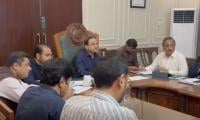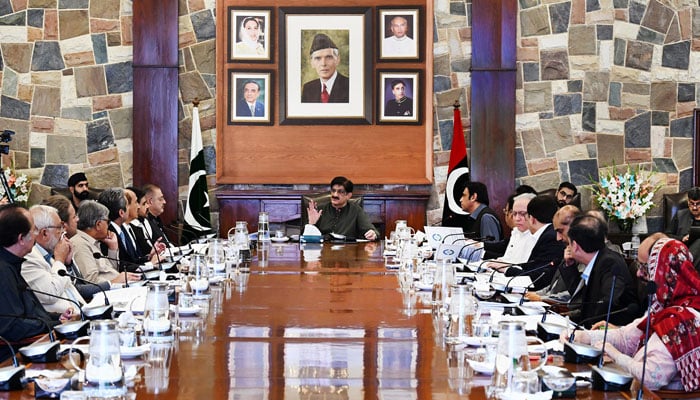
Sindh Chief Minister Syed Murad Ali Shah on Friday presided over the 52nd meeting of the Public-Private Partnership (PPP) Policy Board, during which he approved and deliberated upon a wide range of strategic infrastructure, and education, transport, technology and industrial development projects aimed at accelerating Sindh’s socio-economic growth through public-private partnerships.
The meeting, held at the CM House, was attended by provincial ministers Sharjeel Inam Memon, Nasir Hussain Shah, Jam Khan Shoro, Ismail Rahu and Ziaul Hassan Lanjar, CM’s Special Assistant Syed Qasim Naveed, MPAs Ghulam Qadir Chandio and Qasim Soomro, Chief Secretary Asif Hyder Shah and others.
Murad said four public-private partnership projects in Sindh had been selected as international case studies at the 10th United Nations Economic Commission for Europe (UNECE) International PPP Forum held in Barcelona, Spain.
Of the 139 PPP projects submitted from 21 countries, only 69 projects were selected globally for inclusion in the UNECE PPP Forum Compendium, and all four projects submitted by Sindh secured selection, the meeting was told.
The selected projects included the Teachers Training Institute, Shahrah-e-Bhutto Expressway, Education Management Organisations (EMOs), and Carbon Emission Reduction through Forestation.
The meeting was told that the Teachers Training Institute & College (TTIC) project was showcased as one of the most impactful projects during a plenary session attended by over 600 participants, including government representatives, investors and development practitioners from more than 60 countries.
The CM said the international recognition reflected the strength of Sindh’s public-private partnership framework and its alignment with sustainable development goals and global best practices.
The board deliberated on the Sindh Institute of Teacher Education (SITE) project proposed under the universities & boards department. The meeting was informed that the Sindh government had established SITE through the Sindh Institute of Teacher Education Act, 2025, as an autonomous degree-awarding institution dedicated to teacher education, educational research and leadership development.
The project sought to address shortage of competent faculty in Sindh’s teacher education system, particularly for four-year B.Ed. programmes being offered in 30 teachers training institutes across the province.
The board was informed that Durbeen, a non-profit organisation and sister concern of the Zindagi Trust, had submitted an unsolicited proposal for the establishment, management and operation of SITE.
The board was also informed about Durbeen’s collaboration with the University of Oxford for the development of an MPhil curriculum for teacher educators adapted to Pakistan’s context.
The board approved the concept proposal and authorised utilisation of the existing consortium of transaction advisors already engaged by STEVTA for conducting due diligence and transaction advisory services for the project. The board also reviewed progress in the NED Science & Technology Park being developed in collaboration with the Enertech Holding Company, a subsidiary of the Kuwait Investment Authority.
The meeting was informed that the concession agreement had already been signed while site clearance and preparatory works were under way. The participants discussed complications arising from delays in the grant of special technology zone status due to federal restrictions linked with the IMF’s conditions.
Officials presented alternative structuring options in case the STZ status was not granted. The board was informed that under one proposed structure, the government’s obligation to purchase unsold commercial space would only arise three years after commercial operations, if occupancy remained below 60 per cent.
The board authorised continued engagement with federal authorities for obtaining the STZ approval while simultaneously refining alternative project structuring mechanisms. The board approved key decisions regarding the Karachi Port to Qayumabad corridor, a major elevated road connecting the Karachi Port with Jam Sadiq Interchange.
The 16.5-kilometre project includes 10.4 kilometres of elevated structure and 6.1 kilometres of embankment sections. The meeting was told that the bidding process had been completed through an international competitive bidding conducted electronically.
Following the technical and financial evaluation, a firm had emerged as the lowest evaluated bidder. The board approved the consortium as the successful bidder and authorised the executing agency to sign concession agreements and financing instruments.