WASHINGTON: US President Donald Trump has notified Congress that the hostilities the United States initiated against Iran on February 28 have been “terminated,” though he did not rule out future military action.
Trump administration argued that a ceasefire with Tehran “terminated” hostilities as a legal deadline arrived on Friday for coming to Congress about the two-month Iran war.
President Trump said Friday he was unhappy with a new proposal from Iran for peace talks with the United States, and threatened to “blast them to hell” if they failed to strike a deal.
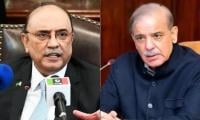
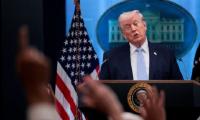
“At this moment I’m not satisfied with what they’re offering,” Trump told reporters at the White House. He added that negotiations were taking place by phone. Talking to media on Friday, President Trump in response to a reporter’s question said he has great respect for Pakistan and for Prime Minister Shehbaz Sharif and Field Marshal Asim Munir.
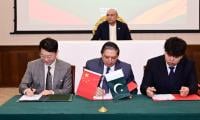
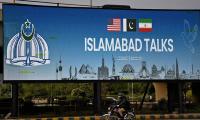
The president’s remarks came after Iranian state media and a Pakistani official said on Friday that Tehran has submitted its latest proposal for negotiations with the United States, a move that could offer hope for breaking a deadlock in efforts to end the Iran war.
The official, involved in Pakistani mediation over the war, said Pakistan had received the proposal late on Thursday and had forwarded it to the US.
Neither the official nor Iranian state news agency IRNA gave details, and the White House declined to comment, while saying negotiations continued. Global oil prices, which remain well above $100 a barrel, eased following news of the proposal.
The war, launched by the United States and Israel with a vast wave of surprise strikes on February 28, has been on hold since April 8 with a ceasefire. But only one failed round of direct talks has taken place between Iranian and US representatives.
Meanwhile Iran has maintained its stranglehold on the Strait of Hormuz, cutting off vast amounts of oil, gas and fertiliser from the world economy, while the US has imposed a counter blockade on Iranian ports.
Asked why he was unsatisfied with the Iranian offer, Trump said: “They’re asking for things that I can’t agree.” He gave no details.
Trump said Iran had “made strides” in negotiations, but added that there was “tremendous discord” in the Islamic republic’s leadership and warned: “I’m not sure if they ever get there.”
Trump was asked what he would do if there was no deal but refused to say whether he would launch more strikes. “Do we want to go and just blast the hell out of them and finish them forever—or do we want to try and make a deal? I mean, those are the options,” he said.
Trump added that he would “prefer not” to launch a huge offensive but added: “That’s the option: do we want to go in there heavy and just blast them away or do we want to do something?”
He was also asked about blowing past the 60-day deadline set out in the War Powers Act for getting congressional approval for the war and claimed that the notion that he would need approval was “totally unconstitutional.”
“Also, we had a ceasefire so that gives you additional time, but no other country has done it,” he said. “We’re in the midst of a big victory. This is a victory like we haven’t had since Venezuela.” He meant the US ouster of Nicolas Maduro in January.
A ceasefire has been in place since April 8 but reports that US President Donald Trump was to be briefed on plans for new military strikes to compel Iran to negotiate had pushed global oil prices up to a four-year high at one point on Thursday.
Iran has activated air defences and plans a wide response if attacked, having assessed that there will be a short, intensive US strike, possibly followed by an Israeli attack, two senior Iranian sources told Reuters on condition of anonymity.
Underlining the concerns of the Gulf states, UAE presidential adviser Anwar Gargash said the “collective international will and provisions of international law” were the primary guarantors of freedom of navigation through the strait.
“And, of course, no unilateral Iranian arrangements can be trusted or relied upon following its treacherous aggression against all its neighbors,” Gargash wrote.
Iranian Foreign Ministry spokesman Esmaeil Baghaei cautioned on Thursday against expecting quick results from talks. US President Donald Trump repeated his prediction that oil and gas prices would fall when the war with Iran ends.
Despite a ceasefire in the Middle East war, the US military has blockaded Iran’s ports, disrupting oil shipments, while inflation has risen past 50 percent in recent weeks, according to the national statistics centre.
The Iranian rial plummeted to a record low against the dollar this week, according to currency trackers, and a labour official said 191,000 people had filed for unemployment after losing their jobs due to the impacts of the war.
President Trump’s administration argued that a ceasefire with Tehran had “terminated” hostilities as a legal deadline arrived on Friday for coming to Congress about the two-month Iran war.
Under the 1973 War Powers Resolution, the president can wage military action for only 60 days before ending it, asking Congress for authorization or seeking a 30-day extension due to “unavoidable military necessity regarding the safety of United States Armed Forces” while withdrawing forces.
Trump formally notified Congress of the conflict 48 hours after the first airstrikes, starting the 60-day clock that ends May 1. As that date approached, congressional aides and analysts said they expected the Republican president to sidestep the deadline. A senior Trump administration official said on Thursday the administration’s view was that the war powers law deadline did not apply.
Congressional Democrats, who have tried repeatedly to pass war powers legislation that would force Trump to end the war or come to Congress for authorization, dismissed that characterization, saying there was nothing in the 1973 law allowing for a ceasefire. They also said the continuing deployment of US ships blockading Iranian oil exports was evidence of continuing hostility, not a ceasefire.
“After sixty days of conflict, President Trump still does not have a strategy or way out for this poorly planned war,” Senator Jeanne Shaheen of New Hampshire, the top Democrat on the Senate Foreign Relations Committee, said in a statement calling the deadline “a clear legal threshold” for Trump to act.
On Thursday, Trump received a briefing on plans for fresh military strikes to compel Iran to negotiate an end to the conflict.
Iran’s judiciary chief Gholamhossein Mohseni Ejei said Tehran remained open to talks with the United States but would not accept what he called policy “imposition” under threats.
“The Islamic Republic has never shied away from negotiations... but we certainly do not accept imposition,” Ejei said in a video carried by the judiciary’s Mizan Online website. “We do not welcome war in any way; we do not want war, we do not want its continuation,” he said.
He however insisted that Iran was “absolutely not willing to abandon our principles and values in the face of this malicious enemy in order to avoid war or prevent its continuation”.
The United States imposed new sanctions on three Iranian foreign currency exchange firms, in an effort to target Tehran’s “financial lifelines” in the Middle East war.
The US Treasury Department warned in a separate statement against paying a “toll” to Iran’s government in exchange for safe passage through the Strait of Hormuz, saying this could also trigger sanctions.
US Treasury Secretary Scott Bessent said that his agency would “relentlessly target the regime’s ability to generate, move, and repatriate funds, and pursue anyone enabling Tehran’s attempts to evade sanctions.”
In targeting the foreign currency exchange firms, the US Treasury charged that Iran’s “shadow banking networks handle tens of billions of dollars’ worth of trade each year, much of it derived from Iran’s overseas sales of oil and petrochemicals.”
In a separate statement, the Treasury’s Office of Foreign Assets Control issued an alert to warn people from and outside the United States about sanctions risks of making payments to Iran’s government for safe passage through the Strait of Hormuz.
China’s UN ambassador Fu Cong said it was an urgent necessity to maintain the Iran war ceasefire and that he was sure the Strait of Hormuz issue would be high on the agenda if it is still closed when US President Donald Trump goes to China this month.
Fu told reporters at the United Nations the strait needed to be reopened as quickly as possible. He said China was very concerned about remarks it had heard recently about the ceasefire being temporary and the need to initiate another round of attacks. “Iran needs to lift its restrictions on the Strait of Hormuz, and the US needs to lift its naval blockade,” he said.
“The most urgent issue is to keep the ceasefire. And the ceasefire needs to last, and there has to be a good-faith negotiation between the two sides,” he said.
“I think the international community should be mobilized and raise our voices against the resumption of fighting.”
Fu also rejected allegations from some US officials about military cooperation between China and Iran as “false.”
President Trump said that he will hike US tariffs on cars and trucks from the European Union next week, charging that the bloc is not complying with an earlier trade deal. “The Tariff will be increased to 25 per cent,” he wrote on his Truth Social platform.
The price of oil fell on Friday after Iranian media reported that Tehran had proposed fresh talks with the United States in a message sent via mediator Pakistan.
A barrel of West Texas Intermediate (WTI) fell briefly more than five percent, dipping below the symbolic $100 mark, before clawing back to stand at $101.7 by 1530 GMT. The other main US benchmark Brent North Sea crude also recovered slightly, initially dropping by more than three percent to $106.98 before edging back to $108.4.
Meanwhile, seven members of the OPEC and OPEC+ group are to decide on Sunday on production quotas for the first time since the United Arab Emirates left the cartel.
The group is expected to increase its quotas by 188,000 barrels per day, according to Arne Lohmann Rasmussen, chief analyst with Global Risk Management.
But he added that the meeting was “largely irrelevant” for prices as members including Saudi Arabia, Kuwait and Iraq, were “unable to produce that oil” owing to the conflict.
The USS Gerald R Ford aircraft carrier has left the Middle East after taking part in operations against Iran, a US official said Friday, leaving two of the massive American warships in the region.
The Ford is currently in the US European Command area of responsibility, according to the official, who put the number of remaining US Navy ships in the Middle East at 20, including the USS Abraham Lincoln and USS George H.W. Bush aircraft carriers.
France’s top diplomat said a new US-led coalition to reopen the Strait of Hormuz would complement and not compete with a similar mission spearheaded by France and Britain.
Foreign Minister Jean-Noel Barrot, speaking in Abu Dhabi following a regional tour, said he briefed Gulf allies on the UK-France initiative which was now at an “advanced” stage.
President Trump said the White House had given Spirit Airlines FLYYQ.PK and its creditors a final proposal to try to rescue the bankrupt airline, even as the budget carrier makes preparations to shut down if no deal is reached.
President Trump told reporters he was not worried about the state of US missile stocks amid reports of concerns about the pace of weapons use during the conflict with Iran.
US Treasury warned on Friday any shipper paying tolls to Iran for passage through the Strait of Hormuz, including charitable donations to organizations such as the Iranian Red Crescent Society, is at risk of punitive sanctions.
Ukrainian Foreign Minister Andrii Sybiha said that a vessel carrying grain that Kyiv says was stolen from its territories occupied by Russia would not unload its cargo in Israel, describing it as a “welcome development” on Thursday.
Ukraine has asked Israel to seize the vessel, amid a diplomatic tussle between the two countries over the shipment. “This is also a clear signal to all other vessels, captains, operators, insurers, and governments: do not buy stolen Ukrainian grain,” Sybiha said in a post on X.
Kyiv has repeatedly protested against Russian exports of grain from eastern Ukrainian regions occupied since Moscow’s 2022 invasion and from Crimea, annexed by Russia in 2014. Ukrainian President Volodymyr Zelenskiy on Tuesday threatened sanctions against those attempting to profit from the shipment, and Kyiv summoned Israel’s ambassador over what it described as Israeli inaction.
The EU said on Tuesday it had approached Israel regarding a “Russian shadow fleet vessel” carrying stolen grain and was ready to sanction individuals and entities in third countries that helped to fund Russia’s war effort.
President Trump said the United States would not exit its confrontation with Iran early “and then have the problem arise in three more years”.
Axios reported that the US blockade has cost Iran $4.8 billion.