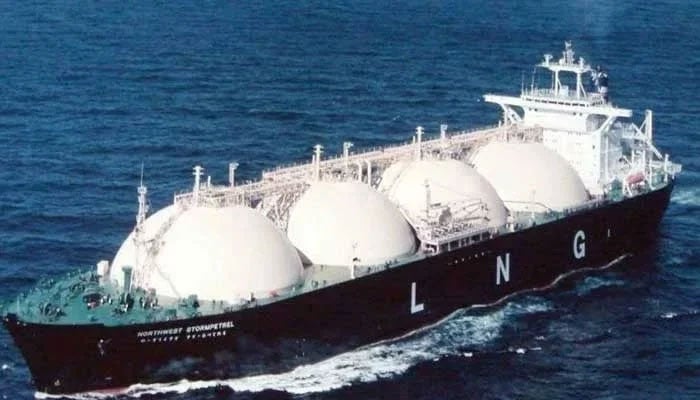
ISLAMABAD: A new liquefied natural gas (LNG) cargo is set to arrive at Port Qasim today (Thursday offering temporary relief to Pakistan’s strained power sector, though officials caution that the shipment alone will not be enough to end loadshedding across the country without further imports.
The LNG vessel Seapeak Magellan, carrying around 140,000 cubic metre of gas, will berth at the Pakistan GasPort Consortium Limited (PGPL) terminal between 10–11am. The cargo has been arranged by Pakistan LNG Limited under a contract with TotalEnergies at a price of $18.4 per MMBtu.
Once unloading begins, regasification will convert the imported LNG into re-gasified LNG (RLNG), which will be injected into the national grid to support electricity generation. The immediate focus, according to energy officials, is to ease peak-hour loadshedding rather than fully eliminate power shortages. They emphasise that sustained relief would require additional LNG cargoes in the coming weeks.
At present, the power sector is receiving around 135 million cubic feet per day (MMCFD) of gas. The new LNG supply is expected to increase availability by about 100 MMCFD, taking total supply to roughly 235 MMCFD. If supply is increased by 200 MMCFD, officials estimate the cargo could be fully consumed within about 15 days, while a lower draw of 100 MMCFD could extend it to around 30 days. Authorities will determine the daily regasification rate based on demand and the expected timing of the next LNG shipment at Port Qasim.
However, even with the additional supply, the system remains significantly constrained. Officials note that to generate approximately 4,800 megawatts of electricity at full load, four RLNG-based power plants require at least 720 MMCFD of gas — far above current availability.
The government recently received bids for three LNG cargoes but chose to procure only one, rejecting the remaining two scheduled for May due to higher prices. For the April 27–30 delivery window, TotalEnergies initially offered $18.88 per MMBtu before reducing it to $18.4, which was accepted.
For the May 1–7 cargo, Vitol submitted the lowest bid at $18.54 per MMBtu. For May 8–14, OQ Trading offered $17.997 per MMBtu, while Vitol also submitted a higher alternative bid of $18.74. Both May cargoes were declined.
The duration and usage of imported LNG depends heavily on the regasification rate. At 100 MMCFD, a cargo lasts roughly 30 days; at 200 MMCFD, about 15 days; and at 300 MMCFD, it would be exhausted in around 10 days if directed primarily toward power generation.
Future LNG procurement, officials say, remains uncertain and closely tied to geopolitical developments, particularly in the Strait of Hormuz, a critical chokepoint for global energy shipments. Pakistan had expected four LNG cargoes from Qatar, but these deliveries were disrupted due to regional tensions, shipping delays, and uncertainty in maritime access routes.
In response to rising prices and failed negotiations involving Iran and the United States, Pakistan is also considering alternative supply arrangements, including a negotiated LNG deal with SOCAR. Under an existing framework, SOCAR can offer one distressed LNG cargo per month, subject to Pakistan’s acceptance. However, officials note that such cargoes are currently scarce due to strong global demand. SOCAR has recently indicated willingness to supply LNG if Pakistan proceeds with formal arrangements.
Any potential deal with SOCAR would likely be indexed to spot market rates, currently estimated at around $16.48 per MMBtu, with Pakistani authorities aiming for a negotiated range of roughly $17 to $17.30 per MMBtu to ensure affordability.
Officials warn that if geopolitical uncertainty persists and prices remain elevated, Pakistan may increasingly avoid spot LNG procurement through competitive bidding, instead relying more on negotiated supply agreement with SOCAR. For now, however, the incoming cargo offers only short-term relief to the country’s ongoing energy shortfall.