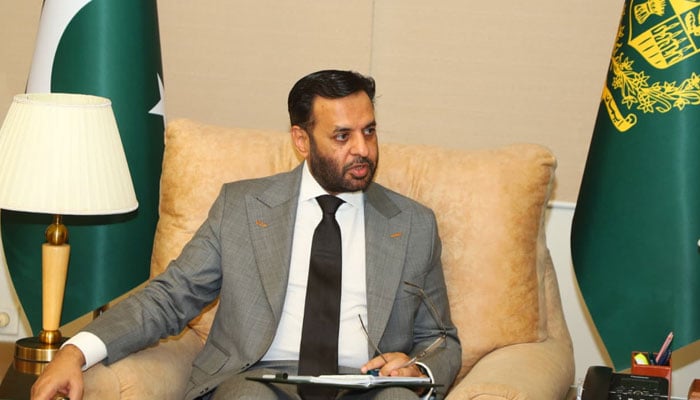
ISLAMABAD: Federal Health Minister Syed Mustafa Kamal on Monday raised serious concerns over the utilisation and oversight of funds provided by the Global Fund for HIV programmes in Pakistan. He revealed that out of $65 million allocated for the 2024–26 grant cycle, more than $61 million has been disbursed to the United Nations Development Programme (UNDP) and Nai Zindagi Trust, while the federal government received only $3.9 million, despite being held accountable for the spread of the virus.
Speaking at a press conference held at the National Institute of Health (NIH), the minister stated that the government maintains complete records of how its allocated share is being utilised—primarily for treatment and programme support—but lacks access to detailed information regarding the bulk of funds managed by the two organisations.
Accompanied by Federal Health Secretary Aslam Ghauri, NIH Executive Director Dr Muhammad Salman, and Director General Health Dr Abdul Wali Khan, the minister noted that the organisations receiving over 93 percent of the funding neither share operational data nor provide transparency to the ministry. “They claim the information is sensitive, yet the government is blamed for HIV transmission,” he remarked.
Expressing concern over financial transparency, the minister said there is currently no effective mechanism for the government to verify how the $61 million allocated to UNDP and Nai Zindagi Trust is being utilised. He added that the issue would be raised with the Global Fund mission expected to visit Pakistan soon, noting that continued HIV transmission despite substantial financial support raises critical questions about efficiency and accountability.
He also disclosed that concerns regarding the misuse of Global Fund resources had been raised during meetings in Geneva. These included allegations of embezzlement linked to the procurement of mosquito nets worth approximately $800,000. He assured that those responsible would be held accountable following a thorough inquiry.
Kamal emphasised that controlling HIV in Pakistan requires improved coordination, enhanced data sharing, and robust oversight of all funding streams. He warned that the current fragmented system is undermining the overall effectiveness of intervention strategies.
The minister further explained that Pakistan had been placed under an Additional Safeguard Policy by the Global Fund due to alleged irregularities during previous administrations. As a result, most funding has been routed through non-governmental organisations rather than the government. However, he questioned the effectiveness of this arrangement, stating that HIV transmission continues despite significant financial allocations.
Providing updated statistics, the minister confirmed that Pakistan reported 14,182 new HIV cases in 2025, identified through the screening of 374,126 individuals during the year. He clarified that the trend does not indicate a sudden surge, explaining, “The cases appear stable and largely reflect expanded testing rather than an outbreak.”
Data shared during the briefing showed that HIV screening has increased significantly, from 37,944 individuals tested in 2020 to over 374,000 in 2025. Similarly, the number of testing centres has grown from 49 to 97. He added that the country currently operates around 95 Antiretroviral Therapy (ART) centres, with plans to expand this number to 160 at the district level.
Despite these improvements, the minister acknowledged persistent gaps in treatment coverage. Of approximately 84,000 registered HIV patients, around 61,000 are currently receiving treatment, while nearly 23,000 remain untreated. He cautioned that untreated individuals could continue to transmit the virus, whereas those undergoing proper treatment do not pose a transmission risk.
Referring to the broader national burden, Kamal stated that the estimated number of people living with HIV in Pakistan could be around 369,000, placing the prevalence rate at approximately 0.1 percent.
He also addressed recent reports regarding clusters of HIV cases, dismissing claims of a new outbreak in Taunsa and clarifying that the cited cases relate to 2024. Regarding Islamabad, he noted that 618 HIV cases had been recorded over the past 15 months; however, only about 210 involved residents of the capital, while the remainder were referred from other regions. “There is no outbreak in Islamabad,” he reiterated.