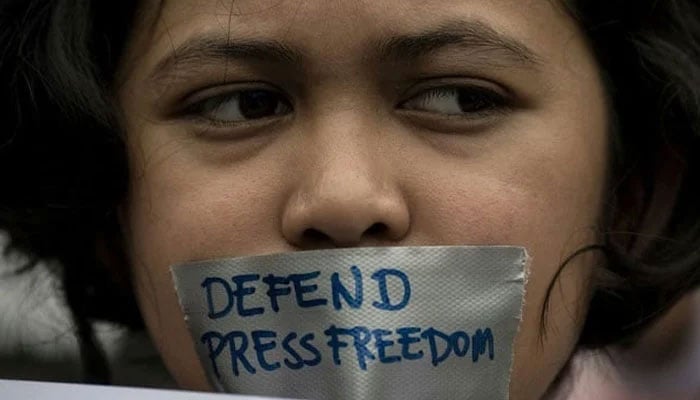
The Pakistani government does not bother even paying lip service to the article of the country’s Constitution where the freedom of press is enshrined.
Hameed Haroon, former president of the All Pakistan Newspapers Society (APNS) and former chief executive officer of Dawn, made this candid remark as he spoke with journalist Mazhar Abbas at a talk hosted by the APNS at a hotel on Wednesday afternoon.
The event was the second under the series, APNS Talks. It was told that the first event of the series was held in Lahore where Mujibur Rehman Shami shared his experiences as a journalist. Haroon was introduced by APNS President Senator Sarmad Ali, who said he had known him since 1982 when he was hired by Haroon for the Star, which was an evening English newspaper of the Dawn group.
Senator Ali called Haroon one of his mentors and fondly remembered the days when the two worked together in the APNS with Haroon being the president and him being the secretary. A short documentary was also screened on the occasion on the life and works of Haroon. It surprised many in the audience when it was told in the documentary that Haroon also worked as a reporter in his early career and one of his famous stories was about the guerrilla war in Balochistan during the era of Zulfikar Ali Bhutto that was published by The Guardian.
The documentary also touched upon Haroon’s fascination with culture and arts and his services in preserving and documenting various art forms of the country. As he started the conversation, Mazhar said he was often amazed at Haroon’s versatility in the field of journalism and could not grasp how he excelled at being a journalist, publisher and the CEO of an organisation simultaneously.
Remembering his days at the Star, Mazhar said once the late Idrees Bakhtiar filed a story against a builder that was to be published as the lead story of the front page; however, for the very same issue, that builder had paid for an advertisement on the back page. The moderator said that when the dilemma reached Haroon, he asked the editor whether the story was accurate and good. Upon receiving a reply in the positive, Haroon decided to drop the advertisement and the builder was refunded.
Being from a family that owned Dawn, Haroon said he was acquainted by the daily when he was as young as four or five years old. He said his father would often drive him to the old Dawn office on Napier Road to check whether the paper had been published. He said he had developed a fascination with the print media since then.
He then discussed his early career as a reporter for the Star, how he was commissioned a story by The Guardian about the insurrection in Balochistan, which eventually led him to leave the country for some time and pursue higher education. He then shed light on his involvement in the managerial affairs at Dawn and how once the legendary editor Ahmed Ali Khan told him it had not been appropriate for him to call the editor to his office.
To this, Mazhar asked how over the years the Dawn group had kept the sanctity of the institution of editor intact. Haroon replied the paper was founded by the Quaid-i-Azam and Liaquat Ali Khan had served as its general manager. He added that his family had made it a point never to interfere in the editorial functions and hence the editor was totally responsible for whatever was published in the paper.
Haroon said this editorial independence in Dawn benefitted the group during negotiations with the government as it gave a moral high ground to the Dawn management.
An interesting answer came when the moderator asked Haroon which era in the history of Pakistan was most difficult for the press. “Martial law periods were morally the best periods,” was the reply. Haroon said dealing with censorships and succumbing to pressures during the democratic governments caused dissonance.
Connecting his point with the current period, he said Dawn had been facing immense financial pressures currently and private advertisers were being told not to issue advertisements to Dawn. He said that when the ruling political parties were questioned about Dawn’s plight, they said they were not responsible for it as the pressure was being exerted by the “other side”.
He said the policies during the eras of Bhutto and Ziaul Haq were not press-friendly, but even they would operate behind masks and things were not so brazenly done as they were being done today. He said it was the law of a jungle for the media right now and Dawn was “surviving on a shoestring”.
Mazhar also asked Haroon about pressures he faced during “the MQM era”. Haroon said it was the most violent era for journalism as even hawkers were attacked. He also recounted the infamous attack on Zafar Abbas, who is currently the editor of Dawn, by the MQM.
Interestingly, he said, he had to leave his journalistic ethics after the attack on Zafar as the editor of the Star at that time was affiliated with the MQM who covered the incident with a bias as the story published in the Star appeared apologetic in favour of the MQM. To undo this, Haroon said he intervened and took a decision that deprived the editor of some editorial independence.
To a question about Razia Bhatti’s departure from Herald, Haroon said it was he who sacked her due to some differences. He said some Herald employees were in contact with a rival organisation, and he believed Bhatti had some involvement in that. Moreover, during that time something was published in Herald that was factually contradicted, and this all led to departure of Bhatti and some of her friends from Herald who then launched Newsline.
Regarding the role of the APNS, Haroon said it was once a powerful body that could effectively resist powers bent on curbing the freedom of press, but now the APNS did not have a clout on a par with government. He called for amendments to the APNS constitution to make it more effective.
He also recalled how the APNS fought for the Jang group when it was attacked by the government and its institutions.
At the end, some members from the audience asked questions about Haroon’s interest in music, antiques and other art forms. When asked whether his passion for journalism was stronger than his passion for arts, he said he had retired from journalism and media industry, but he was still immersed in music and arts. He said he became happy whenever he listened to Ahir Bhairav or Nat Bhairav after waking up in the morning. He also recalled being in the company of Ali Imam that helped him understand and appreciate paintings.
To a question about his relations with Benazir Bhutto, Haroon said she was his schoolmate and they were always close friends. He said some people misinterpreted their friendship as a romantic relationship but that was not the case.
He recalled once Benazir gave him a sound advice. She told Haroon to always keep this in mind that he was a kingmaker, not a king, and there was a fine line between the two that must not be crossed.