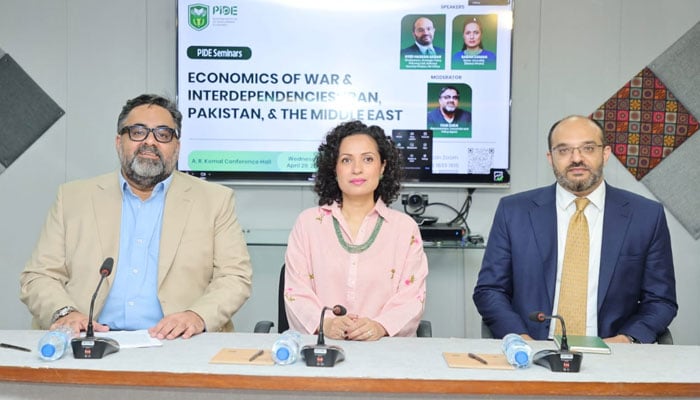
Islamabad: National Security Division’s Strategic Policy Planning Cell Chairperson Syed Hassan Akbar has said that as global inter-dependencies increased, both military and economic tools are used in tandem to pursue strategic and political objectives, a shift that greatly influenced Pakistan’s national security framework reflected in the country’s first comprehensive National Security Policy released in 2022.
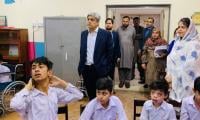
Hassan was addressing a seminar on “Economics of war & interdependencies: Iran, Pakistan & the Middle East” hosted here by Pakistan Institute of Development Economics (PIDE) at its campus situated in the premises of Quaid-i-Azam University.
He cited US-China strategic competition, the Huawei and TikTok cases and sweeping tariff wars as examples of geo-economics being deployed as strategic coercion.
He projected at least a decade or two of global turbulence before any new equilibrium sets in. For Pakistan, he argued, this transition presents an opportunity: the ability to navigate great-power competition through strategic flexibility and a deliberate policy of “no camp politics” -- maintaining deep ties with China while preserving a productive relationship with the United States.
Hassan outlined several near-term gains: the arrival of the first US LNG cargo diversifying Pakistan’s energy supply; growing US interest in Pakistan’s critical minerals sector; Washington’s support for Pakistan’s latest IMF programme; new land transit revenues from routes opened with Iran and the potential revival of the stalled $18 billion Iran-Pakistan gas pipeline should Iran sanctions be lifted, which could open transformative trade and energy corridors through Iran and Turkey into Central Asia and Europe.
Journalist Sarah Zaman highlighted the role of social media in democratising information noting that troop movements and military logistics are now traceable through open-source platforms and pointed out the challenges this poses for governments and news outlets trying to ensure the credibility and accuracy of their reporting. The Iran internet blockade, now in its second month, was cited as evidence of how seriously states are treating the social media battle space.
She observed that Pakistan historically positioned itself as a “glorified highway rather than a factory,” questioning how transit-route diplomacy can translate into productive economic capacity without investment in manufacturing, labour force development and population management. She cautioned that “flattery and hope are not strategy” and that sustaining Washington’s goodwill beyond the current administration would require deep structural reforms.