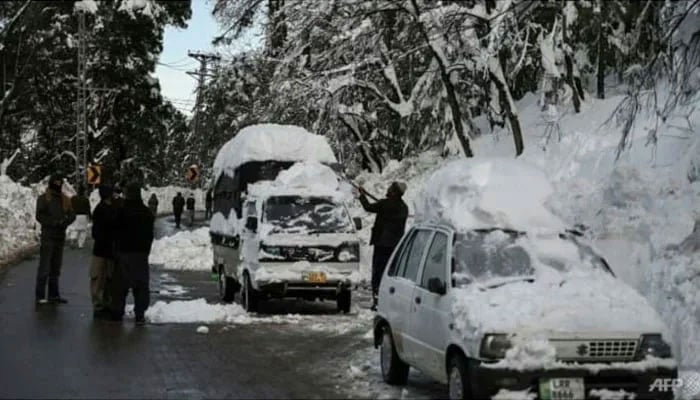
In January 2022, twenty-three tourists died after being trapped in their cars during a snowstorm that overwhelmed an underprepared administration in Murree. The tragedy called for a clear response: proper emergency protocols, road-clearing machinery in place before peak season and enforceable entry controls during extreme weather.
What followed was something else entirely. Within days, then Punjab CM Usman Buzdar announced that Murree would be upgraded from a tehsil to a full district. By October 2022, the notification was issued. By February 2023, a caretaker government reversed it. The Lahore High Court struck down that reversal. A second deputy commissioner was posted in September 2023. As of late 2024, Murree still does not have full administrative, revenue or judicial autonomy as a district.
Three governments. Multiple notifications. One court order. No coherent plan. None of it brought a single stranded motorist back to life. Even the population figures should have raised questions. The entire Murree District has 372,947 people across two tehsils. Yet the government’s blueprint proposed 31 departments and over 3,600 staff. This is a district smaller than many subdivisions in Punjab, handed the administrative machinery of a major city.
The result is predictable: overlapping jurisdictions, blurred accountability and officials who answer upwards to Lahore rather than to the people of Murree. When district status is imposed as a political deliverable, it does not protect residents. It extends state control deeper into their daily lives.
The most serious damage has been to property rights. Under the Land Acquisition Act of 1894, a Section 4 notification allows the government to enter, survey and begin acquisition of private land for a stated public purpose. The sequence is familiar and brutal. Section 4 freezes development. Section 6 formalises the acquisition. By the time compensation is calculated, owners have already lost control of their land, property and shops for months or years, often at values far below market rates.
At the Grand Jirga held in December 2024, Murree’s Joint Action Committee of traders and residents demanded the abolition of what they called ‘Section 4 on Mall Road’. This legal complaint reflects what happens when a newly empowered district administration, under pressure to justify itself, begins targeting commercially valuable land without meaningful consultation or a clearly defined public purpose.
The Murree Development Plan, approved in June 2024, made the direction unmistakable. Authority for building approvals across Murree was shifted from local offices to the provincial government. A shopkeeper in Jhika Gali, whose family has run a business for generations, now needs approval from Lahore just to repair his premises. High-rise hotels obstructing views of Mall Road were marked for removal. The historic bazaars of Jhika Gali, which have supported 13 surrounding villages for two centuries, were included in remodelling plans. At the same time, well-connected outsiders continued to build freely.
Shahid Khaqan Abbasi put it bluntly at the protest. Locals are blocked from building in their own areas, while outsiders face no such barriers. There is little in the record to contradict that assessment. This raises a basic question the government has not answered. Who is this plan actually for?
Consider the pieces together: a proposed glass train, the removal of existing commercial structures, the Section 4 acquisition of prime land along Mall Road and centralised approval powers. Each step can be framed as development on its own. Taken together, they suggest a town being cleared and repackaged. There has been persistent talk in Islamabad’s business and diplomatic circles about foreign interest in high-end tourism projects in Murree. The government owes a direct answer: is land being acquired and livelihoods dismantled to prepare for private foreign investment? If the answer is no, it should be stated clearly on the record. If the answer is yes, then the people losing their homes and businesses deserve to know who benefits from their displacement.
Then came Jhika Gali. The remodelling project at Jhika Gali Chowk triggered a landslide. Homes in Kausar Colony were pushed to the edge of collapse. Deep cracks appeared in the surrounding ground. Residents had warned officials beforehand that the valley-facing side of the chowk sat on weak terrain and that widening the road in that direction was dangerous. Those warnings were ignored. A previous parking plaza project on the opposite side had already caused serious subsidence during construction. That lesson was not applied either. Now Rescue 1122 teams are on site, families have been evacuated, and a two-hundred-year-old market that supported 13 villages has been severely damaged.
What the administration has not explained is why no proper geotechnical assessment was carried out before construction began in a known fragile zone of the Himalayan foothills. The most likely answer is uncomfortable. The misuse of Section 144 completes the picture. This legal provision exists for genuine emergencies. In Murree, it has become routine. When thousands of traders, residents, and political leaders gathered at Lower Topa in December 2024 to protest the development plan, the administration imposed Section 144 to prevent any ‘untoward situation’. The crowd came anyway, blocking roads for hours. The provision was then used again for Independence Day 2025, and again for New Year. The legal threshold is immediate danger to life or property. In practice, Murree’s administration has reduced that threshold to mean a busy weekend.
None of this has addressed the underlying issues. Murree’s tourism economy has long been shaped by an informal alliance between sections of the administration and a commercial class of hoteliers, transporters and landowners. Tourists have been overcharged and exploited for years with little consequence and the district status has not disrupted this system but rather expanded it.
More offices mean more appointments through connections, more signatures required for routine work, and more points where rent-seeking can occur. The people of Murree were not demanding district status. They were asking for basic services: clean water, reliable gas supply, proper parking infrastructure and protection from tourist flows that overwhelm their roads every season.
What they received instead was a notification, a development plan that threatens historic markets, repeated use of Section 144 to suppress protest, demolition activity targeting long-standing homes and a project that has physically destabilised the ground at Jhika Gali.
A town is being slowly emptied – and the process is carried out through law, public funds and state machinery.
The writer tweets/posts @FarrukhJAbbasi