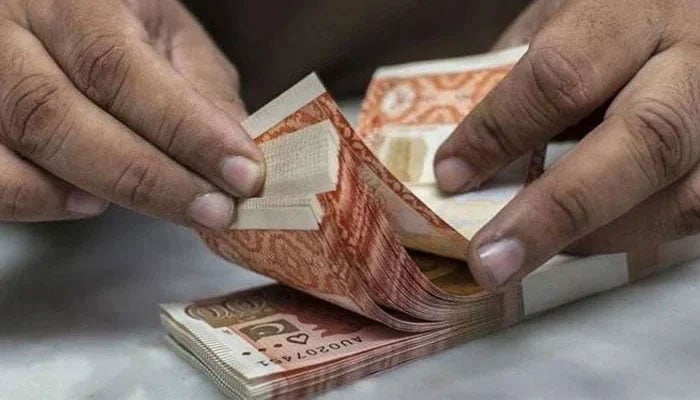
ISLAMABAD: Following the finance ministry’s confirmation that the public entities had parked Rs1 trillion into the commercial banks’ accounts instead of depositing the money in the Treasury Single Accounts (TSA), the government has assured the IMF of bringing 70 new accounts of public entities with an average balance of Rs290 billion under the TSA.
This indicates that the IMF is keeping an eye on the amounts parked outside the ambit of the TSA and is pressing the authorities to abandon this old practice of keeping the money outside the government’s loop.
Top official sources confirmed to The News on Friday that Pakistan had committed to the IMF to continue working on consolidating the cash holdings of government institutions.
In a recent parliamentary panel proceedings, Senator Anusha Rahman from the ruling PMLN had raised the issue of not defining the state owned entities (SOEs) in the Public Finance Management Act 2019.
When the Ministry of Finance high-ups were grilled by the senators, the additional secretary, budget conceded that the public entities had parked Rs1 trillion into the accounts of commercial banks instead of depositing the money in the TSA.
On the other hand, the Ministry of Finance has shared with the IMF in writing that Pakistan would move towards consolidation of improved fiscal management. In order to achieve consistency, the government will not conduct sectorization study but will adopt legal criteria to identify entities that should comply with the TSA rules. There are 70 new accounts of public entities having an average balance of Rs290 billion that will be brought under the TSA, which already includes 242 accounts with Rs200 billion in balances.
Parliamentarians are furious over the non-implementation of the PFM Act enacted in 2019, and referred to its Section 40C stating that the revenue collection officer shall deposit the collected amount in the Federal Consolidated Fund (FCF) promptly without delay in the prescribed manner under the head of account specified by the Finance Division in consultation with the Accountant General of Accounts.
On the rising debt and its management, the sources said the government will address the increased debt trap risk stemming from elevated gross financing needs and significant sovereign bank nexus.
The government will implement the debt strategy for 2026-28, converting the domestic debt portfolio towards long-term maturity.
“The government will continue to implement a plan to gradually retire domestic debt held by the SBP. It is also making progress in strengthening the institutional arrangements for public debt management,” said the official.
In order to broaden the investors’ base, the government has increased its efforts to enhance investor relations by actively informing current and potential investors about its debt management strategy.
The government, according to the sources, is evaluating potential instruments that cater to investor preferences while carefully considering associated costs and risks.
The government will refrain from issuing any instrument that could expose the government’s debt portfolio to excessive risks. The government is going to finalize plans to reform the retail debt program and is actively exploring digital channels to distribute debt securities more efficiently.
The government will remain committed to conducting a comprehensive study by the end of September 2026 as a new structural benchmark in line with guidance from international institutions to assess the key pillars of the government securities market and to develop a strategic action plan aimed at addressing the identified bottlenecks.
$3.45bn repayment to UAE completes: In another development on the financial front, the State Bank of Pakistan (SBP) on Friday said it had repaid $1 billion to the Abu Dhabi Fund for Development (ADFD), completing the return of $3.45 billion in UAE deposits after settling $2.45 billion last week, reports Geo News.
In a post on X, the central bank said the latest payment was made on April 23, marking the full repayment of deposits placed by the UAE.
“This completes the repayment of total deposits of $3.45 billion to UAE,” the SBP said.
Earlier, on April 18, the central bank had confirmed that the government had returned $2 billion in debt to the UAE. An SBP spokesperson had said the amount was kept with the central bank as a safe deposit.
The repayments come as Pakistan manages pressure on its external financing position, with the financing gap likely to expand after the return of the UAE deposits, along with a 6% interest payment.
Pakistan has also recently repaid $1.43 billion in external debt, including a $1.3 billion Eurobond.
The development follows an agreement with Saudi Arabia to extend the maturity of a $3 billion deposit placed with the SBP.
The central bank had also said earlier this month that it received $2 billion from the kingdom with a value date of April 15, 2026.
Finance Minister Muhammad Aurangzeb had said earlier that Pakistan was considering Eurobonds, loans from other countries and commercial debt to replace the UAE loan facility and manage foreign reserves.
“All options are on the table,’ Aurangzeb said when asked whether the government was in talks with Saudi Arabia for a loan that could replace the UAE facility.
Speaking on the sidelines of the IMF and World Bank spring meetings, he said Pakistan could manage all debt repayments and that reserves remained at around 2.8 months of import cover.
Maintaining at least that level, the finance czar said, would be “an important aspect of our overall macro stability as we go forward”.
“We are looking at Eurobond, we are looking at Islamic Sukuk; we are looking at dollar-settled rupee-linked bonds,” Aurangzeb said, adding that Pakistan expected to issue Eurobonds this year and was also exploring commercial loans.
He also said the shock from the ongoing Middle East war meant Pakistan must consider a strategic petroleum reserve and a faster switch to renewable energy.
Aurangzeb said Pakistan had not yet requested any additions or changes to its $7 billion IMF lending programme due to the economic shocks of the war in the Middle East, but added that it remained a possible option depending on developments in the coming weeks.
The IMF board is likely to approve the latest lending tranche next month, which would unlock just under $1.3 billion through the Extended Fund Facility and the Resilience and Sustainability Facility.
Emergency LNG for Pakistan: In another development on the energy front, Pakistan on Friday secured an emergency LNG cargo at $18.40 per million British thermal units, while deliberately passing on May deliveries in a calculated bet that the escalating US-Iran tensions will ease and drive prices lower, Israr Khan adds.
Pakistan LNG Limited (PLL) awarded the single spot cargo to TotalEnergies Gas & Power Limited for delivery on April 27–30, a petroleum ministry official said.
The purchase marks the country’s first LNG acquisition since Iran effectively halted shipping through the Strait of Hormuz on Feb. 28, cutting off a corridor that carries roughly 20 percent of global oil and LNG supplies.
The urgency was stark, as Pakistan has received no LNG cargoes loaded since the Middle East conflict began, and the April shipment was deemed critical for power generation.
In an unusual development, TotalEnergies voluntarily reduced its bid after markets softened late Friday, dropping from an initial $18.88/mmbtu to $18.40 after 6 pm, when the international gas prices had eased.
PLL received four bids, with three companies qualifying technically under Pakistan’s public procurement rules. Vitol Bahrain bid $18.54/mmbtu for a May 1–7 delivery, while OQ Trading posted the lowest offer at $17.997/mmbtu for May 8–14. PLL declined both May contracts, hoping that a resolution to the U.S.-Iran standoff would soften prices further before those deliveries are needed, official said.
The Strait of Hormuz, connecting the Persian Gulf to the Indian Ocean, is the world’s most critical energy chokepoint. Recent confrontations between Washington and Tehran have amplified risks to global energy security and price stability.
Pakistan, competing against larger Asian buyers for limited spot cargoes in an increasingly volatile market, remains acutely exposed to further supply shocks. The government is weighing additional spot LNG imports to cover near-term energy requirements, with final procurement decisions resting with the PLL board, he said.