The Indian Ocean is fast emerging as the decisive arena where the future of warfare will be shaped, Chief of the Naval Staff Admiral Naveed Ashraf warned, cautioning that any disruption in this vital maritime region—through which a significant share of global trade flows—could trigger far-reaching consequences for international supply chains, energy markets and interconnected economies worldwide.
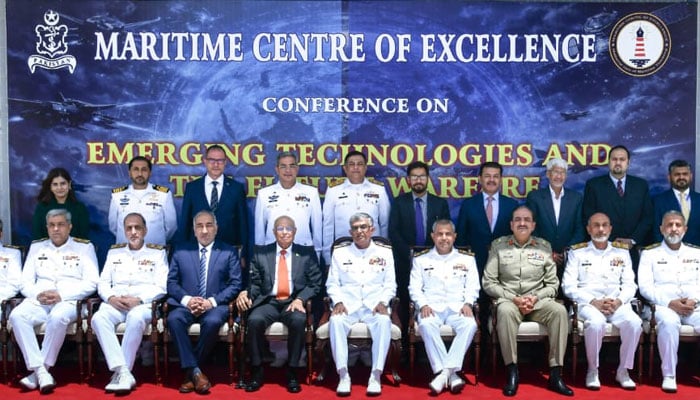
He was addressing a two-day international conference on “Emerging Technologies and the Future of Warfare,” hosted by the Maritime Centre of Excellence of the Pakistan Navy War College that concluded here the other day.
The naval chief reminded the audience that the Indian Ocean remains the planet’s most vital artery. The naval chief warned that the region is rapidly emerging as a central arena where the future of warfare is being shaped. He noted that, given its vital role in global trade flows, any disruption in the Indian Ocean could have far-reaching consequences for international supply chains, energy markets and interconnected economies.
Admiral Naveed Ashraf, also highlighted the critical need for a trinity of collaboration: a seamless synergy between the industry, the end-users (the military), and academia. He asserted that this triangle is the only engine powerful enough to drive genuine innovation, adaptability, and operational relevance. Admiral Naveed Ashraf emphasised that such partnerships are essential to promoting indigenisation and self-reliance, enabling Pakistan to build a cost-effective and globally competitive defence ecosystem with significant export potential.
Held against the backdrop of a rapidly shifting global order, the conference brought together a powerful cross-section of maritime experts, defence industry leaders, policymakers, academia, and university students. The singular objective was to decipher how cutting-edge technology is rewriting the ancient rules of naval conflict.
While highlighting innovative trends in naval warfare, speakers traced the evolution of naval power from decisive fleet battles in the Age of Sail and Steam, to maritime dominance in the unipolar era. For decades, sea power was defined by large capital ships like aircraft carriers and submarines. Now that dominance is eroding, naval warfare is increasingly shaped by a mix of geopolitics, geoeconomics, and technology and doctrine.
This shift is powered by disruptive technologies: unmanned and autonomous systems, artificial intelligence, space-based surveillance and communications, cyber and electronic warfare, hypersonic missiles, directed energy weapons, and quantum technologies.
Naval warfare is moving from network-centric to algorithm-centric. Victory now belongs to those who decide faster, fuse data better, and harness AI for superior judgment. Cyber operations increasingly shape the battlefield before any shots are fired.
The speakers also underscored how these technological shifts are enabling smaller and less resourced navies to challenge more powerful forces. Recent conflicts like Russo-Ukrainian War, have shown the use of unmanned systems and precision strikes by Ukraine to contest Russian naval presence in the Black Sea. Similarly, Azerbaijan’s use of advanced drone warfare in the Nagorno-Karabakh conflict demonstrated how technology can offset traditional military disadvantages. Tensions between Iran and the United States in the Gulf further show how asymmetric tactics and emerging technologies can be used to challenge a conventionally superior naval power. They have narrowed capability gaps and made maritime competition more contested and complex.
The conference concluded with a reaffirmation of the need for sustained intellectual synergy and institutional collaboration to effectively navigate technology-driven transformations and harness emerging trends in future warfare.