Islamabad: The centuries-old art of sculpture in Pakistan, particularly in the historic city of Taxila, is fast declining, with practitioners warning that without timely government intervention, the craft may soon disappear.
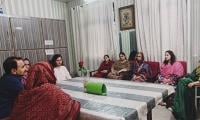
This concern was highlighted during a visit by Managing Director of the Pakistan Land Port Authority (PLPA), Lt Gen (r) Hassan Azhar Hayat, to the workshop of master sculptor Ilyas Khan near the Taxila Museum in Dhibian on Sunday. He was accompanied by representatives of the Ghandhara Resource Centre Pakistan, including Sara Mahmood and Riaz Ahmed.
Recounting his visit, the PLPA chief said he entered a modest open compound where large blocks of black schist stone lay scattered, and found artisans engrossed in carving. Among them was Ilyas Khan, a seasoned sculptor in his mid-50s, chiselling a Buddha figure while seated on a traditional stool.
Despite the simplicity of the setting, the quality of craftsmanship stood out. “The work on display was remarkable—an extraordinary expression of art produced in the most unassuming surroundings,” he observed, adding that artists often possess a rare blend of candour and pride in their craft, with little concern for material gain.
Speaking to ‘The News’, Ilyas Khan lamented the lack of meaningful support. “Many people visit, appreciate the work, but few take any concrete steps to sustain this art,” he said. He added that although initiatives such as an art village exist, he was unable to continue there due to personal constraints.
Tracing his roots, Khan said his father migrated from Manki Sharif in Nowshera to work at Heavy Industries Taxila, where he himself was raised. His interest in sculpture began at the age of seven, observing roadside artisans, and by 1982 he had adopted it as a profession.
Today, only 10 to 12 master sculptors remain in Taxila, with around 25 practitioners in total. While local youth show natural aptitude for the craft, economic uncertainty discourages them from pursuing it professionally. “Even girls here are learning the skills, but there is no financial incentive to continue,” he noted.
Khan also pointed to legal and market challenges. He said provisions of the Antiquities Act 1972 restrict artisans, while middlemen dominate the trade, often selling pieces at high prices abroad. Some, he alleged, are involved in the illicit trade of genuine artefacts alongside replicas.
His work, he said, finds buyers in Europe -- including Italy, France and Germany -- as well as Southeast Asia, where sculpture remains widely appreciated. The raw material used, primarily schist stone sourced from Malakand, is both costly and increasingly scarce. Large blocks can cost hundreds of thousands of rupees, adding to the financial strain on artisans.
When asked about solutions, Khan stressed the need for government-backed stipends for trainees and policy reforms to encourage the craft. “With passion, a learner can produce a basic sculpture within a month, but they need support to sustain themselves during that period,” he said.
However, even within his own family, the future of the craft appears uncertain. His sons have opted for careers outside the field, citing limited financial prospects.
Lt Gen (r) Hayat underscored the urgency of intervention, suggesting that targeted policies, incentives and institutional support—particularly at the provincial level -- could revive the sector. He expressed hope that the Punjab government could play a decisive role in preserving the heritage and transforming it into a viable industry, potentially with private sector participation.
During his visit, he also noted the deteriorating condition of the Nicholson Monument on the Grand Trunk Road, calling attention to the broader neglect of cultural heritage sites in the region.