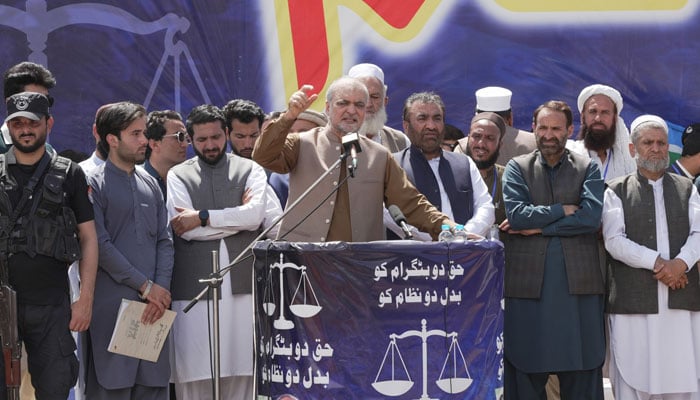
BATTAGRAM: Jamaat-e-Islami (JI) chief Hafiz Naeem-ur-Rehman on Tuesday urged the people to rise against what he termed an outdated system and fight for their rights.
Addressing a gathering here, he claimed that around 44 percent of the country’s population was living below the poverty line and over 2.3 million cases remained pending in courts. He also questioned the transparency in judicial appointments.
He added that both the justice and education systems were on the decline, while retired employees were struggling to receive their pensions. Hafiz Naeem said that JI was fighting for the rights of the entire nation, which was why the public continued to support the party.
Focusing on local challenges, he described the condition of Battagram as deeply concerning. He stated that nearly 75,000 children were out of school in Battagram. He also criticized the dominance of feudal lords and influential elites in the area, saying that dynastic politics and vested interests deprived citizens of their basic rights.
He alleged that powerful groups were suppressing public rights, adding that people were being given minimal facilities in the name of charity while being denied their fundamental entitlements.
He pointed out the lack of hospitals and basic infrastructure in the district, prolonged electricity outages of up to 18 hours in areas where power was available, and the complete absence of gas supply in many areas.
Highlighting national concerns, Hafiz Naeem said that access to justice had become increasingly difficult for the poor, while middle-class citizens were financially devastated pursuing court cases.
He also made a commitment to the youth of Battagram, promising that every young boy and girl in the district would receive free IT education through the Bano Qabil Centre in Battagram, ensuring that no youth was left without digital skills.
Khyber Pakhtunkhwa was facing a severe shortage of basic amenities, including education, healthcare, and road infrastructure, he added. Highlighting the situation in Battagram, he termed it “shameful” that there was not even a single degree college in the district and no lady doctor available across the tehsil. He demanded answers from the provincial government and said the time had come to change the system.
He announced that JI would challenge the existing system and traditional political leadership, urging party workers to prepare for a movement.
He said that despite having the capacity to produce 49,000 megawatts of electricity, people were forced to endure up to 16 hours of power outages daily. He criticized the payments made to Independent Power Producers (IPPs) in the form of capacity charges, saying billions of rupees were being paid while the poor were burdened with heavy taxes, including Rs150 per litre on petrol.
The interest-based economic system was the root cause of the country’s economic decline, he said, claiming that around 45 percent of the national budget was consumed by interest payments.
As a result, he said, rulers were forced to beg for billions of dollars in loans. He stressed that systemic change was inevitable and could only be achieved by moving away from traditional political families.
On international issues, Hafiz Naeem condemned Israeli atrocities in Palestine and described the United States as a declining power. He appreciated Pakistan’s recent efforts for regional peace but warned that relying on American support would be a mistake.