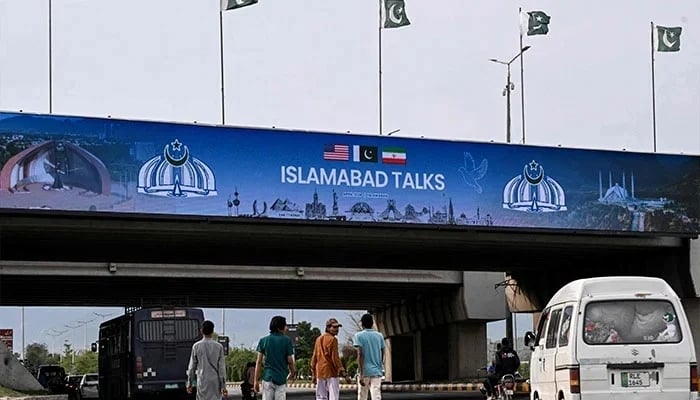
The conflict between Iran and the US has entered a deadlock, with neither side willing to budge on core demands. While Pakistan continues to play a constructive role in bridging gaps between the two, an effort that has earned its political and military leadership international recognition, both principal actors remain engaged in calculated brinkmanship to achieve their respective objectives (intentionally leaving out Israel to retain focus on the main belligerents).
Much has already been written about the origins of this conflict, the current positions of both sides and the sticking points involved. This article, therefore, will not revisit those aspects. Instead, it focuses on a critical dimension of any high stake dispute: ‘psychological warfare’ and ‘brinkmanship’, drawing upon historical examples to better understand the dynamics at play today.
The term ‘brinkmanship’ was coined in the 1950s to describe cold war nuclear strategy. It relies on the threat of escalation, creating uncertainty and pressure on the opposing side to force a retreat. For brinkmanship to succeed, the threat must be credible and there must be a perceived willingness to follow through. It typically involves a calculated mix of coercion and negotiation – including the threat of walking away from talks – to gain advantage without engaging in direct conflict. At its core lies a test of resolve: who blinks first.
However, brinkmanship is inherently risky. It can lead to a complete breakdown of dialogue and the loss of diplomatic opportunities. For this reason, it is rarely the first choice of states and is generally adopted only when conventional diplomacy fails to yield results.
This strategy was frequently employed during the cold war, notably in the Korean War (1950–53) and the Berlin Crisis (1961). It’s most dramatic manifestation, however, was the Cuban Missile Crisis of 1962, when the US and USSR brought the world to the brink of nuclear catastrophe – often described as ‘13 days to doomsday’. The Soviet Union had deployed nuclear missiles in Cuba, just 90 miles from Florida, aiming to intimidate the US and secure strategic leverage. President Kennedy responded with a naval blockade and the threat of massive retaliation, effectively countering brinkmanship with brinkmanship.
What ultimately defused the crisis was not public posturing but quiet, behind-the-scenes diplomacy. In contrast to today’s environment of instant communication and public signaling, discreet negotiations enabled both sides to step back without losing face. The Soviets withdrew their missiles from Cuba, while the US, in a strategic compromise, agreed to remove its missiles from Turkey and pledged not to invade Cuba. The episode demonstrated that restraint and dialogue could outperform bluster. It also underscored the delicate balance between confrontation and diplomacy – a lesson that continues to shape international relations.
The Russian invasion of Ukraine offers another example, albeit of failed brinkmanship. The West and Ukraine tested Russia’s resolve by rejecting Moscow’s demand to halt Nato’s eastward expansion, coupled with Ukraine’s clear aspirations for closer alignment with Nato. Russia, perceiving this as a direct challenge, responded decisively with military force and as they say, rest is history. In this case, brinkmanship did not compel retreat; it triggered escalation, thus, clearly indicating that once red lines are crossed, brinkmanship fails.
Closer to home, the Kargil War of 1999, set against the backdrop of nuclear overhang, can also be seen through the lens of brinkmanship. Pakistan initially sought to alter the status quo in Indian-held Kashmir to internationalise the dispute and pressure India towards a resolution. India responded with the threat of overwhelming military retaliation, mobiliaing forces in a manner that raised global alarm. This escalation prompted US intervention, illustrating how brinkmanship can quickly draw in external actors.
In contrast, the 2025 Pakistan-India conflict demonstrated a more calibrated approach. While Pakistan achieved both strategic and operational success, there was no overt brinkmanship in its classical sense. India confined its actions to what it described as terrorist infrastructure rather than striking core military targets, thereby avoiding a full-scale escalation.
Pakistan responded in self-defence, downing seven Indian aircraft in the initial phase. Thereafter, it exercised restraint, refraining from further escalation despite having additional targets within reach. This reflected controlled signaling of resolve and deterrence – firm yet measured – which was clearly understood by the other side.
At present, the US and Iran are engaged in a high-stakes standoff, each expecting the other to yield. With leverage over the Strait of Hormuz – a vital artery for global oil supply – and cognizant of the broader economic implications of a prolonged conflict, Iran appears determined to hold its ground. This continuing volatility coupled with political stakes for President Trump in the upcoming elections, has evolved more into a political survival than geopolitical strategy. And while Iran has defended itself strategically well, it also is in a catch-22 situation, knowing that it could also risk economic collapse in case the war prolongs. What begins as a calculated defiance can quickly become a burden if escalation triggers forces beyond one’s control.
Compounding the challenge is the ongoing war of words between both sides, which is proving counterproductive. Public threats, including rhetoric about ‘obliterating’ adversaries or imposing severe consequences, leave little room for diplomatic maneuver once positions harden in the public domain. Assertions that Iran has already conceded to most US demands further narrow the space for compromise, as they risk undermining Iranian leadership domestically. Predictably, this has contributed to a hardening of Iran’s stance because leaders bound by public positioning reinforce rigidity at the negotiating table.
Another significant obstacle is the deep-rooted lack of trust and antagonism. Iran remains wary of US intentions and may view any proposed agreement as a temporary political arrangement. Consequently, Tehran is likely to insist on the lifting of sanctions as well as blockade and a political arrangement for foolproof long term guarantees. The US, on the other hand, may demand that Iran first reopen the Strait of Hormuz and address concerns regarding its enriched uranium stockpile. This sequencing dilemma places the burden of initiating concessions – arguably more on Washington – if progress is to be made.
Once a breakthrough is achieved, other broader regional challenges, from Lebanon to Israel and gulf security will follow. These will be easier to attain once the primary impasse is resolved.
The Cuban Missile Crisis remains a powerful reminder that, while brinkmanship can push adversaries to the edge of catastrophe, it can also create space for backchannel diplomacy to prevail. It is here that Pakistan’s role as a neutral mediator can prove most beneficial to both parties.
Ultimately, the current impasse will test the judgment, prudence and statesmanship of both leaderships. Patience, perseverance, and a genuine commitment to reaching and honoring an agreement are essential. Without these, the conflict risks imposing heavy costs not only on Iran and the broader Middle East but also on the global economy.
The writer is a former rector of NUST. He can be reached at: [email protected]