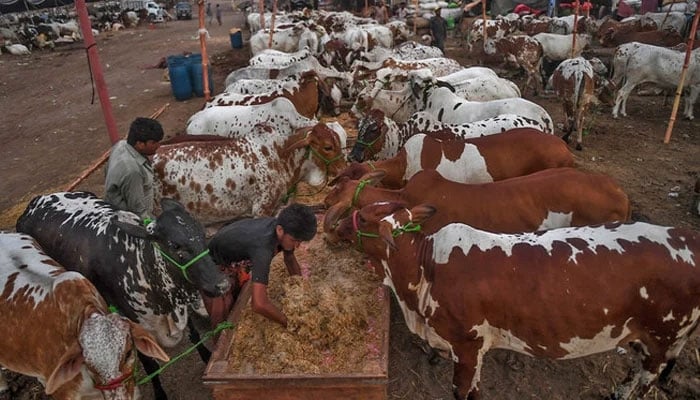
Qurbani is not merely an act of worship; it is a profound expression of sacrifice, love and obedience to the Almighty. In the same spirit, the enthusiasm of Karachi’s people continues to grow with each passing year.
The cattle mandi has evolved beyond being just a marketplace for buying and selling sacrificial animals; it has become a vibrant social and cultural festival, symbolising joy, tradition and a shared sense of collective excitement for the residents.
The renowned cattle market at Karachi’s Northern Bypass has entered its fourth consecutive year of successful operations, reflecting a clear shift in public confidence and changing urban leisure trends in the city.
Earlier, when the cattle mandi had been shifted from the Super Highway to the more remote Northern Bypass area, many had raised concerns that its distance from the city and relatively less populated surroundings would discourage visitors and traders.
Questions had also been raised about law and order, with fears of robberies and other street crime in such an isolated location. However, those early apprehensions have proven unfounded.
In previous years, livestock used to reach the market only a few days or weeks before Eidul Azha. However, this year traders from across the country began bringing animals more than seven weeks in advance.
Moreover, visitor turnout continues to grow steadily, with weekends witnessing particularly heavy rush as Karachi’s residents make these visits part of their social and recreational routine. Interestingly, this growing trend reflects a broader shift in the city’s public interest in organised events and recreational spaces.
Alongside traditional gatherings like the cattle mandi, events such as the recently held DALFA exhibition at the Expo Centre also highlight how Karachi’s residents are increasingly engaging in large-scale public activities, exhibitions and entertainment-based experiences. Over time, this evolving culture of outings and events shows a rising enthusiasm among residents for structured public leisure spaces.
People often say that passion has no price, and nowhere is this more visible than in Karachi during Eidul Azha. While the festival is observed by Muslims around the world, the enthusiasm, energy and devotion seen in Karachi is truly unmatched.
Here, passionate individuals spend a significant portion of their annual earnings on fulfilling the Sunnah of Hazrat Ibrahim (AS), turning a modest childhood hobby that once began with a few thousand rupees into a passion that now extends into millions.
For true enthusiasts, no expense is too great when it comes to honouring their love for the tradition. “It has been my childhood passion,” says enthusiast Haris Wakeel. “I can’t raise animals throughout the year, but on Eidul Azha I fully fulfil my passion. It’s not just a hobby but also the Sunnah of Hazrat Ibrahim (AS), which teaches us many valuable lessons.”
The cattle mandi established at the Northern Bypass is not the only livestock market operating in Karachi, as dozens of small and large seasonal mandis are set up across the city every year, alongside hundreds of cattle farms such as the Jamil Memon Society, from where residents purchase a significant number of sacrificial animals.
According to market observers, last year a major portion of traders from Asia’s largest Northern Bypass cattle mandi reportedly took their animals back to their respective cities and villages.
However, their media cell incharge Zaki Abro clarified that this does not reflect failure, as the total inflow still ranges between 400,000 and 500,000 animals every year.
He said that any return of livestock is based on traders’ own business decisions. Many traders take animals back intentionally to further fatten and prepare them for sale in the following season, he added. He also said that due to current regional geopolitical tensions, animals would not be exported to Islamic countries such as Iran and Afghanistan, so they would remain within Pakistan, increasing local supply.
He noted that the mandi was operationalised around a month and 20 days earlier than usual due to strong pressure from traders demanding early arrangements for their livestock. Market administrator Tariq Tanoli said livestock arrivals from key regions, including Moro, Sheikhupura, Sahiwal, Kandhkot and Dera Allah Yar are increasing steadily. A trader from Sanghar, Mohammad Ali, brought 20 high-quality Maari-breed camels, reflecting the growing demand for premium sacrificial animals.
Officials said veterinary teams are conducting strict health checks on all animals, ensuring that only healthy livestock are allowed inside the market. Moreover, with the weekend rush expected to rise further, the market administration has finalised additional arrangements to manage crowds and traffic flow smoothly.
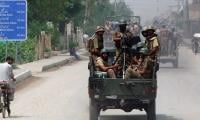
The Northern Bypass cattle market is so large that it does not fall under the jurisdiction of just a single police station. Its security requires the deployment of police from two major zones of the Karachi police.
The joint deployment by the West Zone and the East Zone police is necessary to provide a safe environment for both traders and the visiting public, ensuring smooth movement and protection across the entire cattle market and its surrounding routes.