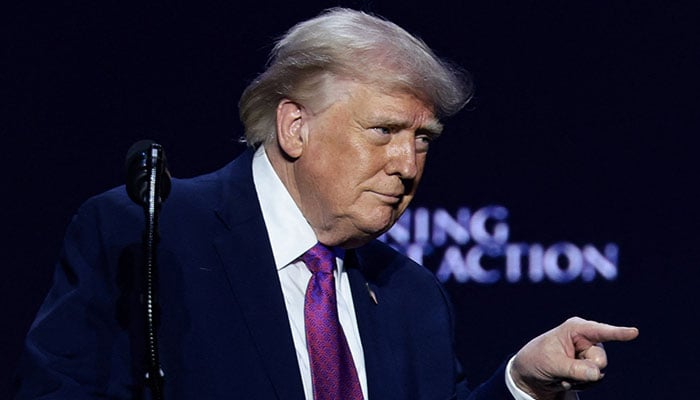
WASHINGTON: US President Donald Trump claimed on Friday that Iran had agreed to suspend its nuclear programme indefinitely and that it would not receive any frozen Iranian funds from the United States, while also insisting that there were “no sticking points” left for a peace deal with Iran, which he said was “very close” as Tehran declared the Strait of Hormuz open to commercial shipping.
In another statement President Trump said that he does not think there are too many significant differences with Iran remaining, adding that talks will continue over the weekend.
In an interview with Bloomberg News, Trump claimed “Iran has agreed to suspend its nuclear program permanently” and said no Iranian assets frozen by Washington would be released. “The deal is mostly complete,” he said.
However, a senior Iranian official indicated that major gaps remain. After Iranian Foreign Minister Abbas Araghchi announced that commercial shipping would be allowed to pass through the Strait of Hormuz for the remainder of the ceasefire period, a senior Iranian official told Reuters that keeping the strategic waterway open was conditional on compliance with the ceasefire between Iran and the United States. The official said significant differences remained between Tehran and Washington, including over nuclear issues, and that serious talks were still needed. Still, the official said a preliminary agreement could be reached in the coming days, with the possibility of extending the ceasefire. Such an agreement, the official said, could create room for talks on sanctions relief and compensation for war damage. “In exchange, Iran will provide assurances to the international community about the peaceful nature of its nuclear programme,” he said, adding that any other “narrative about the ongoing talks is a misrepresentation of the situation”.
Iran’s foreign ministry said the country’s stockpile of enriched uranium would not be transferred “anywhere”, denying Trump’s claim that the Islamic republic had agreed to hand it over. “Iran’s enriched uranium is not going to be transferred anywhere,” Iranian foreign ministry spokesman Esmaeil Baqaei told state TV.
Trump in a brief telephone call with AFP said, “We’re very close. Looks like it’s going to be very good for everybody. And we’re very close to having a deal”. He added there were “no sticking points at all” left with Tehran. “The strait’s going to be open, they already are open. And things are going very well,” he added.
Trump hailed a “GREAT AND BRILLIANT DAY FOR THE WORLD!” in celebratory posts. He denied that any money would be involved in a deal with Iran over its nuclear programme, after an Axios report that Washington was considering a $20 billion cash-for-uranium exchange.
“The U.S.A. will get all Nuclear ‘Dust,’ created by our great B2 Bombers - No money will exchange hands in any way, shape, or form,” Trump said on his Truth Social network.
After the start of the truce in Lebanon, Iran’s Foreign Minister Abbas Araghchi said the Islamic republic would lift its blockade on shipping through the key Gulf energy trade route.
“In line with the ceasefire in Lebanon, the passage for all commercial vessels through Strait of Hormuz is declared completely open for the remaining period of ceasefire,” Araghchi said. Military vessels are still banned from the waterway, a senior Iranian military official told state media.
Trump however warned that the US blockade of Iran’s ports would continue until a deal was struck.
The ceasefire and the reopening of the strait represent a key step in Washington’s efforts to reach a deal to end its war with Iran, after Tehran insisted that halting the Lebanon fighting must be part of any agreement.
In Lebanon, displaced families packed their belongings onto the roofs of their cars and thronged the roads, taking the chance of a 10-day truce to return to homes in bomb-damaged south Beirut or the war-torn south of the country.
Trump declared that Israel had been “prohibited” by Washington from carrying out further strikes.
“Enough is enough!” he said, adding that the United States would itself work with Lebanon “and deal with the Hezbollah situation in an appropriate manner”. The Israeli military did not immediately comment on the report.
The fighting broke out in Lebanon on March 2 when Hezbollah fired rockets at Israel a few days after the start of the Middle East war in retribution for the killing of Iran’s supreme leader Ali Khamenei.
Separately, the Israeli military said it was lifting wartime restrictions, although Minutes before the ceasefire came into effect at midnight, a series of Israeli strikes in the southern Lebanese city of Tyre killed at least 13 people, a city official said.
Israeli Defense Minister Israel Katz said military action could resume if the area between this security zone and the Litani River was not “cleared of terrorists and weapons”.
According to details of the truce deal released by the US State Department, Lebanon “will take meaningful steps to prevent Hezbollah” from undertaking hostile acts against Israeli targets.
Lebanon’s President Joseph Aoun said now that a truce was in place, direct negotiations with Israel were “crucial”.
Beirut’s goal, he said in a statement, was to “consolidate a ceasefire, secure the withdrawal of Israeli forces from the occupied southern territories, recover prisoners and address outstanding border disputes”.
Hezbollah, meanwhile, said its finger remained “on the trigger” in the event of any Israeli violations.
Secretary-General Antonio Guterres welcomed Iran’s agreement to stop blocking the Strait of Hormuz and urged full freedom for shipping through the crucial waterway.
French President Emmanuel Macron urged the unconditional reopening of the Strait of Hormuz. “We welcome the announcement,” Macron said after a meeting of heads of state and government mainly by video conference, adding the leaders urged the “full, unconditional reopening by all the parties” of the Strait of Hormuz. UK Prime Minister Keir Starmer also hailed the announcement.
President Trump said Iran was removing mines from the Strait of Hormuz with US assistance. “Iran, with the help of the U.S.A., has removed, or is removing, all sea mines!” Trump said on his Truth Social network.
France and Britain said Friday they will lead a multinational mission to ensure freedom of navigation in the Strait of Hormuz, while emphasising the force would be entirely defensive and only deployed once lasting peace in the region was agreed.
British Prime Minister Keir Starmer and French President Emmanuel Macron confirmed the force was being set up as they co-chaired international talks in Paris focused on ensuring free-flowing trade through the critical shipping corridor.
The conference, held mainly by video link, brought together a total of 49 countries from Europe and Asia, which were represented at various levels including dozens of heads of state and government.
Neither the United States nor Iran, as warring parties, participated in the meeting. US President Donald Trump said on social media after Tehran’s announcement he had rejected an offer from Nato to help secure the Strait of Hormuz, telling the transatlantic alliance to “STAY AWAY”. It was not clear if he was referring to the Paris talks, where Nato was not represented.
Australian Prime Minister Anthony Albanese said the United States has made “no new requests” to help in Iran after President Donald Trump said he was “not happy with Australia”.
Gulf countries and Jordan want the United Nations’ telecoms agency to condemn Iran’s attacks on their infrastructure, and to monitor and report on the damage, according to the text seen Friday.
The six countries of the Gulf Cooperation Council, plus Jordan, have circulated a letter at the UN’s International Telecommunications Union (ITU) agency, demanding action over the impact on telecoms infrastructure.
Air Canada said it was suspending flights to New York’s John F. Kennedy International Airport from June through October because of jet fuel cost increases caused by the Iran war.
The Middle East war has so far boosted Boeing’s defense business and hasn’t impacted deliveries to airline customers confronting high jet fuel prices, the company’s CEO said Friday.
Shipping industry figures gave a cautious welcome to Iran’s announcement that it was reopening the Strait of Hormuz trade route to commercial freight.
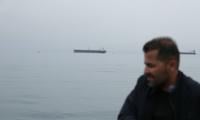
Iranian forces’ closure of the strait has trapped hundreds of ships in the Gulf and driven up the costs of shipping goods, with captains avoiding the region for fear of attacks or mines.
A spokesman for German transportation giant Hapag-Lloyd, which has ships stuck in the Gulf, told AFP by phone that the reopening was “in general... good news”. But he cautioned that shippers still needed details of what route vessels could take and in what order, citing fears of sea mines.
“One thousand ships cannot just go now to the entrance of the strait, that will be chaos. They (the Iranians) need to give clear orders,” said the spokesman, Nils Haupt.
“We would be ready to go very soon if some of these open questions can be solved within the weekend.”
Bloomberg data indicated there were about 770 vessels used for carrying commodities sending transponder signals inside the Gulf on Thursday, of which about 360 were oil and gas carriers.
Before the war, average daily crossings of the strait overall numbered about 120, according to industry journal Lloyd’s List.
Jakob Larsen, chief security officer of major shipping association BIMCO, said in a statement emailed to AFP that this claim was “inaccurate”.
“The status of mine threats in (Iran’s maritime) traffic separation scheme is unclear, and BIMCO believes shipping companies should consider avoiding the area,” he said.
The secretary general of leading industry lobby the International Chamber of Shipping, Thomas Kazakos, said the announcement was “a positive step (but) there is still much uncertainty around what it means in practice”.
London shipping insurers have agreed to provide $1 billion in extra coverage for vessels sailing through the Strait of Hormuz.
All ships can sail through the Strait of Hormuz but this needs to be coordinated with Iran’s Islamic Revolutionary Guard Corps (IRGC), a senior Iranian official told Reuters, adding that unfreezing Iranian funds was part of the deal. The Iranian official said transits would be restricted to lanes that Iran deemed safe, adding that military vessels were still prohibited from crossing the strait.
“Releasing Iran’s funds was part of the agreement for reopening the strait,” the official noted, referring to an estimated $30 billion in frozen revenue, generated mainly from oil and gas exports, blocked amid U.S. sanctions on Tehran.
It was not immediately clear if this included or excluded the established Traffic Separation Scheme (TSS) lanes for entering and exiting the Gulf used by international shipping since the 1970s. “Even US vessels would be permitted, excluding military ships,” he said.
The official added that certain routes through Hormuz would remain open, but added that those would need to be determined as secure by Iran. “Navigation would take place in coordination with Iran, and with authorisation from the Guards and Iran’s Ports and Maritime Organization to ensure the safety of shipping,” the official said.
A group of around 20 ships including container ships, bulk carriers and tankers was seen moving in the Gulf towards the exit via the Strait of Hormuz on Friday evening, ship tracking data showed.
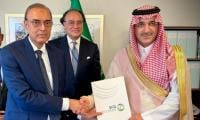
Saudi Foreign Minister Prince Faisal bin Farhan and US Secretary of State Marco Rubio, during a phone call, discussed efforts to ensure the continued opening of the Strait of Hormuz and consolidate the ceasefire in Lebanon, the Saudi state news agency SPA reported on Friday.
Meanwhile, Saudi Finance Minister Mohammed Al-Jadaan welcomed news that Iran would reopen the Strait of Hormuz, clearing the path for oil shipments to resume, but warned the situation in the Middle East would remain very fragile until a durable de-escalation was achieved.
Certain countries would be able to restore their production capabilities quickly, but others would need more time, depending on the extent of the damage they suffered, Al-Jadaan, who chairs the International Monetary and Financial Committee (IMFC), which advises the International Monetary Fund, told reporters.
The biggest challenge was not how much production of oil and natural gas could be ramped up, but whether insurers would feel comfortable backing shipments, he said at a briefing during the IMF and World Bank spring meetings in Washington.