_akhbar.jpg)
KARACHI: US Vice President JD Vance ended his visit to Islamabad without any agreement between the United States and Iran, after long and difficult talks.
In its report titled ‘21 Hours in Pakistan: How Vance Tried and Failed to End a War He Opposed’, The New York Times said that Vance appeared tired and disappointed when speaking to the media early Sunday morning.
Per the reports, Vance said the discussions had faced “shortcomings” and that no progress had been made. He gave very few details, answered only a few questions and left.
He did not address whether the two-week cease-fire with Iran would hold or what would happen to the Strait of Hormuz or if US President Donald Trump would now follow through with his threat to wipe Iranian civilisation off the map.
It was a remarkable conclusion to a high-stakes diplomatic trip for Vance, who made his opposition known to a full-scale war in Iran. America’s allies and adversaries alike were pinning their hopes on the vice president to find a way out of a conflict that has upended the global economy, frayed alliances and expanded to the wider region, NYT added.
Instead, he left with nothing. He blamed Iran for the failed talks, saying the US sought a commitment that Iran would not seek a nuclear weapon, and they refused.
This was a key moment for Vance, who has openly opposed a full-scale war with Iran. Despite this, he was chosen by Trump to lead the highest-level talks between the two countries in decades. During the talks, the US president was in Miami attending a sporting event.
The conflict has already had serious effects. The US and Israel have carried out weeks of air strikes in Iran, targeting thousands of sites and killing many people, including civilians. Iran has responded with attacks across the region and by effectively closing the Strait of Hormuz, a key route for global oil supplies.
Now, NYT added that Trump must decide what to do next: return to the negotiating table or resume a deadly and costly conflict that has already created the largest energy disruption in modern times. On Sunday, he partly answered the question by announcing a naval blockade on the Strait of Hormuz, which is generally considered an act of war.
‘Extend the Open Hand’
Vance started his trip to Pakistan striking a cautiously optimistic tone, telling reporters that the US would “extend the open hand” if Iran were “willing to negotiate in good faith”.
But as he set off from Washington, with a brief refuelling stop in Paris, the details of how the negotiations would take place remained unclear.
Iranian officials repeatedly threatened to refuse direct meetings if the United States did not accede to various demands, including unfreezing Iran’s overseas assets and expanding the ceasefire to include Lebanon. The latter demand underscored the degree to which many events of this war are out of US control: Prime Minister Benjamin Netanyahu of Israel has expressed the desire to continue fighting with Hezbollah, an Iranian proxy.
And in the hours leading up to the meeting, even once the vice president was on the ground in Islamabad, disagreements were spilling out into the press. Some Iranian officials told media outlets that the US had agreed to unfreeze Iranian assets held in Qatar and foreign banks before the meetings began as a sign of good faith. The United States said those reports were false.
Iranian state media then reported the American team was confused.
Foreign trips by US presidents or vice presidents are usually highly-scripted affairs, with detailed schedules and planned deliverables. Advance teams travel far ahead of the principal to iron out the details, building minute-by-minute timetables.
Vance’s team had only a few days.
The NYT report said that security in Islamabad was extremely tight, and most of the meetings were held in secret. Even officials in Washington had limited information about what was happening.
A Sceptic From the Start
Vance has long been cautious about military action, warning it could lead to wider conflict and heavy loss of life. He has also stressed that many American voters support avoiding new wars.
Despite his personal concerns, he has publicly supported President Trump. However, the failure of these talks puts him in a difficult position going forward.
The Iran war is not the only disagreement Vance has had with Mr. Trump’s approach to foreign policy. When the president was considering striking Yemen last year, Vance told other administration officials that he thought the operation was a “mistake” and appeared to question if Trump understood the potential consequences of the action, according to The Atlantic, which published parts of the exchange.
And for Vance, widely seen as the front-runner for the 2028 Republican nomination, the conflict risks his connection to the anti-interventionist wing of the Make America Great Again political movement. The war has scrambled Trump’s coalition: prominent conservative voices like Tucker Carlson, who is especially close to Vance, have emerged as some of the fiercest critics of the war, the NYT report said.
Even as Vance and his allies make little secret of his private opposition to the conflict, he has publicly stood by the president. And as the leader of the delegation, he will find it challenging to separate himself from the war moving forward regardless of the outcome.
“If it doesn’t happen, I’m blaming JD Vance,” Trump said to laughter of Vance trying to secure a deal at an Easter lunch earlier this month. “If it does happen, I’m taking full credit.”
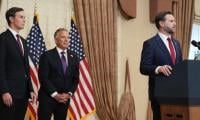
The American delegation was led by three men with limited traditional diplomatic experience. Vance’s political career before ascending to vice president included a two-year stint in the Senate, and Witkoff and Kushner built fortunes in the real estate business.
But Witkoff and Kushner have emerged as Trump’s fix-it guys, dispatched to conflict zones around the world to try to make peace. They’ve found some success with the Israel-Hamas conflict and much less with Russia and Ukraine. With Iran, they tried to strike a deal and the collapse of their negotiations led to the current conflict. But by closing the strait, Iran has more leverage in this round of negotiations than it did before the war.
‘Regardless of what happens, we win.’
As Vance travelled to Pakistan and even during the negotiations, the president repeatedly weighed in on Truth Social. He bashed the news media for reporting anything other than Iran is “LOSING, and LOSING BIG!” and bragged about what he described as absolute American military success.
“The Iranians don’t seem to realize they have no cards, other than a short term extortion of the World by using International Waterways,” he wrote on Truth Social as Mr. Vance was flying to Pakistan. “The only reason they are alive today is to negotiate!”
Later in the day, as Trump left the White House to travel to Florida, he said it did not matter to him if a deal with Iran is reached or not.
“Regardless what happens, we win,” he said. “We’ve totally defeated that country.”
In Islamabad, Pakistani officials were eager to promote their role as peacemakers. They announced a two-day holiday in the capital to clear out the city, deploying thousands of police officers to bulk up security ahead of the visit. As Vance’s motorcade made its way through the city, there were no vehicles on the road and few signs of any people, NYT said.
Pakistani officials also quickly printed new signs, affixing them to lampposts and billboards around the city to celebrate the ‘Islamabad Talks’, featuring the American, Pakistani and Iranian flags to advertise the negotiations. But still, most everyone was in the dark about what was happening behind closed doors.
Hundreds of reporters who had gathered in Islamabad to cover the negotiations spent the day scouring for any information about the talks. Stationed in the city’s Jinnah Convention Centre, directly across the street from the Serena Hotel, journalists sipped coffee from specialty branded ‘Brewed for Peace’ cups while a band played traditional Pakistani music. A giant #IslamabadTalks sign sat on a green-carpeted stage with a lectern that went unused.
“No one knows when, where, or how these talks are taking place,” Nadir Guramani, a Pakistani journalist, said at the convention centre.
“We do not even know what is happening outside, as movement across the city is restricted,” he added.
It turned out, after 21 hours on the ground in Islamabad, not much had happened to bring a lasting peace between the United States and Iran.