WASHINGTON: President Donald Trump ordered the US Navy on Sunday to block the crucial Strait of Hormuz shipping lane, furious with Iran’s refusal to surrender its nuclear ambitions after peace talks in Pakistan broke down without an agreement.
In response to Trump’s announcement, Iran’s Revolutionary Guards warned they had traffic in the strategic waterway under their full control and would trap any enemy who tried to challenge it “in a deadly vortex”. The force’s naval command insisted that “contrary to the false claims of some enemy officials”, the Strait of Hormuz is “open to the harmless passage of civilian vessels in compliance with specific relevant regulations”.
In a lengthy declaration on his social media platform, Trump said his eventual goal was to clear the strait of mines and reopen it to all shipping, but that in the meantime Iran must not be allowed to profit from its control of the waterway.
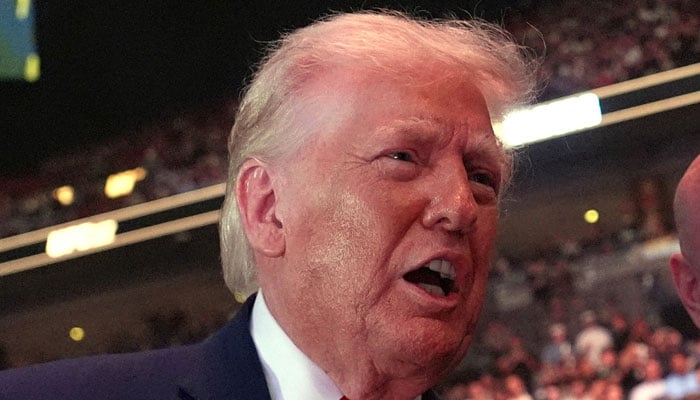
“Effective immediately, the United States Navy, the Finest in the World, will begin the process of BLOCKADING any and all Ships trying to enter, or leave, the Strait of Hormuz,” Trump said. “Any Iranian who fires at us, or at peaceful vessels, will be BLOWN TO HELL!”
Iran has itself been restricting traffic through the strait -- a key route for global shipments of oil, gas and fertiliser -- while allowing vessels deemed to be working for friendly countries, such as China, to pass. There have been unconfirmed reports that Tehran plans to charge tolls.
“THIS IS WORLD EXTORTION,” Trump said. “I have also instructed our Navy to seek and interdict every vessel in International Waters that has paid a toll to Iran. No one who pays an illegal toll will have safe passage on the high seas. We also begin destroying the mines the Iranians laid in the Straits.”
The US military had said Saturday that two Navy warships transited through the strait to begin clearing it of mines and ensure it was a “safe pathway” for tankers, a claim denied by Tehran.
Fears of renewed fighting rattled an already tense region after the US-Iran talks collapsed.
Trump later in a Fox News interview again threatened Iran’s energy infrastructure, before warning he would impose a 50 percent tariff on Chinese imports if Beijing tried to help the Iranian military.
“I could take out Iran in one day. I could have their entire energy everything, every one of their plants, their electric generating plants, which is a big deal,” he said.
President Trump said the price of oil and gasoline may remain high through November’s midterm elections, a rare acknowledgement of the potential political fallout from his decision to attack Iran six weeks ago.
“It could be, or the same, or maybe a little bit higher, but it should be around the same,” Trump, who is in Miami for the weekend, told Fox News’ “Sunday Morning Futures With Maria Bartiromo” when asked whether the cost of oil and gas would be lower by the fall.
The president’s latest ultimatum appeared to have been triggered by the failure of talks to secure a deal to end the six-week-old war, which began when the US and Israel launched strikes on Tehran and killed Iran’s supreme leader, Ali Khamenei.
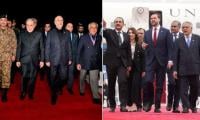
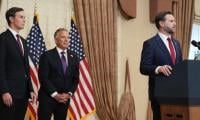
The US delegation to the Islamabad talks was led by Vice President JD Vance, White House envoy Steve Witkoff and Trump’s son-in-law Jared Kushner. “I have always said, right from the beginning, and many years ago, IRAN WILL NEVER HAVE A NUCLEAR WEAPON!” Trump said. “The Blockade will begin shortly. Other Countries will be involved with this Blockade,” he added, without specifying.
Experts said blocking the crucial waterway in the middle of a two-week ceasefire, after the Islamabad negotiations, would further erode America’s global credibility.
“Imposing a blockade on the Strait of Hormuz right now -- even if it’s implementable, which remains an open question -- is bewildering and seems self-defeating,” said Shibley Telhami, a professor of peace and development at the University of Maryland.
Vance left Pakistan after the talks -- the highest-level meeting between the two sides since the 1979 Islamic revolution -- and warned that Washington had made Tehran its “final and best offer” for a deal, adding: “We’ll see if the Iranians accept it.”
Iran’s parliamentary speaker Mohammad Bagher Ghalibaf, the head of his country’s negotiating team, said he had “put forward constructive initiatives” but the US team did not win Iran’s trust.
Later, Qalibaf said Trump’s new threats would have no effect on Iran. “If you fight, we will fight, and if you come forward with logic, we will deal with logic,” he said, in comments carried by state media.
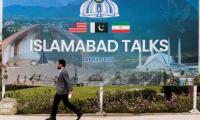
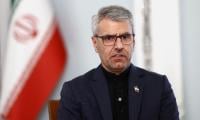
Iran’s Ambassador to Pakistan Reza Amiri Moghadam said that the Islamabad talks are “not an event but a process” which laid the foundation for a diplomatic process that, if trust and will are strengthened, can create a sustainable framework for the interests of all parties.
“I would like to express my gratitude to the friendly and brotherly county of Pakistan, especially H.E. Prime Minister Shahbaz Sharif and Field Marshal Asim Munir, for their initiative of goodwill and good office for the talks,” the Iranian ambassador said in a post on X.
Reza Amiri said, “With the tireless efforts of all sectors in Pakistan, including the government, army, police and security forces to facilitate and manage the talks, talks were held in a dignified and befitting atmosphere for the guests in a calm, orderly and secure environment with equal logistic opportunities for both sides.
“The Iranian high ranking negotiating team, with dignity, self-confidence and faith in Allah Almighty and attention to the concerns of the people, pursued dignified talks for the great Iranian nation to ensure and secure the national interests and legitimate rights of the people.”
The failure of the talks will raise concerns that a return to fighting could drive world energy prices higher and further damage shipping and oil and gas facilities.
UK Prime Minister Keir Starmer called the Sultan of Oman, Haitham bin Tariq, and both leaders agreed it “was vital there was a continuation of the ceasefire, and that all parties avoided any further escalation”.
An EU spokesman said diplomacy would be “essential” to securing peace and hailed Pakistan’s mediation efforts, while Russia’s President Vladimir Putin called Iranian President Masoud Pezeshkian to offer his services to the diplomatic effort.
“Vladimir Putin emphasised his readiness to further facilitate the search for a political and diplomatic settlement to the conflict, and to mediate efforts to achieve a just and lasting peace in the Middle East,” the Kremlin said, in its readout of the call.
Iran´s navy chief Shahram Irani called President Trump´s threat to blockade the Strait of Hormuz “ridiculous”. “The brave men of the naval force of the Army of the Islamic Republic of Iran are monitoring and supervising all the movements of the aggressive American army in the region. The threats of the US president to blockade Iran at sea... are very ridiculous and funny,” he said, according to state TV.
Iran and the United States failed to reach an agreement to end the war in the Middle East, US Vice President JD Vance said Sunday after marathon talks in Islamabad, adding that he was leaving after giving Tehran the “final and best offer”.
Vance said Washington was seeking a “fundamental commitment” from Iran that it would not develop a nuclear weapon, but that “we haven’t seen that” after holding the highest-level meeting between the two sides since the 1979 Islamic revolution.
However, he signalled that he was still giving Iran time to consider the offer from the United States, which on Tuesday said it would pause attacks with Israel for two weeks pending negotiations.
Iran’s state broadcaster IRIB said negotiations stalled over “unreasonable demands of the American side”, though the country’s foreign ministry spokesman later noted that “no one” could have expected that after 40 days of war, they would reach an agreement within one session.
Iranian President Masoud Pezeshkian said that if the US government respects the rights of the Iranian nation, ways to reach an agreement will certainly be found. “If the US government abandons its totalitarianism and respects the rights of the Iranian nation, ways to reach an agreement will certainly be found. I commend the members of the negotiating team, especially my dear brother Dr Ghalibaf, and say “God gives you strength,” he said in a post on X.
Meanwhile, the UK will not take part in the proposed US blockade of the Strait of Hormuz, according to the British government, Bloomberg reported.
The UK has discussed deploying autonomous mine-hunting drones in the strait as part of a separate proposal to reopen it, and will take part in a meeting with other countries to discuss a plan to open the waterway.
The British government said in a statement Sunday that it continued to call for freedom of navigation and the opening of the strait, following Trump’s announcement that the US would begin a full naval blockade of the strategic waterway that’s essential for global energy supplies.
Britain won’t be taking part in that blockade, people familiar with the government’s position said on condition of anonymity to speak freely about the proposed US operation.
US Central Command (CENTCOM) forces will begin implementing a blockade of all maritime traffic entering and exiting Iranian ports on April 13 at 10 a.m. ET, in accordance with the President’s proclamation, CENTCOM stated in a post on X.
“The blockade will be enforced impartially against vessels of all nations entering or departing Iranian ports and coastal areas, including all Iranian ports on the Arabian Gulf and Gulf of Oman. CENTCOM forces will not impede freedom of navigation for vessels transiting the Strait of Hormuz to and from non-Iranian ports.
“Additional information will be provided to commercial mariners through a formal notice prior to the start of the blockade. All mariners are advised to monitor Notice to Mariners broadcasts and contact U.S. naval forces on bridge-to-bridge channel 16 when operating in the Gulf of Oman and Strait of Hormuz approaches.”
Iran’s former foreign minister Mohammad Javad Zarif, who led his country’s delegation at 2015 nuclear talks, blamed the failure of negotiations to end the Middle East war on US attempts to “dictate” its terms. “No negotiations - at least with Iran - will succeed based on ‘our/your terms’,” said Zarif.
Oman’s foreign minister called for more talks between Iran and the US and for the ceasefire to be extended. “I urge that the ceasefire be extended and talks continue,” Badr al-Busaidi wrote in a post on X. “Success may require everyone to make painful concessions, but this is nothing as compared to the pain of failure and war.”
UK government minister Wes Streeting said it was “disappointing” that negotiations between the United States and Iran in Islamabad had stalled, adding that US President Donald Trump’s earlier social media comments had been “incendiary”.
Australian Foreign Minister Penny Wong on urged a continuation of the Middle East ceasefire after US-Iran talks ended with no deal. “The priority now must be to continue the ceasefire and return to negotiations,” Wong said in a statement, adding it was “disappointing that the Islamabad talks between the United States and Iran have ended without agreement”.
Iran’s Foreign Minister Abbas Araghchi has accused US of “maximalism, shifting goalposts’ at Islamabad talks.
“In intensive talks at highest level in 47 years, Iran engaged with U.S in good faith to end war,” Araghchi wrote in a social media post. “But when just inches away from “Islamabad MoU”, we encountered maximalism, shifting goalposts, and blockade,” added Araghchi.
“Zero lessons earned,” he continued, before concluding, “Good will begets good will. Enmity begets enmity.”