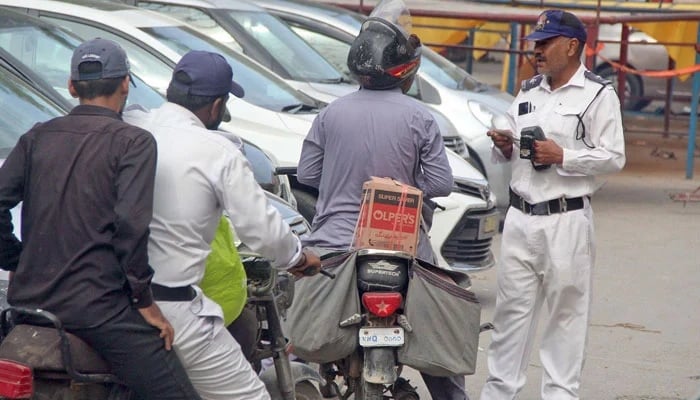
In a dramatic policy reversal, Karachi traffic police have decided to redeploy officers at major roads and intersections with the authority to issue on-the-spot fines, as they struggle to contain the growing menace of motorists deliberately concealing or removing their vehicle registration number plates to evade detection by surveillance cameras.
This disclosure was made by city traffic police chief Peer Muhammad Shah during an interactive session at the recently held Karachi edition of the 18th Annual CSR Summit & Awards 2026, organised by the National Forum for Environment & Health (NFEH).
Explaining the decision, DIG Shah recalled that traffic police officials had been stripped of on-the-spot fining powers a year ago following widespread public complaints of harassment and extortion at busy intersections.
“We withdrew these powers to ease public hardship, even though our camera-based enforcement system currently covers only 10 per cent of the city, leaving the remaining 90 per cent dependent on conventional methods.”
However, he admitted, the move created unintended consequences, with violators exploiting gaps in the surveillance system. According to him, a large number of offenders, particularly motorcyclists, have resorted to tampering with number plates by blackening, folding, taping over or even completely removing them to avoid identification.
“We are left with no option but to redeploy personnel. Vehicles with unreadable or missing number plates will be fined immediately to ensure they do not repeatedly violate traffic laws.” Providing further data, the DIG revealed that nearly 70 per cent of traffic violations now involve vehicles whose number plates cannot be read by cameras, while the remaining 30 per cent relate to vehicles whose owners have not provided accurate residential details to the excise department, preventing delivery of e-challans.
He also disclosed that around 60 key routes in Karachi have been identified as hotspots for one-way violations. Officials have completed a detailed study of these corridors, and plan to instal advanced cameras capable of automatically detecting such offences.
In another major development, surveillance cameras installed along Sharea Faisal will soon be upgraded to detect heavy vehicles using fast lanes as well as motorists using phones while driving.
DIG Shah noted that the camera-based enforcement system has already been extended beyond Karachi to Sukkur and Umerkot, with plans for gradual expansion to other major urban centres.
Addressing concerns over the newly introduced Ajrak-designed security number plates, he advised motorists awaiting issuance to carry proof of application. He said citizens may temporarily procure plates of the same design from the open market until official ones are issued.
On environmental policy, he proposed a shift away from fuel subsidies, suggesting that the government instead facilitate access to electric bikes through banking channels to curb vehicular emissions in Karachi.
He, however, cautioned that an indiscriminate crackdown on unfit and polluting vehicles could severely disrupt economic activity in the country’s commercial hub. “A large number of vehicles, including commercial and heavy transport, would be taken off the roads. We must maintain a balance.”
Earlier, speaking at the session, NFEH President Muhammad Naeem Qureshi urged the authorities to intensify action against smoke-emitting vehicles, identifying them as a major contributor to Karachi’s worsening environmental pollution.