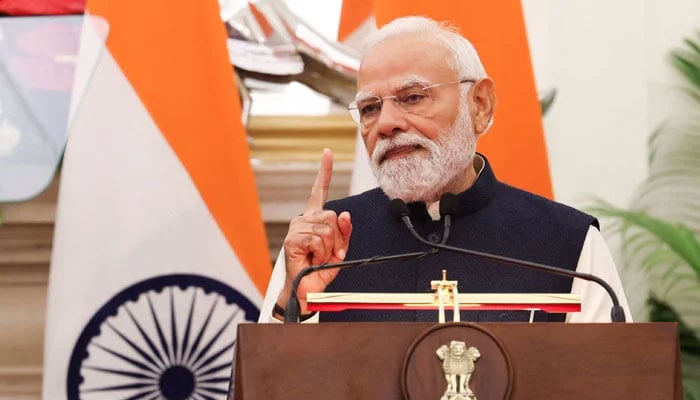
From the ancient land of India arose Ashoka, transforming his realm of power into a legacy of compassion. It is symbolised by the Ashoka Chakra at the heart of India’s flag. The Chakra’s 24 spokes denote life principles like righteousness, progress, justice, peace and virtue.
Indian Prime Minister Narendra Modi has unmoored India from that inheritance and hitched it to a militant Hindutva bogey. Praveen Swami, an authority on India’s national security, describes it as saffron terror. It is a framework which, under Modi, has shaped India’s internal governance and external posture.
This total pivot has bled into everyday life. In Kashmir, grief lingers in every home, with loved ones torn away with ruthless cruelty. Within India, minorities endure insidious violence. Muslims bear the brunt of lynchings and merciless persecution. This is not the land of Ashoka. It is one where fear rules and the minorities are under siege.
Culture, instead of resisting this shift, has absorbed and amplified it. Cinema, once a bridge across the divide, now functions as a glorifier of conflict and majoritarianism. Films like Dhurandhar elevate hyper-nationalist fantasies.
This is not harmless escapism but the entrenchment of moral absolutism. Portraying Pakistan as a demented antagonist, it espouses conflict as inevitable and victory as foregone.
The Indian media, once a check on power, now frequently mirrors it. Modi-crony ownership patterns and regulatory pressures have reduced it to an echo chamber. Prominent Indian journalist Ravish Kumar has famously coined the term ‘Godi Media’, the outlets that snuggle in the lap of those in power.
Given this atmosphere, even the last insulated spaces stand stripped bare. Sports are now an extension of hostility. Cricketers who once humanized rivalry now refuse a handshake; the preamble of a gentleman’s game. Pakistani artists, once embraced for their craft, have been recast as enemies.
This political, cultural and informational convergence has produced a dual-axis fixation. Pakistan is the perpetual external adversary. Minorities within India are the internal ones. This hate-mongering enhances political capital but comes at the cost of social cohesion and strategic fragility.
The most profound shift, however, is psychological. A steady diet of triumphalist narratives has fostered foregone expectations of effortless military dominance. The abject failure of Operation Sindhoor exposed the stark void between India’s narrative and operational capability.
It should have been a moment of reckoning and introspection. Instead, demanding reality to match the inculcated delusion, it triggered calls for escalation. Indoctrinated public opinion now pressures policy itself. This is an inexorably dangerous dynamic between nuclear rivals.
Amid this volatility, reports of another potential false-flag operation by India are chilling. The very consideration of manufacturing a trigger for conflict lays bare a strategy unbound by consequence. In a nuclear theatre, such Machiavellianism is not brinkmanship; it is insanity. It cannot be contained and can lead to annihilative retaliation.
Despite this horrific spectre, blatant cross-border strikes and tense standoffs have been Modi’s default mode of engagement with Pakistan. With the temerity of even weaponising water, his stance is one of constant hostility.
The consequences of this virulent dogma now reverberate beyond India’s borders. Incidents of transnational assassinations and repression of dissidents have added a starker dimension. Canada and Pakistan have formally accused India of carrying out assassinations on their soil.
The US has indicted Vikash Yadav, a RAW officer, for a New York assassination bid on Gurpatwant Singh Pannun, a Sikh dissident. Australia expelled two Indian nationals who were monitoring dissidents. Bangladesh has raised concerns about the involvement of India’s intelligence agencies in the targeted killings of its student leaders.
Subrahmanyam Jaishankar, a scholar, second-generation government servant and diplomat turned foreign minister, epitomises Modi’s India. Pakistan’s attempts at peace in the Iran conflict saw the professional decorum of a career envoy morph into street-level scurrilous polemics. It is indicative of the fact that even diplomacy has been subsumed by the toxic tide of Hindutva zealotry.
In contrast, Pakistan’s diplomatic manoeuvring culminated in a ceasefire breakthrough that has resonated worldwide. Islamabad has positioned itself as a central interlocutor at a moment analysts described as the harbinger of World War III. The ceasefire gives peace a much-needed chance. It also highlights the enduring relevance of negotiation over militarism.
The resulting contrast is striking. India appears increasingly entangled in frustration while Pakistan’s pursuit of peace is being hailed around the world. The shift is not merely tactical; it reflects differing approaches to power. One is rooted in jingoism, the other opted for peace parleys.
Amity over delusions is not merely a slogan. It is a defining line between engaging with reality and a state that is a hostage to its own narrative and mythology. It also holds true for the blatant actions of the US-Israel juggernaut that had to ultimately reconcile with Iran’s exemplary defiance.
Statecraft is not a Bollywood set that ensures the hero prevails against all odds. There is no script immunity, no guaranteed triumph and no director’s cut. Reality demands restraint, adaptability and a willingness to accept unsavoury truths. It does not yield to narrative; it defies it. Narendra Modi may script his flick for a time; its consequences shall heed no dictation.
Pierre Victurnien Vergniaud was a brilliant orator and a key architect of the French Revolution. He famously articulated these words while facing the guillotine: “The revolution, like Saturn, devours its own children”.
With the boundaries of Hindutva ever-expanding, the list of those that it views as its enemies also grows. Validation of Vergniaud’s grimly definitive warning about an ideology that eventually self-cannibalises shall be the starkest manifestation of Modi’s delusions.
The writer explores the forces which shape power, belief and society. He can be reached at: [email protected]