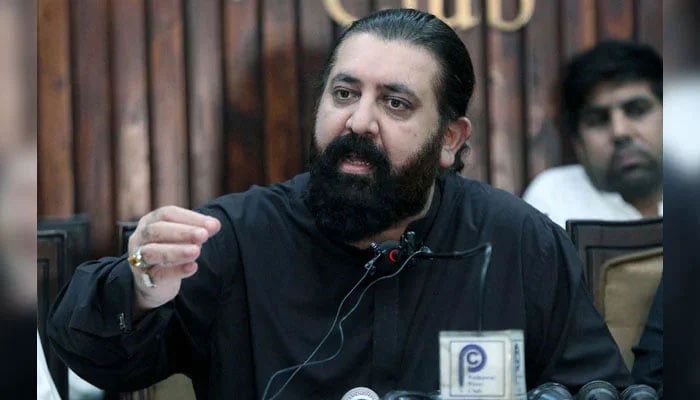
ISLAMABAD: Pakistan Tehreek-e-Insaf (PTI) Information Secretary Sheikh Waqas Akram Thursday said that on April 9, 2022, under a regime change plot, the PTI government of Imran Khan was toppled and replaced by a public-rejected, selfish and power-greedy group.
He called April 9, 2022 a dark day and claimed that since that day, the country continues to pay a heavy price for the conspiracy, which, according to him, pushed a well-performing nation to the brink of disaster, plunging it into a deepening debt burden, causing a mass exodus of educated and skilled youth, soaring inflation, widespread unemployment, politicisation of state institutions, and erosion of hard-won peace.
Highlighting the performance of the then PTI government, Sheikh Waqas said that during its tenure the administration made 63 major achievements across governance, economy, welfare, foreign policy, and institutional reforms.
He noted that Imran Khan became one of the first world leaders to raise the issue of Islamophobia at the United Nations, leading to the observance of an international day against Islamophobia. He said that the PTI government gave a strong response to India during heightened tensions, ended drone strikes inside Pakistan, and initiated major dam projects.
The PTI spokesman said exports were increased significantly, and policies were introduced to convert penalties and fines into avenues for investment.
Waqas claimed that the PTI government created employment opportunities, boosted textile and IT exports, and launched the Billion Tree Tsunami environmental initiative. He insisted that farmer-friendly policies resulted in record crop production and that the Sehat Sahulat Programme provided free medical treatment of up to Rs1 million for families. He also mentioned the establishment of shelters for the homeless under the Panagah project.
Waqas noted that reforms such as introduction of a uniform national curriculum, the Pakistan Citizen Portal for resolving public complaints, and the Roshan Digital Account for overseas Pakistanis were key milestones. He said that Pakistan’s “smart lockdown” strategy during Covid-19 received global recognition.
Among other initiatives, Waqas listed tourism promotion, the upgradation of Skardu International Airport, the establishment of Al-Qadir University, women’s protection laws, online FIR registration, promotion of e-governance, police reform efforts, completion of energy projects, welfare programmes such as Ehsaas Programme and Kamyab Jawan Programmes, ration initiatives, facilities for overseas Pakistanis, and steps to promote sports.
The PTI spokesman voiced grave concern over the rapidly deteriorating eyesight of party founder Imran Khan, reiterating the demand of his family and the party to shift him to Shifa International Hospital for proper medical treatment.
Waqas contended the nation would not tolerate any negligence in the medical care of the unlawfully incarcerated PTI chairman-for-life. He said that the details regarding Imran Khan’s eyesight, shared by his counsel Salman Safdar, were extremely alarming.
He demanded that the authorities provide unhindered access to Imran Khan for his family, lawyers, and party leadership, and allow him to receive treatment at Shifa International Hospital under the guidance and supervision of his personal physicians.


![[Comment] Hour Of Diplomacy — Pakistan’s Historic Hand In Turning War Into Ceasefire](https://www.thenews.pk/assets/uploads/akhbar/2026-04-10/s_1409241_045310_updates.jpg)