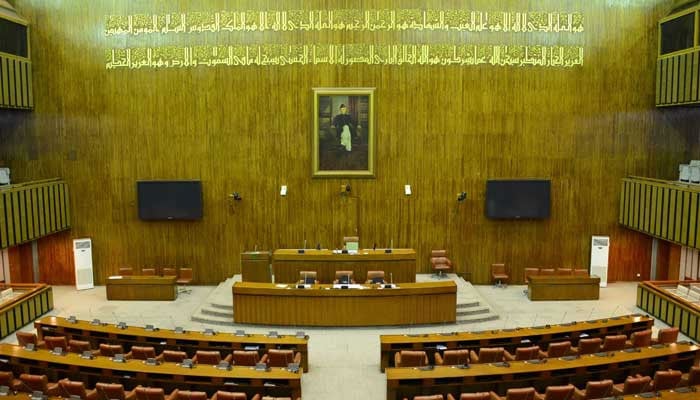
ISLAMABAD: Women Senators contributed around 20 per cent of the regular plenary agenda of the Senate during the 23rd parliamentary year (2025-2026), according to the latest Women Parliamentarians Performance Report released by the Free and Fair Election Network (FAFEN).
This contribution is slightly higher than women’s share in the Senate’s membership, which stands at around 18 per cent.
Titled “Women Senators Did It Too!”, the FAFEN report evaluates female Senators’ parliamentary performance across five dimensions, including their contribution to the parliamentary agenda; participation in plenary debates; attendance in House sittings; parliamentary treatment of agenda submitted by women Senators; and individual performance rankings.
The report focuses solely on plenary performance and does not cover committee work or constituency activities. Moreover, verbal interventions during Question Hour, such as supplementary questions, are also excluded.
Regarding, agenda contribution and per-capita performance, FAFEN reported, On a per-capita basis, female senators contributed agenda items at a slightly higher rate than male senators. On average, each female Senator submitted 12 agenda items during the year, compared with 11 items per male Senator. However, women’s overall share of the agenda declined from 31 per cent recorded in the previous parliamentary year (2024-2025).
The report uses the Gender Responsiveness Score (GRS) to assess how frequently the Senate addresses agenda submitted by women Senators compared with that submitted by male Senators. The overall GRS for the reporting period is 0.9, indicating that the Senate was somewhat less responsive to women Senators’ agenda. Notably, Calling Attention Notices and proposals for amendments to the rules submitted by women Senators were not addressed during the year, while their questions and private members’ bills were taken up at rates comparable to those of male Senators.
While all female Senators remained active either through agenda submission or participation in debates, most fell into the “rarely spoke” category based on their Participation Rate Index. Only one woman Senator did not participate in debates at all, contributing solely through agenda submission, and this pattern points to potential institutional or procedural barriers affecting women’s verbal participation in the House.
The report challenges the perception that women parliamentarians focus primarily on gender-related issues. Agenda submitted by female senators covered economic policy, national security, taxation, governance, and parliamentary procedure, alongside legislation on women’s rights and social protection.
Female Senators demonstrated relatively strong attendance, attending an average of 38 sittings during the year, compared to 34 sittings attended by male Senators. The FAFEN report concludes that while women Senators are contributing to parliamentary business at rates comparable to or exceeding their male counterparts on a per-capita basis, disparities remain in terms of institutional responsiveness and opportunities for meaningful participation in plenary debates.




![[Comment] Hour Of Diplomacy — Pakistan’s Historic Hand In Turning War Into Ceasefire](https://www.thenews.pk/assets/uploads/akhbar/2026-04-10/s_1409241_045310_updates.jpg)