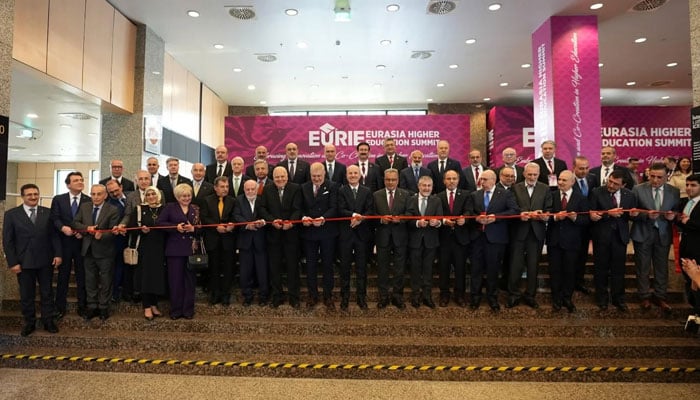
Islamabad:Pakistan marked a significant milestone in global academic engagement at the Eurasia Higher Education Summit (EURIE) 2026 held in Istanbul, where the country emerged as a confident and forward-looking voice in international higher education.
The summit, one of the world’s leading academic gatherings, brought together representatives from 61 countries, including more than 380 universities and higher education institutions, alongside ministers, policymakers, and academic leaders.
Against this global backdrop, Pakistan’s presence stood out for its clarity of vision and strategic engagement. A high-powered delegation led by the Association of Private Sector Universities of Pakistan comprised 42 members representing 17 leading universities along with participation from the OIC-COMSTECH.
This coordinated representation reflected Pakistan’s growing confidence and collective strength in the higher education sector. A defining highlight of the summit was the keynote address delivered by Prof. Dr. Sumaira Rehman, Commission Member of the HEC.
As the sole female keynote speaker at the inauguration, she presented a compelling narrative of Pakistan’s academic progress and global outlook. Her message “Pakistan has a compelling story to tell” resonated strongly with the international audience. She emphasized that while technical competence remains important, the future of higher education must prioritize the development of ethical, responsible leaders.
Following the keynote, a high-level meeting was held between the Pakistani delegation and Prof. Dr. Erol Özvar, President of the Council of Higher Education (YÖK). The discussions focused on strengthening Pakistan-Türkiye cooperation through educational diplomacy and expanding collaboration in research, innovation, and mobility programs.
Both sides explored opportunities for joint research initiatives, faculty and student exchanges, and technology transfer. Prof. Dr. Özvar also invited Pakistani institutions to participate in Türkiye’s 500 Research Projects Initiative, opening new avenues for deeper academic collaboration.
The engagement further included an invitation extended by APSUP leadership for a high-level visit to Pakistan, signalling continued momentum in bilateral academic relations. Pakistan’s participation also gained recognition from broader international leadership.