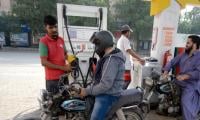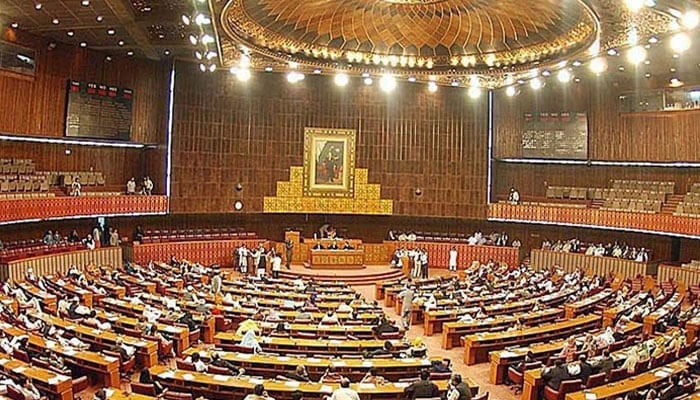
ISLAMABAD: The government on Monday drew strong criticism from the opposition and members of the Pakistan People’s Party (PPP) in the National Assembly over an exorbitant increase in the prices of petroleum products.
Minister for Petroleum Ali Pervaiz Malik defended the decision by stating that targeted subsidies were being provided to the vulnerable segments of the society. At the outset of proceedings, Speaker Ayaz Sadiq allowed discussion on increase in the petroleum products on demand of the opposition parties.
Noor Alam Afridi of JUI-F and Syed Naveed Qamar from PPP also supported the PTI-supported member Shahid Khattak, who sought permission for a detailed discussion on the issue. “The government should tell us as to why prices of petroleum products were increased when the country’s economy was making rapid progress,” Noor Alam asked.
Naveed Qamar said the government should take the House in confidence on increase in the petroleum products and the austerity measures. Aminul Haq of MQM also favoured debate on the issue, saying the opposition member Iqbal Afridi should not point out lack of quorum.
After suspension of the question hour, the speaker allowed debate on the issue. Initiating discussion, Pervaiz explained that the decision was taken in light of the ongoing regional conflict. He highlighted that Pakistan met 80 to 90 percent of its petroleum demand through imports.
He said the crisis in the Middle East had adversely affected the global energy supply chains. He further said Pakistan was now importing oil through the Yanbu port in Saudi Arabia, as well as through ports in the UAE and Oman. However, he reassured that there was no shortage of petroleum products in the country.
Regarding fertilizer availability, Ali Pervaiz Malik said an uninterrupted gas supply was being ensured to all 10 fertilizer factories. He added that the prime minister had issued strict directives to maintain fertilizer availability at Rs4,500 per bag.
Briefing the House on the targeted subsidy, the minister said millions of rupees were being disbursed to motorcyclists, passengers, goods transporters, and farmers through digital wallets.
He informed the House that motor bikers would continue to get Rs100 per liter subsidy on petrol for three months saying the Ministry of Information Technology had made a transparent mechanism for distribution of targeted subsidy.
He claimed that in some parts of the world petroleum products had increased by 80 percent. Talking informally to newsmen after attending the proceedings, he said Pakistan would take decision on procurement of oil and trade with Iran while keeping in view the international laws.
He said the nation would also hear good news about gas pipeline project with Iran and efforts were on to decide arbitration in this regard. PTI Chairman Barrister Gohar Ali Khan questioned why the government opted for the highest increase in prices of petroleum products in the world.
He pointed out that the government first increased the prices of petroleum products by 20 percent and then from 42 to 52 percent. He also regretted that the prime minister did not attend the House proceedings whereas Imran Khan used to respond questions during the question hours.
MQM parliamentary leader Dr. Farooq Sattar observed that the government needed to take extraordinary measures along with basic economic reforms to cope with the ongoing situation. He proposed doing away with the petroleum levy and heavy custom duties.
“Every opposition party criticizes petroleum levy but when it comes to government, the same levy is collected as easy money to generate revenue,” he said. Mehtab Akbar Rashdi of Pakistan People’s Party (PPP) strongly criticized the government for exorbitant increase in the prices of diesel and petrol saying the decision had put people in great trouble.
Before the start of the discussion, Minister for Finance Muhammad Aurengzeb informed the House that he would wind up debate. “We have been taking measures for availability of petroleum products and adjustment of prices since the start of the Middle East conflict,” he said.