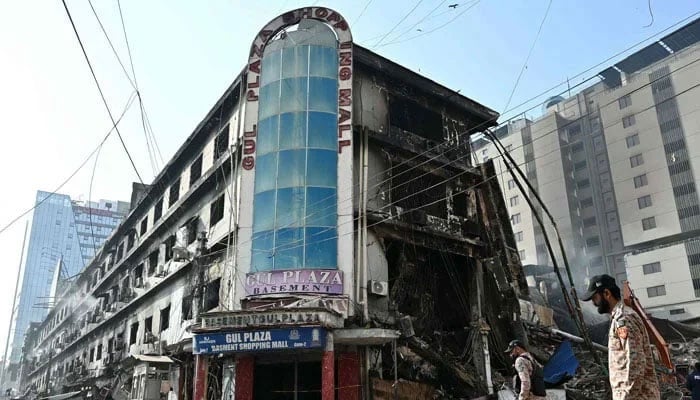
Incidents like the Gull Plaza fire in Karachi are sporadic events, and after amassing tons of footage and volumes of words, they are filed away in the policy implementation dementia corners.
However, such incidents do raise awareness of building safety across Pakistan and prompt us to consider the efficacy of the regulatory mechanisms governing it. A probe into the regulatory mechanism poses two questions: are building safety regulations adequate in Pakistan? And are they being properly implemented?
A review of building and zoning regulations in Pakistan reveals that cities with functional development authorities have decades-old regulations that adequately address concerns about building safety, especially in the event of fire. A comparison between these regulatory frameworks highlights some fundamentals observed across Pakistan, including the inclusion of safety features at the time of building design, at the time of issuance of the completion certificate, and even during the normal course of business.
However, the case of intermediate cities and smaller towns is different, as buildings in these areas are regulated by the relevant local governments. Although high-rise commercial and residential buildings are not common in these cities, fire incidents may occur and the preparedness of authorities, along with the safety features of the buildings, come into question.
In the absence of adequately staffed development authorities, these cities are regulated by the planning offices of the relevant local governments. Planning guidelines and regulations are modelled after the Model Regulations and by-laws notified by the provincial governments.These planning offices are also inadequately staffed under dated Schedules of Establishment, many of which date back to notifications issued four decades ago.
The Regional Interim Building & Town Planning Regulations 2018 for Sindh, and the Karachi Building and Town Planning Regulations 2002, amended in 2017, cover fire resistance and fire precautions in detail with clarity and the same is reflected in the required paperwork of building approval in big cities like Lahore, Peshawar, Faisalabad, Multan, Rawalpindi and Gujranwala. Elaborate provisions for fire safety are in place, complemented by the Building Code of Pakistan 2016, which mandates automatic sprinkler systems in specified categories of buildings.
Karachi’s regulatory regime similarly requires robust firefighting infrastructure and prior approvals before completion certificates are issued. However, safety practices have been found to be in contradiction with regulatory requirements in recent years.
For example, at the planning stage, most development authorities require the developers to submit a comprehensive set of documents to the relevant authority – water supply, sewerage and drainage plans (including rainwater harvesting), structural drawings, electricity safety plans and a detailed fire safety plan. This fire safety plan must also be approved by Civil Defence for issuance of a No Objection Certificate (NOC). In commercial, educational, hospital, industrial, apartment, multi-storey and public assembly buildings, a certificate from the fire-fighting department confirming the adequacy of arrangements is mandatory before a completion certificate can be granted.
The regulations go further and in case adequate fire-fighting arrangements are not provided to the satisfaction of the concerned department, authorities are empowered to seal the building. Civil Defence (Special Powers) Rules 1951 authorise inspections by police officers or designated officials where orders have been passed to ensure arrangements to prevent fire outbreaks. These provisions are not symbolic; they confer enforceable powers.
The required safety infrastructure within buildings is equally detailed. Developers ought to install extinguishers, fire buckets, independent water supply systems, overhead water tanks and external underground tanks accessible to fire-fighting vehicles at all times. Water pressure of internal fire hydrant systems is to be maintained on all floors for emergency purposes. Separate fire exit stairs, fire alarm systems, emergency lighting, smoke detectors, smoke masks, breathing apparatus and clearly marked evacuation plans form part of the compliance checklist.
The Fire Safety Commission’s recommendations emphasise essentials often neglected in practice: fire doors, unobstructed access routes, hydrant systems, emergency response teams, water pumps and functional alarm systems. A plan showing all fire-fighting provisions must be displayed at the site, and fire-fighting drills must be conducted at frequent intervals, at least once annually, in consultation with the city district government’s fire department.
Importantly, the regulations require institutional responsibility within buildings themselves. Each building owner must appoint a designated team to handle emergencies and ensure the implementation of safety plans. This team is to be trained by Rescue 1122 and Civil Defence, embedding operational readiness within the building’s management structure. The Building Code of Pakistan - Fire Safety Provisions 2016 was a shift from reactive to preventive safety measures as it comprehensively covered general safety requirements, building services, fire safety construction features, fire protection systems and access to fire department. Plans for high-rise buildings must also include details on access for emergency responders.
The legal landscape across the development authorities of Punjab and in other big cities of the country shows regulatory consistency. The problem, therefore, is not regulatory absence but regulatory dilution during construction, occupation and post-approval stages. If one checks the building records, the file may be complete with respect to documents, but the actual situation might differ from the filed compliance. Emergency drills may never have taken place, fire exit specifications may not be as per the documents, and alarms and hydrants may be non-functional. Likely might be the case with record of periodic inspections.
As famously said, sunlight is the best disinfectant. It is time to place building control authorities and their records in the light of transparency so that public access and oversight ensure the implementation of laid-down regulations. Safety plans need to be made public records, collaborative fire safety drills ought to be announced, and records ought to be made accessible to the public. Uncontrollable fire incidents do not occur due to weakness in regulations rather they are a result of non-compliance with the rules and regulations. Since other measures of compliance have not delivered the required results, it is time to try transparency. Only then can our cities become not just vertical, but safe.
The writer is a public policy analyst based in Lahore. He can be reached at:[email protected]