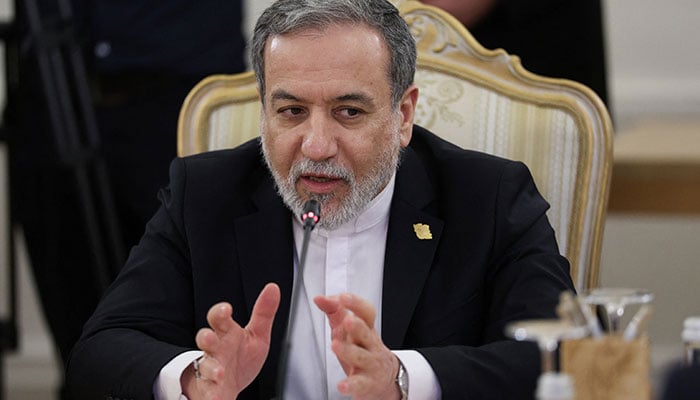
ISLAMABAD: Iran on Saturday dismissed reports that it had refused to visit Islamabad for Pakistan-mediated talks to end the Middle East war, saying it was grateful for Islamabad’s peace efforts.
Iran’s Foreign Minister Abbas Araghchi, referring to a report in a US media outlet claiming Tehran refused to hold talks with US officials in Islamabad, said it misrepresented his country’s position. On Friday, The Wall Street Journal reported that Iran told mediators that it was not willing to meet US officials in Islamabad in the coming days and that the US demands were unacceptable.
However, Araghchi, in a post on ‘X’, expressed gratitude to Pakistan for its efforts to bring an end to the war in the region, saying: “We are deeply grateful to Pakistan for its efforts and have never refused to go to Islamabad [for talks].
“What we care about are the terms of a conclusive and lasting END to the illegal war that is imposed on us,” he wrote. The Iranian foreign minister concluded his statement with “Pakistan Zindabad” in Urdu (long live Pakistan). Quoting Araghchi, the Iranian Embassy in Islamabad also said Tehran’s position was being misrepresented by the American media. In response, Deputy Prime Minister/Foreign Minister Ishaq Dar lauded Araghchi for the clarification. “Truly appreciate your clarification, my Dear Brother,” he wrote in a post.
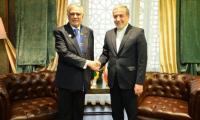
Later, on Sunday night Ishaq Dar spoke with Iranian Foreign Minister Abbas Araghchi, as both sides exchanged views on the evolving regional situation.
According to official sources, the two leaders discussed ongoing developments and assessed the broader implications of the current regional dynamics. The deputy prime minister/foreign minister reiterated Pakistan’s support for all efforts aimed at de-escalation and underscored the importance of resolving issues through dialogue and diplomacy. Both sides agreed to maintain close contact in view of the ongoing developments.
Pakistan emerged as a key mediator in one of the region’s worst conflicts, which erupted after joint US-Israeli attacks on Iran on February 28. The war has since resulted in a sharp increase in global fuel and energy costs, triggered by the effective blocking of Strait of Hormuz by Tehran. Apart from relaying messages between Washington and Tehran, Pakistan also hosted key regional ministers — from Saudi Arabia, Turkiye and Egypt — on March 31, as part of joint efforts to end the war.
Following the quadrilateral meeting in Islamabad, DPM Dar also held a high-level bilateral meeting with Chinese Foreign Minister Wang Yi in Beijing. The meeting’s five-point initiative for peace included the immediate cessation of hostilities, the start of talks as soon as possible, security of non-military targets and shipping lanes, and primacy of the United Nations Charter.
On April 2, the Foreign Office said Pakistan was intensifying diplomatic engagement with the United States to promote de-escalation and facilitate a path towards meaningful negotiations. “Pakistan is actively working to create a conducive environment for de-escalation and dialogue,” Foreign Office Spokesperson Tahir Andrabi told reporters in Islamabad, adding that the next phase would focus on meaningful negotiations among relevant stakeholders.
Meanwhile, DPM Dar held a telephonic conversation with Foreign Minister of Bahrain Dr Abdullatif bin Rashid Al Zayani and discussed the latest regional situation. Dar underscored the urgent need for de-escalation and emphasised the importance of dialogue and diplomacy. He highlighted the Pakistan-China five-point initiative aimed at promoting peace and stability in the Middle East and the Gulf region. FM Al Zayani appreciated the efforts being pursued by Pakistan for dialogue and diplomacy for peace and stability in the region. Both the sides also exchanged views on multilateral efforts, including at the UNSC, and agreed to remain in close contact.
Separately, the DPM held a telephonic conversation with the Foreign Minister of Egypt Badr Abdelatty. They discussed the latest regional developments and ongoing diplomatic efforts, underscoring the importance of dialogue and de-escalation. Both the sides agreed to remain in close contact.
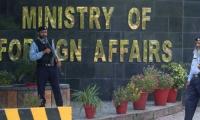
Meanwhile, responding to media queries regarding reports on developments in the ongoing conflict in the region, the Foreign Office spokesperson stated: “We have noted several reports in the media including on social media citing so-called official government sources regarding the ongoing conflict in the region and Pakistan’s efforts to promote peace and dialogue.
“We categorically reject these false insinuations attributed to purported official sources as baseless and a figment of imagination. Any attribution to official sources in this regard is incorrect. It is a matter of concern that the briefing held on Friday at the Ministry of Foreign Affairs has been misrepresented with references to issues that were neither discussed nor alluded to.”
Tahir Andrabi said that at a time of heightened regional sensitivity, diplomacy requires both discretion and responsibility. “We therefore urge all media platforms to exercise due diligence, avoid speculation and rely exclusively on officially issued statements and media readouts for accurate and timely information.”
In a related development, Pakistan strongly condemned the incident of vandalism and unrest targeting the Embassy of the United Arab Emirates in Damascus, says a FO press release.
The FO said that such acts violate the sanctity and security of diplomatic missions, which are protected under international law, including the Vienna Convention on Diplomatic Relations, and undermine the norms governing peaceful diplomatic engagement between states. The FO said that Pakistan reiterates its commitment to the principles of international law and diplomatic norms, and emphasises the importance of maintaining peace, stability and mutual respect among nations.