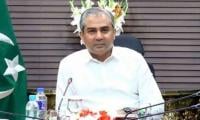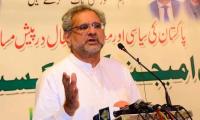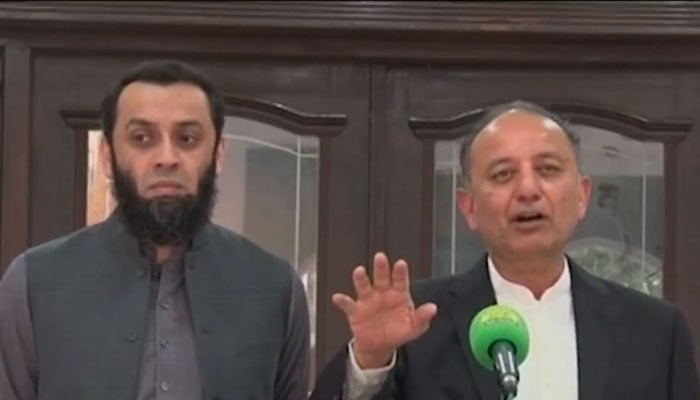
LAHORE: Federal Minister for Information and Broadcasting Attaullah Tarar and Federal Minister for Climate Change Dr Musadik Malik said on Saturday that the government successfully shielded the public from fuel shortages and mitigated the impact of global oil crisis through timely and proactive measures.
Speaking jointly here, they said that despite severe international challenges, the government ensured an uninterrupted fuel supply and took decisive steps to protect citizens from the worst effects of rising oil prices.
They acknowledged that despite these efforts, ordinary citizens continue to feel the pressure of inflation and high fuel costs. “With a heavy heart, we reiterate that while the government is doing everything possible, the impact is still being felt by ordinary citizens,” they said.
They stressed that protecting the dignity and savings of every citizen, particularly the most vulnerable, remains the government’s top priority, adding that all possible measures were being taken to provide relief and ease financial strain.
Dr Musadik Malik highlighted that approximately Rs129 billion was spent to stabilise fuel prices, sourced through development savings and austerity measures rather than fiscal irresponsibility.
He explained that austerity steps included a 50 per cent reduction in fuel usage, shutting down 60 per cent of official vehicles, cuts in ministers salaries, and scaled-down development expenditures.
He said Prime Minister Shehbaz Sharif made a conscious decision to pass the increased cost of oil only to those who can afford it, while protecting farmers, labourers, students and public transport users.
Subsidies were provided for bus fares, motorcyclists, trucks and goods transport to prevent a sharp rise in the prices of essential items such as fruits, vegetables, wheat and rice.
Dr Malik further explained that recent measures, including a Rs80 reduction in the petroleum levy, brought petrol prices down from Rs458 to Rs378 per litre, while additional subsidies reduced the effective price for motorcyclists to Rs278 per litre.
He added the government continues diplomatic engagement internationally while urging citizens to conserve fuel and energy.
Addressing the press conference, Attaullah Tarar said the prime minister had directed all relevant ministries, from the onset of rising regional tensions, to ensure uninterrupted fuel supply, stressing that no segment of society — including farmers, labourers, working women and youth — should face shortages.
He said that while many countries experienced severe fuel crises, Pakistan maintained a steady supply through a strategy that secured oil via multiple international routes, including the Strait of Hormuz, Iran, Red Sea, Fujairah in the UAE and Yanbu in Saudi Arabia. During Eid, oil tankers lined Pakistani ports, ensuring continuous availability.
Tarar explained that Pakistan’s main challenge is not a shortage but the surge in global oil prices driven by disrupted supply chains amid conflict. He noted that the government proactively averted a domestic crisis by arranging Rs129 billion through savings and austerity measures, including cuts in official fuel consumption and salaries.
He added that a coordinated national response was ensured, with federal and provincial governments sharing the burden to protect vulnerable citizens.
Transport fares were regulated, public transport made free in some areas, and targeted subsidies were extended to buses, trucks and vans.
Tarar highlighted that the prime minister holds daily review meetings to monitor relief efforts and that a digital wallet system has been introduced to ensure transparent, direct subsidy transfers.