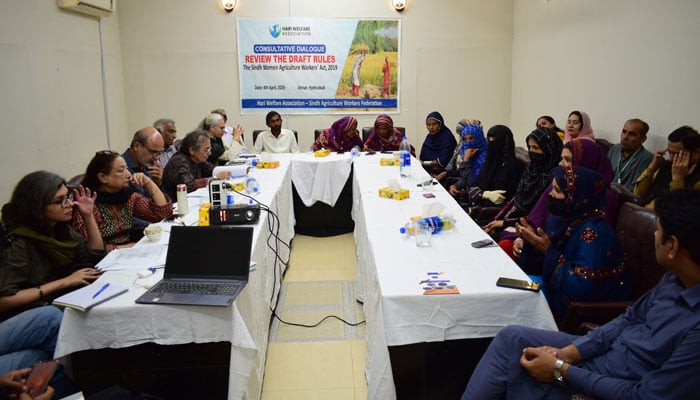
HYDERABAD: Concerns were raised over the absence of an effective accountability mechanism in the recently approved rules under the Sindh Women Agriculture Workers Act 2019 during a consultative dialogue held in Hyderabad.
The dialogue was organised by the Hari Welfare Association (HWA) and attended by representatives from local communities, trade unions, Human Rights Commission of Pakistan (HRCP) and civil society organisations.
The participants appreciated the Sindh government for passing the 2019 Act and approving its rules of business, but highlighted significant gaps that could hinder its implementation.
HWA President Akram Khaskheli said the landmark law recognised the role and contribution of women in agriculture who had long remained invisible despite being a vital part of rural economies.
However, he noted that like many labour laws, the Act lacked a strong accountability mechanism and effective enforcement provisions.
The participants expressed concern over persistent gender-based wage disparities stating that women agricultural workers continued to receive lower wages than men for the same work.
They also pointed out the lack of accessible mechanisms for worker registration, particularly at the union council level, adding that district-level systems remained largely inaccessible to women due to mobility and structural barriers.
It was noted that although the labour department had developed digital registration systems, their implementation remained weak.
Presenting data from the Labour Force Survey, Haris Gazdar highlighted discrepancies in official figures with participants asserting that the actual number of women agricultural workers was significantly higher.
The consultation reaffirmed that the Act recognised unpaid women workers such as those producing goods for household consumption as part of the workforce in line with international standards of the International Labour Organisation (ILO).
However, speakers stressed that despite legal progress, implementation remained a major challenge.
The participants recalled that the HRCP, women trade unions and HWA had approached judiciary to push for implementation of the Act, including the drafting and approval of its rules.
Zahra Khan, general secretary of the Home-Based Women Workers Federation, called for urgent social protection measures, including extending Employees’ Old-Age Benefits Institution (EOBI) coverage to agricultural workers, especially beyond the age of 60.
HRCP Vice Chairperson Qazi Khizar highlighted the prevalence of bonded labour in agriculture noting that the issue had not been adequately addressed in the Act or its rules.
Peasant women from Mirpurkhas also shared their concerns. Shanti pointed out unfair pricing mechanisms in agricultural markets where crop prices remained low at harvest but rose later benefiting middlemen and landlords rather than farmers.
Another participant, Fozia, stressed the need for clearly defining worker categories, such as skilled, semi-skilled and unskilled workers, to ensure fair wages.
She also recommended translating the Act and its rules into Sindhi and other local languages.
Advocate Sara Malkani highlighted inconsistencies between the Act and the draft rules, particularly in the definition of worker.
She noted that while the Act aligned with the ILO standards, the rules relied on outdated definitions, creating contradictions.
She also pointed out ambiguities in provisions related to committee formation.
Nasir Mansoor, secretary of the National Trade Union Federation, emphasised the need for a tripartite mechanism involving workers, employers and the government, which, he said, was currently missing in the Act and its rules.
He also raised concerns about exploitative practices such as third-party contracting.
Researcher Kausar S Khan observed that key stakeholders, including the Sindh Abadgar Board and Employees Federation of Pakistan, were not adequately represented during the drafting process.
She recommended simplifying registration procedures and aligning them with existing industrial laws to better reflect ground realities.
The participants expressed concern that earlier feedback from stakeholders, particularly women trade unions, had not been incorporated into the final rules. It was agreed that formal recommendations would be submitted to the labour department, and legal options may be pursued if necessary.
The consultation concluded with a commitment to raise these issues at a follow-up dialogue scheduled for April 8 in Karachi, aiming to make the rules more inclusive, practical and aligned with international labour standards.