KARACHI: Pakistan’s sharp increase in petrol prices, amounting to Rs137.23 per litre, has been widely described by economists as a painful but largely unavoidable step, as the government moves to pass on the impact of surging global oil prices and contain fiscal risks.
Mohammed Sohail, chief executive of Topline Securities, said the decision was expected given the sustained rise in international crude benchmarks.
“It isn’t a surprising decision because it’s been five weeks since the [US-Israel war against Iran] started, and the oil Pakistan sources from the Middle East has climbed to around $200–$250,” he told Geo News. “The government raised prices for one week and absorbed the impact for four weeks, so this move was inevitable.”
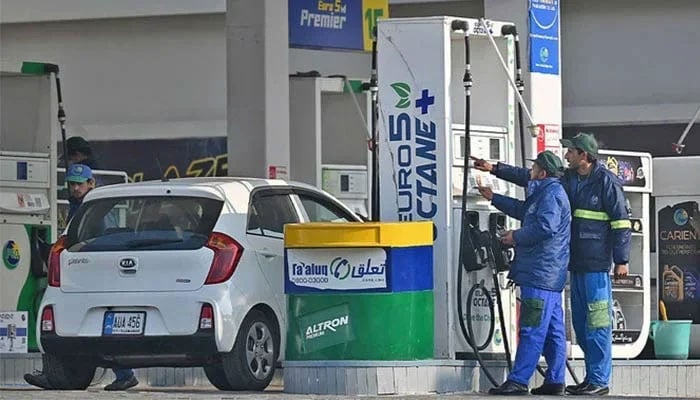
Minister for Petroleum Ali Pervaiz Malik on Thursday announced a massive increase in petrol and diesel prices, citing the ongoing Middle East conflict and rising global energy costs. Addressing a press conference along with Finance Minister Muhammad Aurangzeb, the petroleum minister said the price of petrol was being hiked to Rs458.41 per litre and that of high-speed diesel to Rs520.35 per litre.
Sohail acknowledged the immediate burden on consumers, warning that the increase would raise the cost of daily necessities and disproportionately affect lower-income groups. However, he said the duration of the shock would depend on how quickly global prices ease.
“If the conflict subsides in the coming weeks and oil prices fall, the government will have to pass that relief on domestically as well,” he added.
On the government’s proposed subsidy mechanism, Sohail emphasised the need for targeted support rather than broad-based relief. “The government shouldn’t provide cheap petrol and diesel to everyone, rich and poor alike—it should only be for the poor,” he said, adding that effective implementation would be critical given Pakistan’s limited track record in digital delivery systems.
He also linked the decision to broader macroeconomic constraints, including Pakistan’s commitments under the International Monetary Fund programme and upcoming external debt repayments. “If Pakistan doesn’t meet its obligations, it risks falling back into crisis,” he said, adding that higher prices could also help curb fuel demand and reduce the import bill.
Yousuf M. Farooq, director research at Chase Securities, echoed the view that the move, while painful, was necessary.
“This is going to hurt -- no way around it. It will take a real bite out of household budgets,” he said in a post on X. “Yes, it will push inflation up in the near term. But that pressure is largely external and should ease once the war-driven oil shock subsides.”
He warned that the alternative—absorbing the shock through subsidies or monetary expansion—could have triggered a deeper macroeconomic crisis. “A painful move, but ultimately the right one,” he added.
Oil surged on Thursday after US President Donald Trump threatened further heavy strikes on Iran, and offered no solution to reopening the key Strait of Hormuz.
The address late Wednesday in the US dampened hopes of de-escalation that had earlier buoyed markets. International benchmark, Brent North Sea crude, which had fallen below $100 a barrel ahead of Trump’s speech, went on to rally around 8.0 per cent to above $109 per barrel.
Former adviser to the Ministry of Finance Khaqan Najeeb said the delay in adjusting prices had compounded the problem, noting that domestic fuel demand remained strong despite the global surge.
“We are nearly a month late in taking this step, and sales are still up 19 per cent year-on-year (YoY,” he said in his remarks to Geo News. “The path we were on was not sustainable. Blanket subsidies are the worst kind -- you are giving the same benefit to someone with an 1800cc car as to a motorbike owner.”
Najeeb warned that the price shock would likely push key inflation indicators higher, with the Sensitive Price Index (SPI) rising further and headline inflation potentially returning to double digits. He called for targeted cash support for public transport users and greater coordination with provinces to cushion the impact on vulnerable groups.
He also urged demand-management measures, including energy conservation and changes in consumer behaviour, alongside structural reforms to reduce reliance on imported fuels. “Human behaviour and mindset today will determine how Pakistan gets through this,” he said.
Global diesel prices have surged to an all-time high amid escalating tensions in the Middle East. Since February 27, international diesel prices have risen by more than 222 per cent, including a sharp single-day increase of $46.5 on Thursday. Arab Gulf diesel closed at $284.97 per barrel, compared with $88.46 per barrel on February 27, marking an unprecedented spike.
In Pakistan, petrol has increased by Rs 192.24 per litre; diesel Rs239.49.
Opposition voices, however, criticised the move and the government’s broader policy approach. Pakistan Tehreek-e-Insaf (PTI) Chairperson Barrister Gohar Khan said on X that the scale of the increase reflected policy failures, including insufficient austerity measures and weak demand management.
President of the All Pakistan Anjuman-e-Tajran Sindh Jawaid Qureshi said that the government has dropped a “petrol bomb” on the public in the dead of night. The increase in petroleum product prices will trigger a wave of inflation, and ordinary citizens, especially industrialists and traders, will be affected. We urge the government to take back its decision.