Heavy rains lashed Karachi on Thursday, triggering a series of incidents that claimed at least six lives in different parts of the city. The authorities, including rescue services, police and civic agencies, remained on high alert, intensifying emergency response measures to manage the evolving situation.
The constant downpour caused significant disruption across the city and led to multiple fatalities, primarily due to electrocution and structural collapse. Rescue officials said that one of the victims, Sartaj, died after getting electrocuted at his house in Hassan Brohi Goth, New Karachi.
In another incident near PIB Colony, Abdul Wali lost his life after coming into contact with live electrical wiring, highlighting the dangers posed by exposed wires during heavy rains. Another incident unfolded near Old Golimar, where a rickshaw driver, Irshad, was killed after a wall of a residential structure collapsed on top of him in the rain. The incident raised fresh concerns about the structural safety of buildings in older parts of the city, particularly during adverse weather conditions.
Separately, Dua Batool, 12, died after getting electrocuted at her house in Sector 7A, Surjani Town. The incident has once again drawn attention toward the vulnerability of residential areas to electrical hazards during monsoon-like conditions.
Moreover, Shahabuddin died after getting electrocuted in Sector 3, Ahsanabad, and another person near MA Jinnah Road, close to the 7th Day Karachi Adventist Hospital, in similar circumstances.
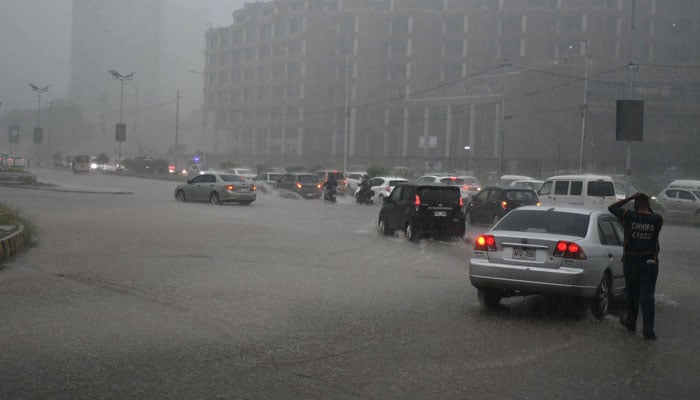
The heavy downpour also resulted in widespread urban flooding, severely affecting traffic movement across Karachi. Several major roads and underpasses were submerged under rainwater, causing long traffic jams and inconvenience to commuters.
Key routes including Sharea Faisal, MA Jinnah Road, Shahrah-e-Pakistan, II Chundrigar Road, and areas in District Central were among the worst affected. Important underpasses such as the one in Karimabad also remained inundated, making them impassable for vehicles.
In response to the situation, the Karachi Water & Sewerage Corporation (KWSC) activated its emergency drainage operations. A KWSC spokesperson said that jetting and suction machines had already been deployed in vulnerable areas prior to the rains as part of precautionary measures.
Low-lying areas, including Sharea Faisal, Baloch Colony, Nursery, FTC, CM House, Governor House, Saddar, Tower and Bilawal Chowrangi, were identified in advance for focused drainage efforts.
Officials said that all zonal chief engineers were directly supervising operations, while executive engineers and field staff remained present on site to monitor the drainage process. The KWSC emphasised that all available resources were being utilised to ensure uninterrupted drainage of rainwater and minimise disruption.
In a video message, KWSC COO Engr Asadullah Khan said that coordinated efforts were under way with all the relevant departments to provide relief to people during the rains. He urged the public not to open manhole covers during the rains, warning that such actions could pose serious risks to human life.
Meanwhile, the Sindh Building Control Authority (SBCA) launched an awareness campaign, urging residents of dilapidated and dangerous buildings to vacate immediately. Officials have been conducting announcements in various localities on the instructions of SBCA Director General Muzammil Hussain Halepoto, warning of potential building collapses during heavy rains.
An SBCA spokesperson said teams were actively delivering precautionary messages and advising people to stay away from unsafe structures. The authority reiterated its commitment to safeguarding lives by ensuring that residents of vulnerable buildings take immediate action.
On the administrative front, Sindh Home Minister Ziaul Hassan Lanjar issued directives to law enforcement agencies to remain on high alert in view of the rain emergency. He instructed that additional police personnel be deployed across all districts to respond to potential emergencies and ensure public safety.
Lanjar also ordered facilitating the timely evacuation of residents from low-lying areas and maintaining close coordination with rescue agencies. Traffic police were instructed to ensure smooth flow on major highways and to identify alternative routes in case of road blockages due to water accumulation.
The Karachi police, acting on the instructions of city police chief Azad Khan, also intensified its preparedness. Police officials were directed to remain present in their respective jurisdictions and continuously monitor the situation.
Patrol vehicles were equipped with the necessary tools and equipment to assist stranded motorists and remove vehicles stuck in the flooded areas. They appealed to people to avoid unnecessary movement during the rains and to stay away from exposed electrical wires, poles, trees and signboards.
Rain statistics
Based on data from the Pakistan Meteorological Department, Paposh Nagar received 69.6mm of rain, Keamari 56mm, Saadi Town 48mm, University Road 44.2mm, Bahria Town 43.5mm, Orangi Town 39.4mm and Gulshan-e-Maymar 36mm.
Moreover, the Jinnah Terminal received 35mm of rain, Surjani Town 35mm, DHA Phase-II 33mm, the old airport area 32.6mm, the PAF Base Faisal 30.4mm, the PAF Base Masroor 29mm, North Karachi 28.8mm, Korangi 18.2mm and Gulshan-e-Hadeed 17mm. Additional reports show that the M-9 areas received 20.5mm of rain.
Naqvi’s visit
Karachi Commissioner Syed Hassan Naqvi visited various areas, with the deputy commissioners and assistant commissioners remaining in field to help institutions and residents. Water drainage work is under way, according to the commissioner’s office, with priority efforts being directed in low-lying areas.
Naqvi took stock of the situation after the rains. He inspected the water drainage work and issued necessary instructions. He said that priority efforts are being made for draining water from low-lying areas and roads.