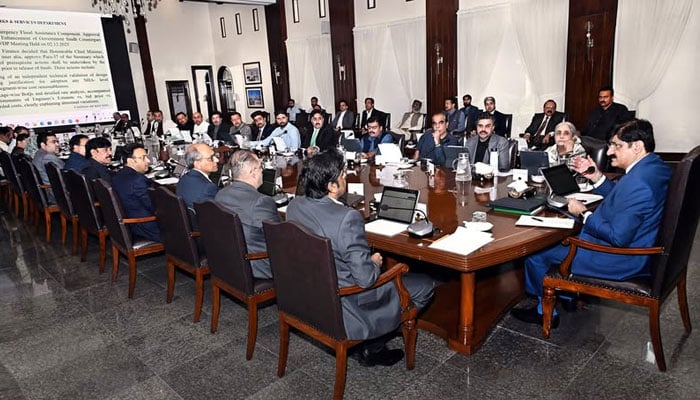
Sindh Chief Minister Syed Murad Ali Shah on Tuesday chaired a cabinet meeting that approved a wide-ranging set of policy decisions and development initiatives aimed at strengthening governance, boosting infrastructure, ensuring food security, and accelerating socio-economic development across the province.
The cabinet approved in principle a comprehensive survey of Kutcha areas to strengthen security, improve land governance, and support the government’s ongoing surrender policy. Shah said the decision to survey Kutcha areas aims to address long-standing discrepancies in land records reported at revenue offices, the forest department, and various federal agencies.
He said the survey would establish a digitised and accurate record of land ownership and usage, enabling authorities to clearly identify lawful occupants and curb illegal encroachments in sensitive riverine regions.
The project estimated at Rs705 million will be executed in collaboration with the Survey of Pakistan on a government-to-government basis. To fast-track implementation, the cabinet approved an exemption under the Sindh public procurement law, allowing immediate commencement of work.
Given the security situation in Larkana and Sukkur divisions, the timeline has been reduced from 25 months to 15.5 months, with multiple directorates operating simultaneously to expedite completion. The survey will employ modern geospatial technologies, including satellite imagery, GIS mapping, and advanced geodetic equipment.
The project will be carried out in two phases: the first phase will focus on boundary identification and GIS mapping of Kutcha lands, while the second phase will involve detailed cadastral mapping of 624 dehs, demarcation of land parcels, and collection of ownership data.
To ensure transparency and financial discipline, the cabinet directed that the project be processed as a non-ADP scheme through the planning & development department rather than as a grant-in-aid.
Shah underscored that the initiative is critical for restoring the state’s writ in Kutcha areas, noting that clear identification of land ownership is essential to distinguish between legitimate settlers and criminal elements, thereby ensuring the success of the surrender policy and long-term peace in the region.
The cabinet also approved a comprehensive financing and execution plan for the power component of K-IV, removing key bottlenecks to ensure the timely completion of the vital water project.
To overcome financing constraints, the cabinet approved shifting from a loan-based model to a grant-in-aid mechanism for the Karachi Water & Sewerage Corporation (KWSC). A total grant of Rs13.9 billion was sanctioned to fund critical power infrastructure, including a 132kV grid station, a 26km transmission line, an 11kV distribution network, and a staff colony to support a 50MW electricity load approved by Hesco.
The Sindh Transmission & Dispatch Company (STDC) will own, operate and maintain the power infrastructure, with the KWSC directed to immediately transfer funds to ensure smooth execution.
To ensure sustainability, the Sindh government will initially bear monthly electricity payments of approximately Rs1 billion to Hesco and Rs74 million to the STDC for operational costs. Shah directed the KWSC to improve its revenue recovery system so that it can gradually take over these financial responsibilities.
The decision is expected to significantly accelerate progress on K-IV, which is crucial for addressing Karachi’s long-standing water shortage and ensuring a reliable bulk water supply to the city.
The cabinet approved the wheat procurement policy for the 2025-26 Rabi season, setting a target of one million metric tons to ensure food security and maintain price stability across the province.
The cabinet fixed the indicative wheat price at Rs3,500/40kg in line with international parity and estimated import costs. To promote transparency and directly benefit genuine farmers, procurement will be limited to the 332,000 plus growers registered under the Sindh Wheat Growers Support Programme who had earlier received DAP fertiliser subsidy.
The cabinet also endorsed multiple infrastructure projects, including Rs2.55 billion for the repair of the Malir Halt-Ghaghar Phatak road, Rs888 million for flood-damaged infrastructure rehabilitation, and Rs1.96 billion for key road widening projects, and the approval of the M-9 interchange to complete the N-5 link road, while Rs1.45 billion was sanctioned for Lyari’s road and drainage rehabilitation under a broader transformation plan.
The cabinet approved Rs100 million for a modern stadium at St Patrick’s School, Phase-II of the Thar Institute (NED campus) costing Rs6.63 billion, the reimbursement of over Rs3.4 billion in student fees (in principle), and Rs4.33 billion for 98 SDG-related development schemes.
The cabinet also approved important development initiatives to improve facilities at major religious sites across the province. Shah sanctioned Rs51.52 million for establishing a library at the shrine of Sachal Sarmast in Daraza Sharif, Khairpur.
Additionally, Rs33.68 million was approved for infrastructure upgrades at the shrine of Shah Abdul Latif Bhittai, including road rehabilitation and installation of a 200kVA transformer at Bhit Shah. The CM approved the immediate release of 25 per cent funds to initiate both projects.
To modernise tourism infrastructure and preserve Sindh’s cultural heritage, the cabinet approved several landmark initiatives. A state-of-the-art Karachi Museum will be established near Beach View in collaboration with the Citizens Archive of Pakistan (CAP), with Rs655.9 million allocated for its development. The museum will showcase Sindh’s 5,000-year history and Pakistan’s independence narrative.
The cabinet also approved upgrading the Hawkesbay Resort into a modern capsule resort, and Rs305.6 million for the modernisation of the Sindh Museum, Hyderabad. A special purpose vehicle will oversee the Karachi Museum project, which will initially be managed by CAP for five years.
The cabinet also approved a special procurement framework to accelerate the 75-acre Inclusive City project in Korangi, aimed at providing world-class facilities for persons with disabilities.
To ensure timely execution, the cabinet allowed flexible contracting while mandating strict oversight through technical scrutiny, independent cost vetting, and continuous monitoring. Recruitment and procurement processes will follow public sector governance rules.
To strengthen health care, the cabinet approved two landmark laws to establish autonomous institutions: the Benazir Institute of Urology & Transplant, Nawabshah, to provide advanced treatment and training in kidney and urological diseases, and the Sindh Institute of Reproductive Health, Karachi, to address maternal and reproductive health challenges. Both institutions will function under independent boards, focusing on research, postgraduate training, and high-quality patient care.
The cabinet also approved the appointment of the NED University of Engineering & Technology as a third-party consultant for the Karachi Safe City Project’s C5ISR command centre. A consultancy cost of Rs130 million was approved to supervise and validate construction works, enabling the long-delayed project to resume and meet international standards.
The cabinet also approved a strategic partnership with the Green Corporate Livestock Initiative under the SIFC framework to modernise livestock through advanced breeding technologies. The five-year programme will introduce sexed semen and embryo transfer technology, improve milk production, and enhance farmers’ incomes. An initial Rs100 million has been allocated, with Rs200 million earmarked for next year.
To resolve key infrastructure bottlenecks, Shah approved Rs1.235 billion for the construction of an interchange on M-9, completing the N-5 link road. “The project will significantly reduce travel time and facilitate smoother movement of heavy and commercial traffic between major highways.”