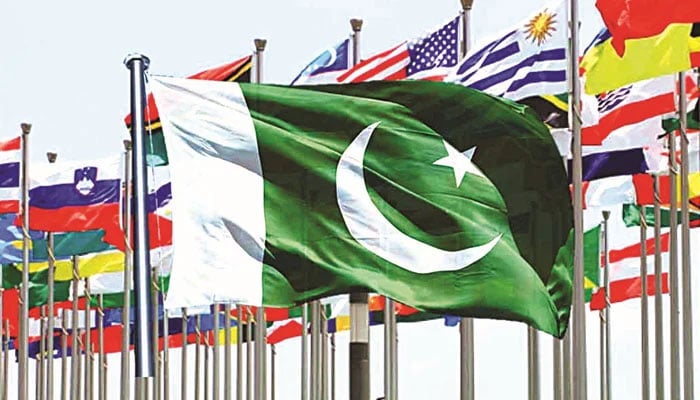
is a prime example of resilience beyond what is written in books. It Allah’s command that we will test you with loss of life, assets, hunger, and efforts: those who show patience will succeed. Since its inception, Pakistan has faced this test, battling complex global, regional, and neighborhood challenges to forge its own path. Within a few years of its establishment, Pakistan had to navigate through critical conflicts, including the Korean War and the Vietnam War, maintaining a principled stance. The country constantly deals with two hostile neighbours, India and Afghanistan. India has proved to be a determined enemy and has been dreaming of destabilising Pakistan since day one. Afghanistan has opposed Pakistan’s admission to the UN and has repeatedly posed challenges for Pakistan.
Despite these challenges, Pakistan did wonder on many fronts. For example, Pakistan brokered the biggest deal in modern history -- rapprochement between China and the US. This reconciliation spurred globalization and rapid global development. Pakistan developed into a formidable military power with nuclear, air, cyber warfare, and missile capabilities. It has cultivated a few friendships and brotherhoods that are time-tested and beyond doubt. The most prominent are China, Saudi Arabia, and Turkey. No doubt Pakistan is struggling on the economic front. There can be many factors of a struggling economy, but governance and natural disasters stand out among all. Pakistan had to cope with one disaster after another, including the 2010 and 2022 floods, the 2005 earthquake, and a drought from 1999 to 2003.
Now Pakistan is trying to deliver peace amid the grave global crisis emanating from US-Israel war on Iran. After the US-Israel attack on Iran, with the world on the brink of a wider war, Pakistan is leading efforts to prevent it. Pakistan was able to do this because it maintains stable, friendly relations with all parties involved.
Now the question is: how did Pakistan achieve this status? Many experts suggest that Pakistan reached this status because of its strategic location, but that’s not entirely true. The real reasons include unique diplomacy—both military and civilian—and a strong military. Pakistan’s diplomacy rests on three pillars: principles, selflessness, and structured diplomacy, aligned with the vision of the nation’s founder: friendliness and goodwill toward all nations.
First, Pakistan’s foreign policy is based on principles because we always support the right cause and oppose oppression or illegal actions. This is evident from Pakistan’s support for the Algerian independence movement, the Kashmir independence cause, the Palestine issue, the conflicts in Bosnia and Herzegovina, the Arab-Israeli war, the Russia-Ukraine war, the attack on Iran, and more. We can keep counting. Pakistan also advocates for the legitimate rights of nations, such as its support for the One China Policy and China’s stance on Xinjiang.
The second key pillar is structured diplomacy. Pakistan applied this pillar wisely and with a forward-looking strategy. Pakistan proved to be a chess player who keeps an eye on the big picture and makes moves accordingly. Pakistan’s policy is not based on immediate events or knee-jerk reactions. Pakistan always maintains relations with countries regardless of their group affiliations. However, Pakistan has never compromised on its core interests and key allies like China, Saudi Arabia, Turkey, and others.
Third, Pakistan has never tried to bill others for its principled diplomacy. Pakistan always remains selfless. For example, Pakistan never asked Algeria, Bosnia and Herzegovina, Korea, or any other nation to show gratitude or grant us special benefits. Particularly, in the case of Muslim countries, we sometimes had to face challenges, or they went against the interests of Pakistan, but Pakistan always continued to stand with them.
On the military and security front, Pakistan has become a formidable power without any doubt. Operation Bunyan Marsoos solidified Pakistan’s position as a strong military force. Pakistan defeated India comprehensively, forcing India to request a ceasefire. After the operation, Pakistan has emerged as a key security provider and stabilizing influence in the Middle East, Central Asia, and South Asia. Several countries are poised to sign defense pacts with Pakistan. The most notable example is the Pakistan-Saudi Arabia Defense Pact. Rumours also suggest that Pakistan and Saudi Arabia might expand this pact to include Turkey, Egypt, and Azerbaijan in the near future.
Moreover, Pakistan also supports its friends during times of crisis. For example, Pakistan assisted Afghanistan during the USSR-Afghan War. Pakistan also supported Azerbaijan, and Iran is the most recent example.
A strong military and a three-pillar diplomacy have raised Pakistan’s global standing, making Pakistan an ideal mediator trusted by the US, Iran, and regional countries. With all these elements and factors, Pakistan has demonstrated resilience, continued to grow, and reached many milestones, earning the reputation of a trusted, principle-based state.