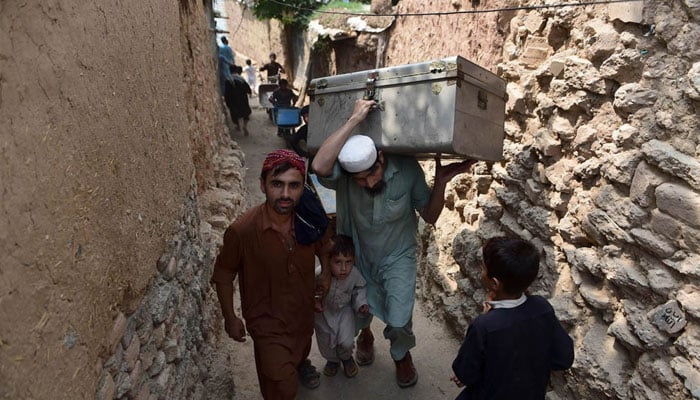
In Islamabad’s katchi abadi settlements, threatened evictions unfold through a reorganisation of land that does not arise from a singular administrative act but from the way contemporary capitalism assembles the capacities to extract value from territory.
Predatory formations refer to an alignment of finance, legal instruments, technical systems, and state authority operating across domains without consolidating into a single centre. This alignment recasts land as an asset whose value is defined by its capacity to circulate within financial and infrastructural arrangements that extend beyond its immediate location.
The settlements were relocated by the state, entered into administrative records and connected to utilities, but these prior stabilisations do not hold once land is reorganised through these formations.
This alignment does not operate only through land but extends across multiple domains, as finance, housing, sovereign debt, environmental degradation and carceral systems organise extractive processes through the same capacity to displace while remaining legible as ordinary economic activity.
Mortgage regimes that produce foreclosure, debt arrangements that hollow out states and ecological transformations that render land unusable proceed through this alignment. These domains operate in coordination, allowing value to be secured across different sites without requiring a single institutional centre. Land is drawn into this wider field rather than standing as an isolated object of intervention.
Saskia Sassen, a sociologist of global capitalism and urban transformation, identifies predatory formations as a defining feature of advanced capitalism, as land, housing and resources are drawn into circuits of value that do not require the continuation of the relations that had anchored them. The organisation of these extractive processes operates within capitalism itself, as these domains are continuously reorganised for new uses without preserving the conditions that had stabilised them.
Capitalism proceeds through displacement and recombination rather than through the expansion of stable relations tied to specific sites. The ground is altered in the terms through which it is held, such that continued presence no longer secures a claim and begins to take the form of expulsion.
The work of these formations lies in making land legible for operations that depend on its abstraction from prior attachments. Value is specified through its potential within broader systems rather than through the lives that sustain it. This does not occur through a single decision but through a layering of actions that shape the ground in advance, allowing it to be integrated into projects that require availability rather than continuity. The effect accumulates through processes that remain ordinary within their own domains while enabling a larger transformation.
This reorganisation does not require the event of eviction to assert itself, as the ground has already been recalibrated into uses that no longer admit those who live on it as part of its value. Markings, directives and the arrival of machinery do not initiate displacement but register a condition already produced through these formations. The force lies in converting land into an asset whose circulation does not depend on those who occupy it, allowing removal to appear as a technical necessity rather than a political decision.
In Islamabad, the threatened eviction of katchi abadi settlements follows from this organisation, as extractive capitalism proceeds by securing land while severing the relations that had sustained it.
The writer is a political geographer and editor.