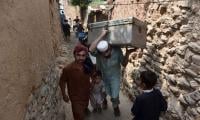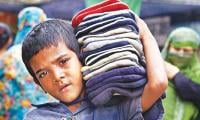
Across Pakistan, families face a daily struggle to stretch limited resources, pay for schooling, afford healthcare and secure a meal. For many, these pressures are compounded by a simple, seldom-discussed reality: the size of a household directly determines the depth of its poverty or the breadth of its opportunity.
For too long, population management has been viewed narrowly as a health or social issue, the domain of clinics and awareness campaigns. But the conversations I recently shared with a group of economists, planners, and development experts, convened by the Population Council, made one thing clear: the choices families make about their future are not merely personal; they are profoundly economic.
If we are serious about sustainable development, about lifting households out of poverty and securing Pakistan’s fiscal future, we must begin to see family planning as a strategic investment, not a peripheral concern.
The concept of ‘tawazun’ (balance) offers a powerful way to frame this conversation. At its heart, ‘tawazun’ recognises that every family has rights, responsibilities and resources, and that true well-being lies in harmonising these three elements. When families are empowered to plan the number and spacing of their children, they can align their aspirations with their means. The result is not merely healthier mothers and children, but stronger household economies.
Consider the household as a small business. When a family grows faster than its resources, the strain on its balance sheet is immediate. The ability to invest in each child’s education diminishes. The capacity to weather an illness or a job loss shrinks. Savings evaporate. By contrast, when families can exercise choice, they can channel their resources more effectively into better schooling, skills training and assets that build long-term security. In this sense, family planning is one of the most powerful tools for reducing poverty.
This is not about imposing targets but about enabling agency. When women and girls are educated and empowered to make reproductive choices, the benefits cascade through the economy. More women enter the workforce. Household incomes rise. Children, especially girls, stay in school longer. An economy that supports informed family planning nurtures a more productive and resilient workforce.
Yet in Pakistan, the connection between population dynamics and economic planning remains curiously absent from mainstream policy debates. Our public expenditure on health and education is stretched thin by the sheer number of young people entering the system each year. Our infrastructure struggles to keep pace. Our fiscal space is squeezed by the recurring costs of servicing a large, rapidly growing population.
These are not abstract concerns. They are felt in overcrowded classrooms, in overburdened hospitals and in the diminishing returns of public investment. Every rupee spent to meet the demands of uncontrolled growth is a rupee not invested in quality. This is the hidden tax of demographic imbalance.
What, then, is the way forward? The conversations among economists and planners pointed to several practical, actionable steps, none of which require radical upheaval, but all of which demand political will and cross-sectoral cooperation.
First, we mainstream population dynamics into economic planning. Our national and provincial development frameworks should treat demographic indicators, such as fertility rates and dependency ratios, as fundamental variables rather than afterthoughts. This means incorporating them into the NFC Award formula, annual budgets, medium-term development plans and the very criteria by which we allocate resources to local administrations.
Second, we need to rethink incentives. The current structure of fiscal transfers, such as the NFC Award, often rewards provinces with larger populations rather than those with better human development outcomes. Shifting the focus towards indicators like girls’ education, contraceptive use and maternal health would align fiscal policy with the goal of balanced, inclusive growth.
Third, we must invest in what works. Programmes that bring family planning services to rural communities, that train lady health workers to counsel families, that use media to normalise conversations about birth spacing - these are not expenses; they are high-return investments. Evidence suggests that every rupee spent on family planning can yield multiple rupees in future savings on health, education, and social services.
Fourth, we should engage every sector of society. Religious and community leaders have a vital role in framing family planning within Islamic principles of responsibility and wellbeing. The private sector can contribute through workplace programmes and telehealth initiatives. And our universities, through the HEC, can integrate population studies into economics curricula.
Critically, this is not about compulsion. It is about rights, responsibilities and resources: the three pillars of ‘tawazun’. It is about ensuring that every family has access to information and services, and that every parent can exercise the responsibility of raising children they can adequately provide for. It is about the state fulfilling its responsibility to create the conditions for families to thrive.
As we look to Pakistan’s future, we must ask ourselves a fundamental question: what kind of society do we want to build? One where families are empowered to plan, to invest, to break the cycle of poverty? Or one where we continue to treat population as a secondary issue, leaving households to bear the consequences of imbalance alone?
The answer is within our reach. By embracing ‘tawazun’ – by aligning rights, responsibilities and resources – we can transform family planning from a health target into an economic strategy. And in doing so, we can build a Pakistan where every child is a blessing, and no family is forced to choose between feeding a child and educating one.
The writer is a former civil servant, economist, and advisor to UNDP. This article is part of the Waqfa campaign’s op-ed series on birth spacing and sustainable development.