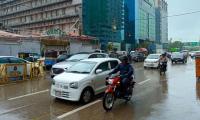
Despite all the talk last year of a ‘grand operation’ against smog, Pakistan has still managed to top IQAir’s rankings as the most polluted country in 2025. The Swiss air quality monitoring firm released its annual World Air Quality report for 2025 on Tuesday, showing that Pakistan’s air had concentrations of hazardous small particles, known as PM2.5, over 13 times the World Health Organisation (WHO) recommended levels. Bangladesh, Tajikistan, Chad and the Democratic Republic of the Congo were the other top five most polluted countries. Of the world’s 25 most polluted cities, all were located in Pakistan, India or China, with India accounting for three of the four most polluted. Faisalabad ranked as the most polluted Pakistani city while Lahore, long perceived as the epicentre of the nation’s smog and air pollution woes, came in third. This does not necessarily mean that the efforts local policymakers have taken to try to minimise the smog problem are not working. In fact, the IQAir report notes that the country achieved a 6.6 µg/m³ reduction in PM2.5 levels in 2025 and air pollution was actually lower in most major cities. Should this trend continue this year, one might be able to state with more confidence that the steps taken by local leaders, such as smog guns, drone surveillance of brick kilns and restrictions on the movement of heavy vehicles, are actually paying dividends.
Unfortunately, even if the trend continues, it will be around a decade before the nation’s air quality reaches the level experts deem to be safe. The human cost of all this toxic air is significant, with the report citing an Ipsos survey that found that 70 per cent of Pakistanis report experiencing smog-related health issues. It is estimated that the air-quality crisis claims around 22,000 lives annually. According to IQAir, while urban air is continually degraded by industrial emissions, vehicle exhaust, brick kilns, and construction dust, winter smog reaches a seasonal peak as stubble burning in Punjab’s wheat-rice belt engulfs Lahore and surrounding cities. Punjab is also where half of the country’s brick-kilns are located, and while government agencies set an October 20, 2025 deadline for kilns to adopt cleaner ‘zigzag technology’ or face demolition, it is unclear whether this has led to the desired changes. But these problems are not unique to Pakistan. Unregulated brick kilns, industrial and vehicular emissions, and crop burning are major barriers to cleaner air across Central and South Asia.
It must be pointed out that these are not exactly the most prosperous regions in the world and, for now, cleaner and less polluting technologies come with a price premium. Vehicles that emit less fumes are usually more expensive and while alternatives to crop burning do exist, do the nation’s farmers have access to the methods and infrastructure that enable these alternatives? This cost barrier parallels many of our other environmental issues. For example, the nation’s solar shift will help reduce emissions, but how many can afford the high up-front cost of panels or a home that makes these panels viable in the first place? And yet, even the world’s richer countries appear to be struggling with the air pollution problem. Only 13 countries/territories met the WHO annual average PM2.5 guideline, with economic heavyweights like the US and the UK missing. If countries with far more resources than Pakistan are struggling to get their air quality right, it only highlights the magnitude of the task that faces the country.