In a region once again teetering on the brink, Pakistan’s recent diplomatic push offers a rare and necessary countercurrent to the drumbeat of war. Prime Minister Shehbaz Sharif’s hour-long telephonic conversation on Saturday with Iranian President Masoud Pezeshkian can be seen as part of a broader, urgent effort to hold the line against a conflict that threatens to spiral far beyond its current theatre. The call, which focused on the ongoing hostilities in the region, came at a time when what is widely being described as a US-Israel war against Iran has stretched beyond a month. During the conversation, PM Shehbaz apprised President Pezeshkian of Pakistan’s diplomatic outreach aimed at creating a conducive environment for peace talks. These are not symbolic gestures. They are backed by coordinated efforts involving Foreign Minister Ishaq Dar and the military leadership, including COAS-CDF Field Marshal Asim Munir, to engage the US as well as Gulf and Islamic countries in pursuit of de-escalation.
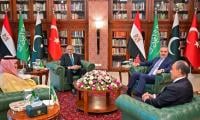
Pakistan has also reiterated its strong condemnation of continued Israeli attacks on Iran, including the latest strikes on civilian infrastructure, and reaffirmed its solidarity with the Iranian people. This position is based on solid ground. Over the past week, Pakistan has increasingly found itself in international headlines, with reports suggesting that US officials may visit Islamabad for talks with Iran – an indication that the country is being seen as a potential intermediary in this conflict. That Islamabad is hosting the foreign ministers of Saudi Arabia, Turkiye and Egypt for in-depth discussions on de-escalation is also a signal of the seriousness of this moment. The convergence of these states tells us something important: while the idea of a cohesive Muslim’ Ummah may remain elusive, there is nevertheless a shared recognition that this war must not be allowed to expand. Iran, for its part, has struck a careful tone, President Pezeshkian reiterating that Tehran does not engage in preemptive attacks but will retaliate forcefully if its infrastructure or economic centres are targeted. His warning to regional countries – that development and security hinge on not allowing Iran’s enemies to operate from their soil – was a pointed reference to US bases in the region and also reflects the fragile balance these states are trying to maintain.
Contrary to some obviously planted stories in sections of the Western media suggesting otherwise, key regional actors appear far more invested in de-escalation than in prolonging conflict. Saudi Arabia, in particular, is reportedly engaged in backdoor diplomacy to end the war. This behind-the-scenes engagement highlights a quiet but consequential reality: many in the region recognise that the costs of escalation would be catastrophic. It is no secret that Israel seeks to draw Arab countries into a wider war with Iran, something that would not only devastate the region but also plunge the global order into prolonged instability. Yet, as diplomatic efforts gather pace, there are repeated reports of Israeli strikes on Iranian infrastructure coinciding with moments of potential dialogue, raising serious questions about the intent to sabotage peace. The US’s position further complicates matters. President Donald Trump’s recent expression of disappointment with Nato for not offering support is a troubling disconnect. At a time when much of the world appears wary of further escalation, Washington’s posture risks reinforcing a war that many rightly view as both unjust and unnecessary. The correct perception that the US is funding, facilitating and actively fighting for Israel only deepens this unease. Ultimately, the current crisis lays bare a stark divide: between those pushing for war and those striving, however imperfectly, for peace. Pakistan’s recent diplomatic initiatives place it firmly in the latter camp. These efforts may not yield immediate breakthroughs, but they are vital in keeping channels open and preventing irreversible escalation. The world does not need another protracted conflict in an already volatile region. In this fraught moment, Pakistan’s attempt to hold the line may well prove more consequential than many realise.