I remember the early 1990s with unusual clarity. I was teaching at the Institute of Business Administration in Karachi, and the cold war had just ended. In many academic circles, there was a mood of triumph. Francis Fukuyama’s ‘The End of History’ was being discussed as if ideology itself had run its course.
Soon after came Samuel Huntington’s notion of a ‘clash of civilisations’. I read both and discussed them with my students. My own position was firm. Civilisations do not wage wars, I argued; states do. Empires do. Economic and political interests do. Religion and culture may supply the slogans, but the real struggle is usually about power, territory and resources. Huntington’s argument seemed to me clever but hollow.
A decade later, while I was in England pursuing my doctoral studies, I found myself watching huge demonstrations against the impending Iraq war. Those marches remain vivid in my mind: students, workers, academics, families, all out on the streets against a war that many understood to be wrong before it had even begun. It struck me then how much the world had changed in barely ten years. In the early 1990s, the idea that the post-cold-war order would be driven towards a quasi-civilisational confrontation had seemed unthinkable to me. Yet by the early 2000s, that was exactly what was happening. Not because Huntington had discovered some eternal law of history, but because the world was being pushed in that direction.
That push served a purpose. Rather than confront the real failures of the post-cold-war order, politics increasingly turned towards new enemies. The new age needed new demons. Islam became one. Later, China would become another. The point was to redirect public anger away from the contradictions of capitalism and towards cultural or civilisational threats. Identity was made to do the work that social criticism ought to have done. At the centre of this shift stood the US, which emerged from the cold war not merely as the strongest power, but as a power convinced of its own moral authority. It saw itself as the custodian of world order. That belief produced a dangerous habit: the assumption that American actions carried legitimacy simply because America undertook them. The invasion of Iraq in 2003 was the clearest expression of this.
The failure to find the weapons of mass destruction that had been used to justify the war did more than expose a lie. It revealed a deeper pattern: evidence could be twisted, legality could be bypassed and international institutions could be ignored when America’s self-image demanded it. The war isolated the US diplomatically, damaged its moral standing and widened the gulf between American rhetoric and American conduct. This was not a one-off lapse. On Palestine, and especially on Israel, America has repeatedly found itself cut off from the broader international mood. It invokes a rules-based order, yet treats those rules as flexible when its allies are involved. Power it still has in abundance. But moral authority is another matter. America is not isolated because it is weak. It is isolated because it mistakes power for innocence too often.
India’s path has been different, but the underlying logic has become increasingly similar. For decades after independence, India enjoyed considerable prestige in the postcolonial world. It had flaws, many of them serious, but it also had a reputation for pluralism, constitutionalism and anti-colonial solidarity. Non-alignment gave it a moral profile that exceeded its material weight. That inheritance has been steadily eroded. Under Narendra Modi, India has moved towards a more overtly majoritarian nationalism. The revocation of Jammu and Kashmir’s special status in 2019 was a turning point, signalling that the republic was becoming more comfortable with narrowing citizenship into a more explicitly civilisational frame. The controversy surrounding the Citizenship Amendment Act reinforced that impression. A state that once took pride in diversity began to sound increasingly anxious about it.
India’s international posture has reflected this change. It still enjoys goodwill in parts of the global South, and its size and economic rise give it room to manoeuvre. Yet its behaviour on questions such as Gaza has exposed a deep tension. Historically, India spoke in favour of Palestinian rights and anti-colonial struggles. More recently, however, its strategic intimacy with Washington and Tel Aviv has made it hesitant and equivocal. This is not classical non-alignment. It is a more nervous calculation: an effort to retain the prestige of independence while moving closer to power.
India has known sharper isolation before, most notably after its nuclear tests in 1998. But those moments were offset by the memory of an earlier India that seemed morally distinctive. That memory is fading. India is not friendless, but it is losing the particular stature it once had. The more it speaks in the language of civilisational grievance and majoritarian certainty, the less it resembles the republic that once inspired admiration.
Israel is the starkest case of the three. Its estrangement from world opinion is not simply the result of hostile neighbours or old enmities. It is the product of prolonged occupation, expanding settlements, repeated military assaults and the normalisation of a system that much of the world now regards as indefensible. For years, Israel insisted that criticism of its conduct was either malicious, prejudiced or strategically blind. But people can see what is happening. International legal bodies, human-rights organisations, students, unions, church groups and large parts of public opinion have become more willing to say plainly that Israel’s conduct has placed it in profound moral isolation.
It still enjoys powerful protection, above all from the US. But protection is not legitimacy. Israel’s deeper problem is that it has come to confuse military superiority with a political solution. Security is invoked as a permanent explanation, but no one can be denied justice forever without consequences. The longer occupation continues, the narrower Israel’s circle of genuine legitimacy becomes. It may remain militarily formidable, yet morally it stands increasingly alone.
What links America, India and Israel is a shared political temperament. Each presents itself as exceptional. Each treats criticism as hostility. Each turns its power into proof of virtue. America claims to defend liberty even when it breaks the rules it preaches. India increasingly wraps majoritarian ambition in civilisational language. Israel presents domination as endless self-defence. In each case, self-righteousness replaces self-criticism. That is why Huntington’s thesis proved so useful, even if it was intellectually shallow. It allowed the real contradictions of the age to be hidden behind cultural drama. It encouraged younger generations to imagine that history’s great conflicts were between civilisations rather than between systems of power and structures of exploitation.
Fukuyama announced the triumph of liberal capitalism. Huntington suggested that what remained was civilisational struggle. Between them, they narrowed the moral and political imagination of the post-cold-war world. And so the deeper questions were pushed aside. Why did inequality worsen after 1991? Why did wealth concentrate so spectacularly at the top? Why did public goods decline while military budgets flourished? Why were poorer societies asked to live with debt, war, sanctions and structural adjustment while the richer world spoke of order and progress? These were the real issues. But it was far easier to mobilise populations through fear of cultural enemies.
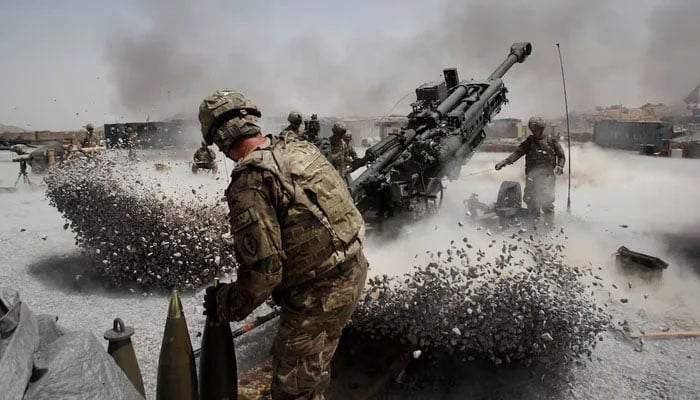
For Pakistan, the consequences of this global shift have been enormous. No country in South Asia has lived more directly with the costs of the post-cold-war search for new enemies. After 9/11, Pakistan became a frontline state in a war whose strategic vocabulary was modern but whose deeper emotional grammar had become civilisational. The results were devastating: militancy, blowback, displacement, economic strain, diplomatic pressure and long-term internal exhaustion. Pakistan paid in lives, security and stability for wars that were never entirely its own.
I think back, then, to those two moments that frame this argument for me: the classroom in Karachi in the early 1990s, and the anti-war demonstrations in England in the early 2000s. In the first, I dismissed the clash-of-civilisations thesis as nonsense. In the second, I watched a world already being manoeuvred into it. What had seemed impossible in one decade became governing common sense in the next – not because history demanded it, but because politics manufactured it.
The writer is dean of the faculty of liberal arts at a private university in Karachi. He tweets/posts @NaazirMahmood and can be reached at: [email protected]