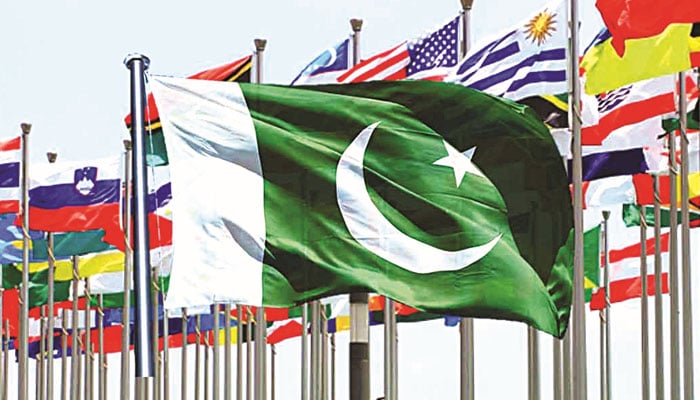
One has often heard that Pakistan has deviated from Quaid-i-Azam Muhammad Ali Jinnah’s vision and that this is not Jinnah’s Pakistan. Every now and then there is a call to revert back to Jinnah’s Pakistan. What exactly was Jinnah’s idea of Pakistan remains a hotly contested and debated subject. This scribe has written about it on these pages earlier. Today, we will address a part of this puzzle: Pakistan foreign policy relations as envisioned by Quaid-i-Azam Muhammad Ali Jinnah and the state of it 79 years later. What was Jinnah sahib’s vision? what sort of foreign policy he wanted Pakistan to pursue? And how Pakistan’s foreign policy and relations have evolved and fared since independence?
Quaid-i-Azam Muhammad Ali Jinnah articulated the guiding principle of “friendliness and goodwill towards all nations of the world” or “peace with all, and enmity with none.” On August 15, 1947, Quaid-i-Azam stated: “Our objective should be peace within and peace without. We want to live peacefully and maintain cordial and friendly relations with our immediate neighbours and with the world at large. We have no aggressive designs against anyone. We stand by the United Nations Charter and will gladly make our contribution to the peace and prosperity of the world.” Pakistan’s foreign policy, according to Jinnah, would be based on the unwavering observance of the principles of the UN Charter, primarily the principles of peaceful settlement of bilateral disputes, territorial integrity, sovereign equality, and non-interference in the affairs of other states.
In pursuit of this vision, one of the earliest foreign policy decisions taken under his leadership was to apply for membership in the United Nations (UN) in September 1947. In February 1948, he further elaborated Pakistan’s foreign policy goals: “Our foreign policy is one of friendliness and goodwill towards all the nations of the world. We do not cherish aggressive designs against any country or nation. We believe in the principle of honesty and fair play in national and international dealings and are prepared to make our utmost contribution to the promotion of peace and prosperity among the nations of the world. Pakistan will never be found lacking in extending its material and moral support to the oppressed and suppressed peoples of the world, and in upholding the principles of the United Nations Charter.”
Translating his foreign policy vision into reality, as Pakistan’s Governor-General, Quaid-i-Azam firmly argued in favour of the right of self-determination and provided unwavering support to the Palestinian people. He also refused to provide transit facilities to and strongly opposed the Dutch attack on Indonesia. Furthermore, he ardently opposed the French occupation of the North African Arab territories. Additionally, Pakistan provided active diplomatic support to the ongoing freedom struggles of several Muslim states, such as Algeria, Libya, Nigeria, Malaya, and Morocco.
Regarding India, Quaid-i-Azam, despite the bitterness between the leadership of Hindu and Muslim communities before 1947, was optimistic that post-independence, could live peacefully as good neighbours. He argued: “It is of vital importance to Pakistan and India, as independent, sovereign states, to collaborate in a friendly way to jointly defend their frontiers, both on land and sea, against any aggression. But this depends entirely on whether India and Pakistan can resolve their own differences. … The Indian government should shed their superiority complex and deal with Pakistan on an equal footing, fully appreciating the realities.”
Sir Zafarullah Khan, a highly respected and globally renowned jurist and the architect of Pakistan’s foreign policy, averred: Pakistan believes in and pursues “friendship towards all states... (and) standing on the side of fairness and, subject to that, to help and succor the weak.” Furthermore, “not to hold any narrow and special commitments or any prejudices in the international sphere,” and that Pakistan would neither tie itself to the apron strings of the Anglo-American bloc nor become a camp follower of the communist bloc. This was the vision and the goal that were set and pursued by Quaid-i-Azam. However, the developments that took place soon after partition created certain compulsions for Pakistan that were compounded by the dictates of geography and external threats.
Pakistan emerged on the world map when the world was on the onset of the cold war. Pakistan inherited the British threat perception and strategic outlook. Furthermore, the events following partition, the issue of Kashmir, and the perceived threat from India compelled Pakistan to make decisions and take actions that had lasting effects.
Pakistan’s foreign policy could be studied in several phases. The first was from 1947 to 53. As the weaker state in its bilateral equation with India, Pakistan sought to overcome its challenges by searching for a balancer or equalizer against India. This quest led it to exploring options ranging from the United Nations and Pan-Islamism to the British Commonwealth. This quest started from United Nations, Pan-Islamism to the British Commonwealth. Eventually, Pakistan became entangled in Cold War bloc politics.
In the second phase (1954-62), Pakistan joined SEATO (1954) and CENTO (1955). Pakistan received military aid and certain security guarantees against Soviet threat. In the third phase (62-71), especially during the 1965 war with India, the limitation of Pakistan’s alliance with the USA were exposed and it started to explore other options. The 1971 debacle and dismemberment of the country further enforced it and Pakistan expanded its foreign relations and policy outreach under Bhutto’s leadership.
From 1972 to 1979, Pakistan pivoted to Islamic solidarity via the OIC, strengthened its relations with the Middle Eastern countries and according to some experts focused on bilateralism and non-alignment. It was during this phase that Pakistan embarked on its nuclear weapons program. During the next two phases (1980-90 and 90-2001), Pakistan joined USA and defeated the USSR in Afghanistan. Post USSR withdrawal, Pakistan remained entangled in Afghanistan that resulted in long term regional and international implications. During this time, Pakistan in response to Indian nuclear tests, conducted its own tests in May 1998 becoming first Muslim state with nuclear capability. 9/11 was a watershed event for the whole world especially for Pakistan as it was Afghanistan’s neighbour. In the ensuing global war against terror, Pakistan became part of the global alliance against terrorism. War on Terror, yielded $33 billion in aid but resulted in terrorism problem and domestic instability. 2010s featured reinforcement of Sino-Pakistan Iron brotherhood in the shape of CPEC. Around the same time, the policy makers’ realisation strengthened that Pakistan needs to reorient its foreign policy towards geo-economics leveraging its territory for ripping economic dividend by acting as a zipper state. This translated into Pakistan’s National Security Policy 2020-2026. Apart from time tested strategic friendship with China, Pakistan now has functioning relations with Russia, USA and several European countries. Post Pahalgam crisis, Pakistan has emerged on the global map as a confident player.
Throughout Pakistan’s history, the foreign policy objectives remained consistent: security from Indian threat, the resolution of the Kashmir problem, support the Muslim causes and Muslim unity, securing economic aid (when required) and balancing relations with major powers. Throughout this period, several developments took place over which Pakistan has little control but these impacted Pakistan and its foreign policy yet overall, Pakistan’s foreign policy remained consistent. In the process Pakistan made several achievements while certain areas remained lacking.
Would Jinnah had conducted Pakistan’s foreign policy or relations differently? Would Pakistan have joined the American block during the cold war? In keeping with the orientation and policy outlook of the Pakistani leadership, this would have been the case. In fact, if we are teleported back in 1950s with the same conditions and outlook, the decision would remain the same. Pakistan in 2026 follows the same principle that were set by Jinnah sahib at the time of independence: friendliness and goodwill towards all nations of the world-or “peace with all, and enmity with none.”
The author is a Karachi based academic