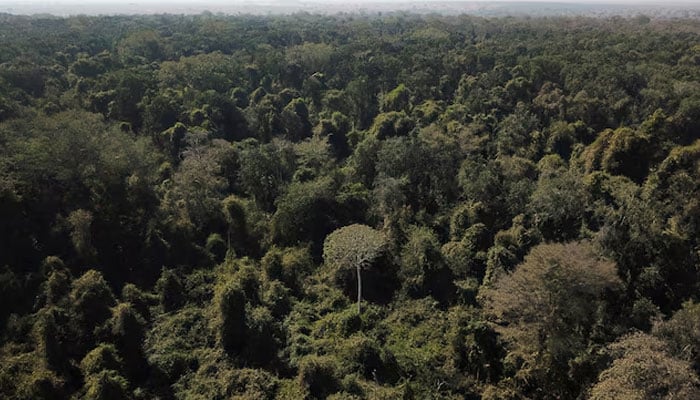
The International Day of Forests is celebrated on March 21 each year to raise public awareness of the critical role of forests for humanity and to urge governments and the private sector to take steps to protect them.
The theme this year is ‘Forests and Economies’, highlighting the contribution of forests to the growth and development of economies worldwide. Forests are a source of livelihoods, health and nutritional products, and services that help boost economic progress. There are multiple ways in which forests provide oxygen to economies for their growth and advancement.
First of all, forests fulfil the timber and fuel needs of local communities and the furniture industry. Rural communities in remote areas lack access to gas and other modern amenities. To cook food and keep warm in winter, they are dependent on wood from forests. According to the Pakistan Institute of Development Economics (PIDE), the total wood supply in Pakistan is estimated at 52 million cubic metres (cbm), of which timber accounts for 29 per cent (15 million cbm) and fuelwood for 71 per cent (37 million cbm). Wood from the forest is used for sports, construction material, and the furniture industry, which are economic drivers in the country.
Similarly, forests are a great source of food and vegetation. They not only feed human beings but also wildlife, which are important for a healthy ecosystem and sustaining economies.
Another important aspect is that forests make a significant contribution to global economies. Many rare herbs and seeds found in forests are used in medicines that help cure many fatal diseases and play a role in the growth of the pharmaceutical industry worldwide. According to the WHO, at least 80 per cent of the world’s population depends on traditional medicine to meet primary healthcare needs. According to the Forest Stewardship Council, “Forests are a vital source of medicine plants for both traditional and modern healthcare systems”.
Another important aspect of forests is their role in protecting against climate change disasters, which destabilise economies, through carbon storage and as natural barriers against floods. According to the European Environment Agency, weather- and climate-related extremes caused economic losses of assets estimated at EUR822 billion during 1980-2024 in the European Union, with over EUR208 billion (25 per cent) between 2021 and 2024.
Per the World Economic Forum (WEF), the world’s forests absorbed nearly twice as much carbon dioxide as they emitted between 2001 and 2019, according to research published in ‘Nature’. Increased carbon emissions lead to global warming, which causes climate change.
Forests also play an important role in job creation and service provision, which is an important aspect of economic activity. According to the Climate Smart Forest Economy Program, “in Canada, employment is created through regeneration practices, which have opened up job opportunities that complement the forestry industry’s contribution to the country’s GDP, which in 2017 was $24.6 billion dollars. Further, it is estimated that every job created in forestry generates an additional 1.5 to 2.5 jobs in the economy, since a major share of a worker’s income goes to purchasing goods and services”.
Similarly, forests promote tourism, an important economic driver. Many countries rely heavily on tourism to boost their economies and generate employment for local communities. For example, hotels, entrance fees, transportation, etc utilised by tourists are an important source of economic benefits. The World Bank says that tourism is projected to contribute 10.3 per cent of global GDP – about $11.7 trillion – and support a record 371 million jobs worldwide in 2025.
Similarly, an indirect cost of the forest is the health challenges it poses. Forests act as air purifiers, providing clean air for humans. Deforestation creates health challenges with economic costs. Healthcare costs and reduced productivity due to health problems weaken overall economic growth. According to the World Bank, “a changing climate could lead to excess health costs in low- and middle-income countries of at least US$21 trillion by 2050, equivalent to approximately 1.3 per cent of their projected GDP”.
Forests are a natural treasure for the world’s economies. The rapid deforestation across the globe is directly and indirectly negatively impacting the world’s economies.
We need to make a commitment on this International Day of Forests to safeguard forests to boost our economies and contribute towards the welfare of humanity. It is our collective responsibility, led by governments, the private sector, and individuals, to play our role and take steps to enhance our collective wealth.
The writer is a graduate of the University of Oxford in Public Policy. She tweets/posts @zilehumma_1 and can be reached at: [email protected]