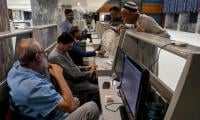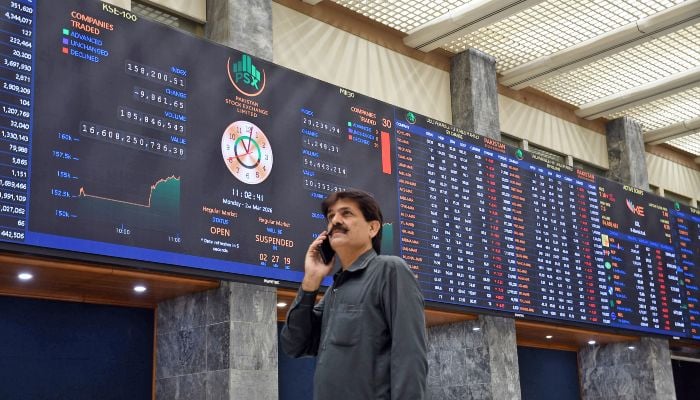
The equity market fell on Thursday as oil prices surged after fresh attacks on Gulf energy infrastructure, while investors also booked profits after Wednesday's strong rally.
"PSX is under pressure today due to increased oil prices caused by the Middle East conflict. The latest attacks on the LNG field in Qatar caused oil to spike 5%, which is creating selling pressure in the market," said Ahfaz Mustafa, CEO of Ismail Iqbal Securities.
"Expected fuel price hike, and deteriorating macros, are also weighing in on the negative sentiment," he added.
The Pakistan Stock Exchange’s (PSX) benchmark KSE-100 Index settled at 152,740.37 points, down 1,551.88 points, or 1.01%, from the previous close of 154,292.25. The index traded between a high of 152,698.51, down 1,593.74 points, or 1.03%, and a low of 150,728.17, down 3,564.08 points, or 2.3%.
Qatar's main gas hub suffered “extensive damage” after two waves of Iranian strikes, QatarEnergy said on Thursday, heightening supply fears as the Middle East war grinds on.
Missile attacks on Ras Laffan Industrial City damaged a gas-to-liquids facility and later sparked sizeable fires and further damage to several liquefied natural gas facilities, though Qatar's interior ministry said all fires had been brought under control and no injuries were reported.
US President Donald Trump warned Iran against further strikes on Qatar's gas plant and threatened to destroy Iran's South Pars gas field if attacks continue. Trump said Israel struck facilities at South Pars but that the United States "knew nothing" of the attack.
The South Pars/North Dome mega-field is the world's largest known gas reserve and is shared by Iran and Qatar; around 70% of Iran's domestic natural gas comes from its portion of the field.
Supply concerns also spread elsewhere in the Gulf. The Ras Tanura complex in Saudi Arabia, one of the largest refineries in the Middle East with a capacity of 550,000 barrels per day, has been repeatedly targeted during the conflict, including an early drone strike that caused a fire and partial shutdown.
Bloomberg reported on Wednesday that operations had resumed. The International Energy Agency said Gulf output of oil and oil products has fallen from 30 million barrels per day last year (excluding Oman) to 20 million currently, while Aramco's president warned the war could have "catastrophic consequences" for oil markets.
Oil rose more than 5% on Thursday, with Brent spiking above $112 a barrel at its peak, as attacks on key regional energy assets heightened fears of further disruption.
In the previous session on Wednesday, the KSE-100 surged 4,276.09 points, or 2.85%, to close at 154,292.25 from 150,016.16, after trading between 154,684.45 and 150,284.26.