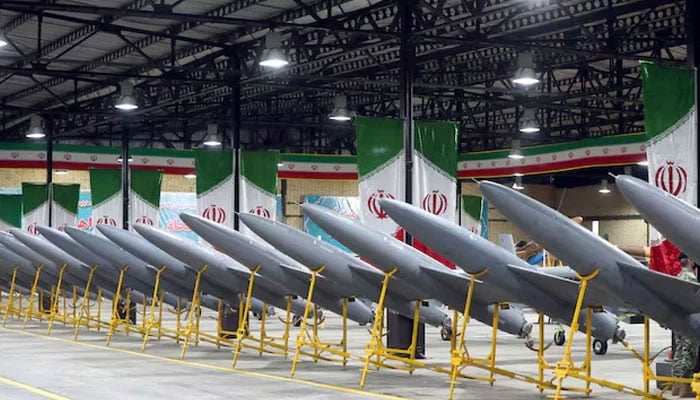
Problem: Iran’s Shahed-136 flies at approximately 185 km per hour at low altitude — nap-of-the-earth, below radar coverage. Iran’s Shahed-136 is slow enough to be tracked but fast enough to be difficult to kill with guns at range. The ideal interceptor needs to be faster than the Shahed, cheaper to deploy than a Patriot and capable of autonomous or semi-autonomous terminal guidance.
Solution: NASCOM’s Burraq, at 215 km per hour, can pursue and destroy a Shahed-136 in an intercept scenario. Burraq’s Barq laser-guided missile gives it a standoff kill capability at 8 km — enough to destroy the target before its warhead can detonate over populated areas.
The UAE is relying on Patriot PAC-3 missiles, each reportedly costing $13.5 million, to intercept Shahed-136 drones that cost an estimated $30,000 per unit. That is a 450-to-1 cost ratio. Imagine: in a swarm scenario involving dozens of Shaheds, the arithmetic becomes untenable regardless of how many Patriot batteries the UAE has deployed.
The UAE is living through the 450-to-1 arithmetic in real time. By March 16, Iran had launched 304 ballistic missiles, 1,627 drones and 15 cruise missiles against the UAE. The UAE’s air defence systems intercepted the vast majority — approximately 90 per cent overall, an impressive performance that is simultaneously an economic catastrophe.
The UAE operates three interceptor tiers: THAAD at $12.7 million per missile, Patriot PAC-3 at $7 million per missile (typically fired in pairs, making each engagement $14 million), and Patriot PAC-2 at $4 million per missile. Blending across all three systems, a conservative average of $4 million per intercept. At that rate, destroying 1,627 Iranian drones cost the UAE approximately $6.5 billion in interceptors alone. Iran spent roughly $57 million producing those same drones at $35,000 each. The kill ratio: 114 to 1 in Tehran’s favour.
Red alert: For every dollar Iran spent launching a drone at the UAE, Abu Dhabi spent $114 shooting it down.
The Burraq’s export price would likely land between $800,000 and $1.5 million per unit. That is 25 to 50 times cheaper than a Patriot intercept. The UAE buying 200 Burraqs as a dedicated counter-Shahed layer — forward deployed at coastal air bases within 100 km of the Gulf — would cost approximately $150-300 million. It would save 10 times that in Patriot missile expenditure over a sustained 90-day campaign.
Pakistan can manufacture Burraqs at a fraction of Ukraine’s interceptor costs and without the export restrictions that currently limit Ukrainian manufacturers from selling their systems abroad.
Admittedly, Burraq would not replace Patriot or THAAD. It would sit beneath them — a dedicated drone-interceptor layer designed to kill slow loitering drones before they force the UAE to spend multi-million-dollar missiles.
In the drone age, victory will belong not to the side with the best missile but to the side with the best arithmetic. The UAE can intercept the Shahed. That is not the question. The question is whether it can afford to keep doing so.
The writer is an Islamabad-based columnist.