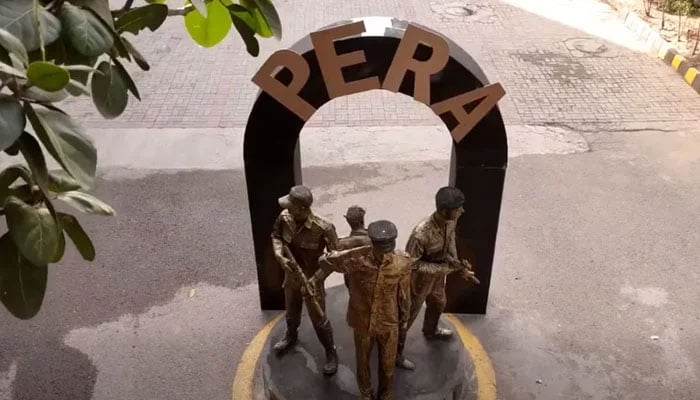
LAHORE: The Punjab Enforcement and Regulatory Authority (PERA) has introduced a new prosecution mechanism under which suspects arrested by the authority will be sent directly to judicial custody and investigated in prison, marking a major shift from the traditional practice of police remand.
Officials said the authority has also made manual challans illegal, directing that all penalties be issued only through the digital e-challan system. Any officer issuing a manual challan will face disciplinary action, as the practice has been declared an offence under the enforcement framework. Authorities also claimed that, owing to what they described as a “strong and precise legislative structure,” PERA has not lost any case in the High Court so far.
The measures come amid a wide-ranging enforcement campaign across Punjab in which the authority has conducted hundreds of thousands of inspections, issued thousands of challans and initiated criminal proceedings in numerous cases.
Official data shows that a total of 304 FIRs have been registered by enforcement stations across Punjab, with 233 challans submitted to courts. Bail was granted to 210 accused, while 213 suspects obtained bail through courts. The data also indicates that 113 accused confessed before courts, 217 suspects were granted judicial remand, and four cases involved physical remand. So far, only one conviction has been recorded while no acquittal has been reported in the latest consolidated figures.
Among enforcement stations, Lahore Nishter recorded the highest enforcement activity with 61 FIRs, followed by Lahore City and Lahore Model Town with 24 FIRs each, Lahore Raiwind with 19, and Lahore Cantt with 16 FIRs. Other districts with notable cases include Chiniot (12 FIRs), Toba Tek Singh (10), Bhakkar (9) and Rawalpindi City (7).
Several districts, including Attock, Bahawalnagar, Gujrat, Hafizabad, Jhelum, Jhang, Khanewal, Kot Addu, Layyah, Murree, Muzaffargarh, Narowal, Pakpattan and Vehari, reported no FIRs during the period under review.
According to the PERA force requisition dashboard, the authority has processed 30,424 requisitions since Aug 29, 2025. Of these, 23,123 requisitions have been completed, 528 squads assigned, 967 requests remain pending, while 799 cases were either rescheduled or withdrawn by initiators. Another 5,007 requisitions have expired.
Category-wise analysis shows anti-encroachment operations dominating the requisition system with 17,569 cases, followed by price control operations (9,813), anti-hoarding drives (2,353), evictions (449) and public nuisance complaints (237).
PERA’s inspection regime has also expanded significantly. Officials conducted 371,553 inspections, of which 219,685 were completed while 151,867 remain incomplete. The inspections resulted in 45,489 challans amounting to Rs165.7 million, out of which 34,240 challans worth Rs119.88m have been paid, while 11,241 challans worth Rs45.84m remain unpaid.
Separate administrative fine statistics show that since Aug 1, 2025, a total of 19,655 challans related to price control, 25,453 encroachment cases, and 230 hoarding violations were issued. The fines collected include Rs72.27m for price control, Rs87.93m for encroachment, and Rs4.39m for hoarding violations.
PERA’s price control monitoring committees (PCMs) have carried out extensive market inspections since Aug 1, 2025. Through two monitoring applications, officials conducted more than 1.86 million inspections, imposed fines exceeding Rs194m, sealed 1,680 shops, and arrested over 6,100 persons. A total of 11 FIRs were registered in connection with price control violations.
Anti-encroachment operations have also been a major focus. PERA teams conducted 219,493 raids, recovered 7,539.58 kanals of government land, issued 103,596 warnings, and arrested 1,055 individuals while registering 207 FIRs. The highest number of raids were reported from Lahore division (53,419), followed by Gujranwala (34,817) and DG Khan (22,526).
In anti-hoarding operations, authorities carried out 1,907 raids, confiscating 15,326.39 metric tonnes of hoarded commodities with an estimated value of Rs575.23 million. About 4,004.59 metric tonnes of seized goods were auctioned through the Price Control and Commodities Management Department, while five persons were arrested and two FIRs registered. The highest raids were recorded in Rawalpindi division (414), followed by DG Khan (269) and Gujranwala (254).
PERA also handled 8,270 public complaints related to nuisance and regulatory violations, resolving 6,317 cases. During these actions, 3,091 warnings were issued, 207 individuals arrested, 284 premises sealed, and 36 FIRs registered. Most complaints were reported from Lahore (1,663), Multan (1,564) and Sahiwal (1,475) divisions.
Fuel station monitoring was another major component of the enforcement campaign. On March 9, 2026 alone, 233 petrol pumps were inspected, with Rs120,000 in fines imposed for violations. Since the start of the inspection campaign, 3,751 inspections have been conducted. Authorities detected 31 hoarding cases, 90 instances of overcharging, and 51 pumps not selling fuel, leading to fines amounting to Rs3.347m, 23 petrol pumps sealed, and 17 persons arrested.
PERA’s enforcement record also shows progress in criminal prosecution. In 2025, the authority registered 125 FIRs, with 20 convictions recorded, 62 complete challans submitted, and 91 suspects arrested. In 2026, the number of registered FIRs rose to 199, with 60 convictions, 106 challans submitted, and 152 arrests. Fines collected in these cases amounted to Rs1.08 million in 2025 and Rs4.37 million in 2026.
Meanwhile, 85 court cases have been filed against PERA to date, of which 43 have been disposed of, while 32 cases remain pending in the High Court and 10 in civil courts.
Infrastructure development for enforcement stations is also underway under the Annual Development Programme. In Phase-I, 85 enforcement stations are planned, including 67 new constructions and 18 renovation or rehabilitation projects, with financial progress recorded at 11.37pc for new construction and 18.37pc for renovation, while physical progress stands at 15.58pc and 31.17pc respectively. Phase-II includes plans for 59 additional stations, with 37 projects cleared through DDWP, 33 receiving administrative approval, and four already tendered.
The authority is also strengthening manpower. In Phase-I, 53 sub-inspectors, 106 head constables and 2,766 constables were required, with 2,842 personnel already reported for duty. In Phase-II, 98 sub-inspectors, 196 head constables and 3,101 constables are required, though a significant number are yet to report.
Overall deputation data shows 2,790 personnel have joined PERA, 3,085 are yet to join, 739 have been repatriated, and 215 dismissed from service. Among those serving, the largest group comprises 1,000 sergeants, followed by 163 senior sergeants and 25 investigation officers.
Disciplinary proceedings have also been initiated within the organisation. The director of personnel has ordered 79 departmental proceedings, with 51 still under process. Punishments include dismissal of five officials, four reductions in pay, two fines, forfeiture of approved service in four cases, withholding of promotion in one case, and 10 warnings.
At the field level, 1,377 disciplinary proceedings were initiated by SDEOs, resulting in 298 fines, 11 censures, six stoppages of increments, 16 forfeitures of service, and 794 warnings, while 145 cases remain under process.
Officials said the introduction of a prison-based investigation mechanism, strict digital enforcement through e-challans and a strong legislative framework were aimed at ensuring transparency, accountability and stronger regulatory compliance across Punjab.