During my first Ramazan in Istanbul, which came hardly a month after I moved here in 2024, I decided to say my Friday prayers in a mosque. For the first Friday, I went to Ayasofia. It was also the first time I was traveling in the city on my own.
In the women’s section of the mosque, there’s a long corridor that runs parallel to the length of the main prayer hall. Adjacent to the corridor, on its left side, are some isolated elevated platforms with small wooden fences separating them from the main hall. On one of the platforms, there was – what I interpreted to be – a hush/do-not-talk sign along with some text in Turkish. Back then, my knowledge of the Turkish language was zero. Taking out my mobile phone and translating the text seemed awkward, so I just sat there with the other women, only to realise after a few moments that the section was meant for the hearing-disabled/mute people.
A woman at the front was repeating the khutba in sign language to the group of which I was also a part. While I was a little embarrassed at not understanding what the sign was, I was impressed by the arrangement, which ensured that the differently abled did not lag behind when it came to practising religion.
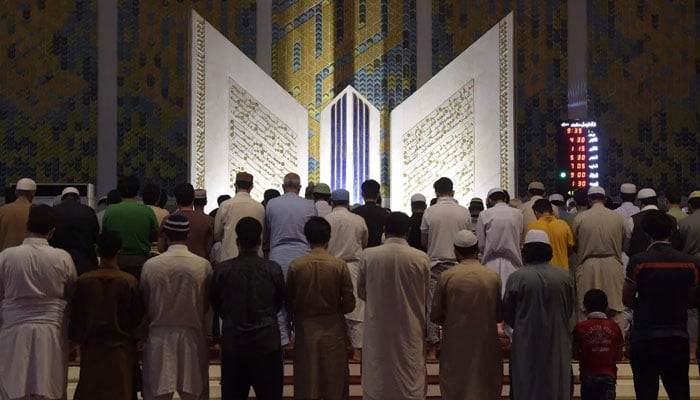
While it’s quite common for religiously inclined women to go to mosques here, the number of attendees increases manifold on special days or occasions like Fridays, the taraveeh or Eid prayers. I’m not sure if it happens at all major mosques, but in Ayasofya, the gates are closed once the mosque reaches capacity. The guards don’t let anyone enter after a certain time. On Fridays, especially, the number of people, both men and women, attending the Friday prayer is huge. People, including Muslim tourists, want to say their prayers in this great mosque, which has immense historical and political importance.
To accommodate everyone, arrangements are made which aren’t too different from what we are used to seeing in our country on Fridays: laying out mats outside the mosque so that people can say their prayers. The only difference is that mats are laid out for both men and women, with a few metres between them. I found out about this when I got late one Friday and had to say my prayers outside the mosque along with a considerable crowd of women of varying ages and nationalities, which makes the overall experience more interesting.
In famous mosques like Ayasofya or the Sultanahmet Mosque, commonly known as the Blue Mosque, you get to see women from around the world who come to pray. I once saw an elderly lady in a beautiful saree who was visiting Istanbul with her son and daughter-in-law and had come to Ayasofya for the Friday prayer. While her colourful silk saree stood out in the crowd, attracting curious gazes from other women, what caught my attention was the jewellery she wore. She had a guluband clasped around her neck, a lighter version of the satlara haar cascaded down the front, heavy rings adorned her wrinkled fingers and gold bangles clanked every time she moved her hands. She was definitely dressed to the nines for the prayers (or wherever she was going to or coming from). She couldn’t sit on the floor, so she sat on the corner of the elevated platform, covered her head with the saree’s pallu and said her prayers.
When we were exiting the hall after the namaz, I approached her and said in Urdu that a woman in a saree leading the Friday prayers in Ayasofya was the last thing I expected to see in Istanbul. Both of us laughed and she asked me if I was from India. I told her I wasn’t but my father came from Hyderabad Daccan, which made her quite happy. She was from Agra. I wanted to ask if I could take her picture because I was sure I would never see a saree-clad bejewelled woman in Ayasofia again. But it seemed like too awkward an ask, so I refrained.
The women’s sections of the mosques here are often full of children as well. Women bring their kids along and the children behave like children without anyone shushing or hushing or scolding them for running or playing in the hall. While the mothers listen to the sermon or pray, the kids run around and play with the other children present there. New friendships are made.
A young woman, who has been going to mosques since she was a child, once said to me that it is these friendships and the excitement of meeting your friends there that encourages kids to go to mosques with their mothers and the visits then turn into life-long habits in many cases.
The season of playing-with-friends-in-the-mosque is at its peak in Ramazan as a large number of women regularly visit mosques for taraveeh prayers. In a more than 316-year-old mosque on the Asian side of Istanbul, I saw queue after queue of women praying their taraveeh prayers in the open courtyard outside their designated section, which was chock-full. Such occasions are a godsend for the children who come with their mothers. While some of them try to emulate their mothers in saying the prayers, others have fun, as it is a longish prayer and the kids have ample time to do whatever they want in the absence of adult supervision.
In some mosques, the local government or the mosque’s management arranges special post-taraveeh activities, such as free food, games, open-air theatre and other activities that attract huge crowds. Even in smaller neighbourhood mosques that do not have dedicated spaces for women in the main prayer hall, some adjacent rooms, which are usually used for Quran classes or similar activities, are reserved for women and kids for the taraveeh prayer. In such places, it isn’t solely a religious activity; women socialise after it. Someone brings a thermos full of tea, someone else brings snacks. Once the namaz is done, people stay back and have lively discussions on every topic ranging from international affairs to those of the neighbourhood.
My favourite post-taraveeh moment remains the group of women I saw outside my neighbourhood mosque a few nights ago. Dressed in abayas and scarves, they were standing outside, collectively enjoying a post-taraveeh smoke in complete silence.
The writer worked for these pages in another lifetime.