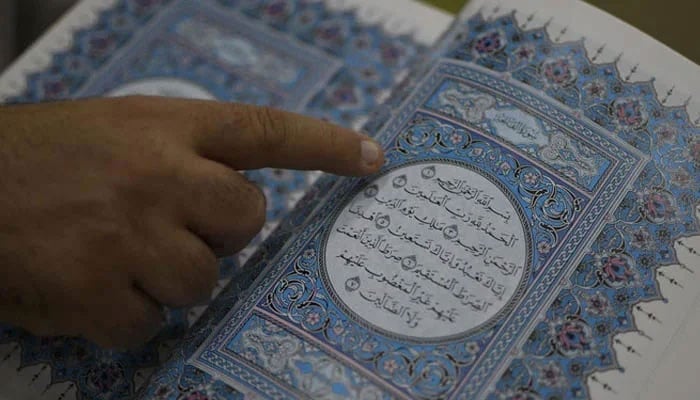
Significantly, the Quran does not demand belief through blind command. Instead, it uses a powerful method of inquiry to awaken the human intellect. It repeatedly invites people to observe the signs embedded in the natural world. It asks: Do you not see how vapours rise and form clouds? How clouds gather and release rain that turns barren land into green pastures?
“Do you not see that Allah drives the clouds, then joins them together, then makes them into a mass, and you see rain emerge from within them?” (Quran 24:43). Another verse calls attention to the miracle of life: “Then We made the drop into a clinging clot, and We made the clot into a lump, and We made the lump into bones, and We clothed the bones with flesh.” (Quran 23:14).
The Quran invites reflection on the seas: “And among His signs are the ships sailing through the sea like mountains.” (Quran 42:32) And on the cosmic order: “He has subjected for you the sun and the moon, both constantly orbiting, and has subjected the night and the day for you.” (Quran 14:33)
These verses encourage human beings to use Aql – the faculty of reason. The Quran teaches that the universe itself is a cosmic symphony of harmony and balance, where every element operates within a divinely ordained equilibrium. Human progress emerges when societies align their social, economic and spiritual lives with this harmony.
When societies respect this balance, they flourish. When they violate it, disorder and decline follow. Muslim Spain was a remarkable historical example of this Quranic principle in practice. It created an ecosystem of learning rooted in communal harmony, where Muslims, Christians and Jews worked together in a shared intellectual environment to advance knowledge and promote societal progress.
Yet history also tells us that this spirit gradually faded. Over time, the culture of inquiry weakened across much of the Muslim world. Intellectual curiosity declined. Societies that once produced knowledge increasingly became consumers of knowledge produced elsewhere.
This raises an uncomfortable question: If the Quran inspired Muslim scholars of Al-Andalus to become leaders of knowledge, why does it not inspire us in the same way today? The Quran has not changed. What has changed is our ability to understand it. The intellectual lens through which earlier generations read the Quran has become rusted. The spirit of inquiry that once animated Muslim scholarship has weakened. Instead of reading the Quran as a call to explore the mysteries of creation, we have too often reduced it to ritual recitation alone.
The Quran speaks of the cosmos, the stars, the seas and the mysteries of life – and invites humanity to explore them. Yet today we must ask: who is exploring these frontiers? The James Webb Space Telescope and the Hubble Space Telescope are among humanity’s most powerful instruments for studying the cosmos. They are products of scientific institutions elsewhere. Yet there was a time when the world’s leading observatories stood in Muslim lands because scholars understood the Quranic invitation to study the heavens. “They reflect on the creation of the heavens and the earth and say: Our Lord, You have not created all this without purpose.” (Quran 3:191).
Today, the Muslim world contributes far less to these frontiers of knowledge. This gap is not merely technological. It is epistemological. It is a tragic irony that, while the Quran encourages exploration of the universe, some religious debates in our societies have been reduced to sectarian disputes. The Quran calls humanity to explore the cosmos, yet some religious leaders remain preoccupied with conquering the mosques of other sects. This is not the spirit of the Quran.
The Quran calls humanity to observe, reflect, inquire and discover. The great philosopher-poet Allama Muhammad Iqbal warned about this intellectual stagnation with remarkable clarity: “From the highest heavens comes a call at dawn:/ How did you lose the jewel of understanding?/ How did the sharp blade of your inquiry grow dull?/ Why can you no longer pierce the hearts of the stars?”
Iqbal also cautioned against reducing religion to passive consumption: “May God acquaint you with a storm,/ For the waves of your sea show no restlessness./ You cannot detach yourself from the Book,/ For you read it but you are not its writer.”
The tragedy of Muslim societies today is not that they lack faith. The tragedy is that faith has been disconnected from the intellectual spirit of the Quran.
Rediscovering the epistemology of the Quran, therefore, requires a profound intellectual renewal. It means restoring the dignity of reason within a framework of faith. It means recognising that scientific inquiry is not alien to Islam but deeply rooted in its worldview. It means reforming education systems so they produce thinkers, innovators and problem-solvers. It means building universities that nurture curiosity, experimentation and discovery.
Above all, it means teaching our younger generations that asking questions is not irreverence – it is obedience to the Quranic call to reflect upon creation.
The ruins of Al-Andalus remind us that civilisations decline when intellectual vitality fades. But they also remind us that renewal is possible when faith and reason once again walk together. The Quran gave Muslims a roadmap for intellectual leadership. When Muslims followed that roadmap, they illuminated the world. When they abandoned it, they lost their place in history.
As Allama Iqbal reminded us: “They were honored in the world because they lived by the Quran;/ And you fell into humiliation when you abandoned the Quran.”
Iqbal was not referring to abandoning ritual. He was referring to the abandonment of the Quran’s intellectual spirit – its call to reflection, creativity and discovery.
Rediscovering the epistemology of the Quran, rooted in observation, inquiry and reflection on puzzles of the universe, may yet become the starting point of a new intellectual renaissance for the Muslim world.
Concluded
The writer is the federal minister for planning, development, and special initiatives. He tweets/posts @betterpakistan and can be reached at: [email protected]